
How many days does an Indian wedding last?
18 August 2026 · 5 min
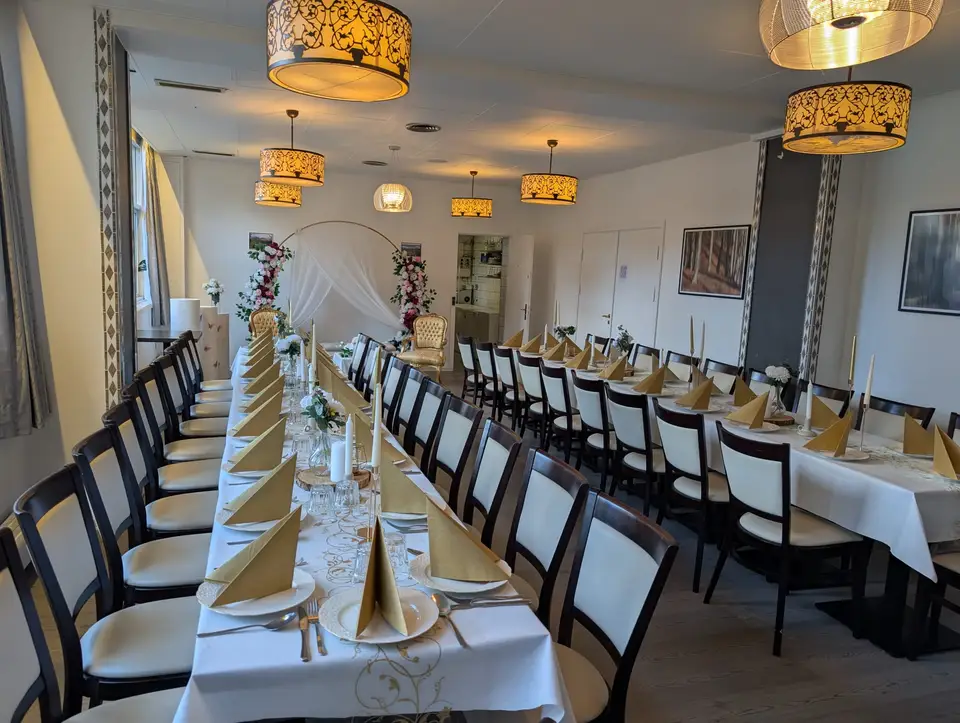
Ask this in Delhi and the answer is three days, often five. Ask the same question of a family living in Copenhagen and the honest answer is usually one long day, sometimes two, with everything else folded into evenings at home.
Both answers are true. The distance between them is the planning problem, and it is worth understanding before you ring any venue about dates.
What fills the traditional three to five days
The traditional shape is not one wedding stretched thin. It is a series of separate functions, each with its own guest list, its own dress code and often its own host.
The pre-wedding evenings belong mostly to the family. In a north Indian Hindu wedding those are the mehndi, the sangeet and the haldi. The wedding day carries the ceremony itself. The reception is the public evening, the one where the widest circle is invited and where most Danish colleagues and neighbours will be.
Regional practice varies a great deal, and a Sikh or a Muslim wedding has a different shape again. We have written the running order out stage by stage in what happens at an Indian wedding, so this piece can stay on the calendar rather than the ritual.
The planning point is that those days are not interchangeable. A sangeet wants a cleared floor and a sound system. A ceremony wants seating around one focal point. A reception wants tables, service and a queue that keeps moving. Asking a single afternoon to do all three is where good plans come apart.
Why families in Denmark compress it
Guests here are at work. Three consecutive weekdays of celebration means three days of annual leave from everyone you love, and relatives flying in have a fixed window they cannot extend.
So most families in Copenhagen land on one of three shapes:
- One day. Ceremony in the afternoon, reception in the evening, in the same building, with the room turned around in between.
- Two days. A Friday evening for the mehndi or the sangeet, then Saturday for the ceremony and the dinner.
- Split venue. The rite itself somewhere it can be done properly, a temple or outdoors, and the whole party moved to a hall afterwards for the dinner. That second half is the part we host, and the Indian and Nepali wedding page lists what comes with a booking here.
One thing to know about the calendar you are competing in. August has held the top spot for Danish weddings since 1995, and June sits behind it, so those Saturdays are the contested ones. If your shape needs a Saturday and the evening beside it, you are asking for two of the hardest dates in the year to hold together.
Booking two days in a row, and how to ask for them
We have one hall, so two days means two bookings. Simple in principle. What is not simple is asking for them separately.
Ask for the pair as a pair, in the first message, with both dates named. The Friday that was free when you secured the Saturday may be gone a month later, and the Friday is the date families forget to lock down while they are busy with the big one.
Two days also changes the arithmetic of what you are booking. The hall fee here is charged per person, so a Friday for forty and a Saturday for a hundred are not two copies of the same figure, and the smaller evening is priced like a smaller evening. The prices page sets out the shape of it.
Parking is free on our own site, on both days. That is worth more across a weekend than across a single night, because a multi day wedding means somebody carrying garlands, trays and three changes of clothes in from the car more than once, on Højdevej rather than four streets away.
Can the decoration stay up overnight?
The honest answer is that it depends entirely on what is booked the next day, and it is a question to settle in writing when you reserve, not in the week before.
If both days are yours, a great deal of the setting can stay standing overnight: the draped backdrop, the floral arch, the lamps, the position of the top table. What does not stay is everything that has to be washed and laid again: cloths, glassware, cutlery and the floor are done fresh for day two.
If somebody else has the hall in between, nothing stays. That is not a policy invented to be awkward. It is one room.
The reset itself is not a crew you have to hire in. Decoration, sound system, projector, staff and cleaning all sit inside the hall fee, on the second day exactly as on the first.
What one hall of 30 to 120 can and cannot carry
Different days carry different guest lists, and that is an argument for one room rather than against it. A mehndi is often thirty or forty people, mostly women, mostly family. A reception can be a hundred or more. Our hall seats 30 to 120, and a range that wide is why the same floor can hold the quiet evening and the loud one.
The ceiling is real too, and we would rather say so early. If your reception list is nearer two hundred, this is not the room for that night, whatever we could do for the Friday.
The kitchen is what makes consecutive days easier than they sound. Maiya Nepali Kitchen is in this building, a corridor from the hall, so a Friday supper and a Saturday banquet are both cooked where they are eaten. Any menu can be made fully vegetarian, which matters when several of the days are vegetarian by design. Children aged 5 to 12 pay half the menu price. Over two nights with the same cousins in the room, that is a line worth counting properly.
Bring the dates before you bring the plan
Send us the shape you are aiming for, every date you are still holding open, and the two headcounts, the family evening and the public one. We will answer with what a single room can honestly carry on each of them.
Then come and stand in it. An hour on the floor settles a running order better than any drawing of it. Arrange a visit whenever suits you. We are on Højdevej 59 in 2300 København S, out on Amager, and the number is +45 21 95 92 92.