
What happens at an Indian wedding, in order
7 August 2026 · 5 min
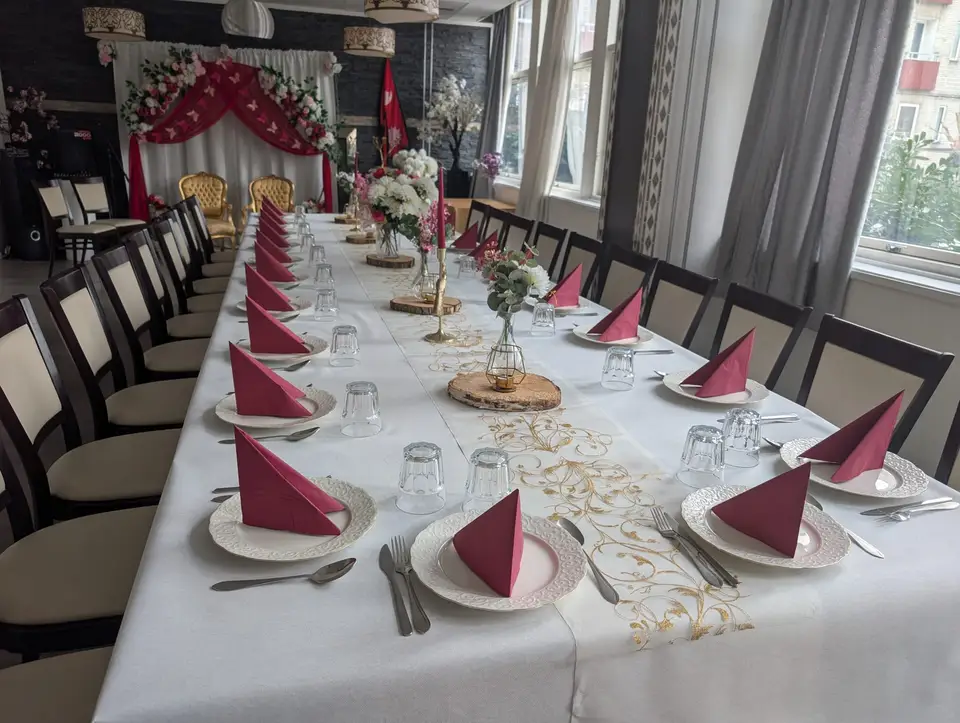
An Indian wedding is not one event. It is a sequence, usually spread across more than one day, and every part of it has its own name, its own guest list and often its own dress code.
That is the most useful thing to know before you attend one, and what catches people out when they book a room for one. The invitation you were sent may cover a single evening out of five. Here is the order things happen in, and the question that decides which venue can host which part.
There is no single Indian wedding
The phrase covers a subcontinent. A Hindu ceremony, a Sikh Anand Karaj and a Muslim nikah are three different rites with three different shapes, and Gujarati, Tamil and Punjabi weddings differ again within the first of those.
The version below is a north Indian Hindu wedding, the one most Danish guests are invited to. A Sikh wedding takes place before the Guru Granth Sahib, which the couple circles four times while the laavan are sung. A Muslim wedding turns on the nikah, the marriage contract, and the walima that follows.
A Nepali Hindu wedding runs on much the same frame under its own names: the janti rather than the baraat, the swayambar for the garland exchange. We notice the difference here, because the kitchen in this building is Nepali.
One note for couples marrying in Denmark. The religious ceremony and the legal marriage are not automatically the same event, so settle early who is registering the marriage and where.
The days before the wedding day
Mehndi. Henna is drawn onto the bride's hands and feet in a design that can take hours, while the women of both families have theirs done alongside her. Informal, loud and long. An invitation to this is an invitation into the family part of the week.
Sangeet. An evening of music and dancing, and the night many families quietly plan hardest. Cousins rehearse for weeks, both sides perform, and there is an unspoken scoreboard. What a venue needs here is a sound system, floor space cleared of tables, and somebody who knows the running order.
Haldi. Turmeric paste is put on the bride and the groom, usually by the handful, usually at home. Yellow ends up on everything, and nobody wears anything they mind about.
Not every family holds all three, and some fold them into one evening. Ask which nights you are expected on rather than assuming all of them.
The wedding day, stage by stage
- Baraat. The groom arrives in procession with his family, with music and dancing outside the door. Traditionally on a horse. In Copenhagen, usually on foot from the car park, which is one reason parking on site matters more than it sounds.
- Milni. The two families meet formally at the entrance and greet each other in pairs.
- Jaimala. The couple exchange flower garlands in front of everybody. This is the photograph.
- The mandap. The couple sit under a canopy with the priest and their parents for the ceremony itself, conducted in Sanskrit with explanation in between.
- Kanyadaan. The bride's parents formally give her into the marriage.
- The phere and the saptapadi. The couple circle the sacred fire, then take seven steps together, each one a promise. This is the part that makes the marriage.
- Sindoor and mangalsutra. The groom marks the parting of the bride's hair and ties on the necklace.
- Vidaai. The bride leaves with her husband's family. It is the emotional opposite of everything before it, and not a moment for photographs.
- The reception. Dinner, speeches, dancing, and the couple seated where every guest can reach them.
What to expect if you are the guest
Wear colour. Black or white reads as the wrong occasion entirely, and deep red is best left to the bride. Shoulders and knees covered is the safe reading of an invitation you are unsure about. Bring cash in a card rather than a wrapped gift, unless the couple asked for something specific.
Eat when the food comes, not when you planned to. Much of the day is vegetarian by design, and the meal is usually a buffet, because sit down service cannot move fast enough for a room that size.
Bring the children. They are expected, they will be looked after by six people who are not you, and nothing in the day asks them to sit still. And do not read the printed start time as a Danish start time. Come when you are asked to come, and plan nothing for afterwards.
The question that decides the venue
Ask this first, in writing, of every venue you look at: what is possible with an open flame indoors? The phere happens around a fire, and no couple should be discovering the answer a fortnight before the wedding. Settle it in a message you can point back to, not in a conversation at a viewing.
The split many couples land on is to hold the fire ceremony where it can properly be held, at a temple or outdoors, and bring the whole party to a hall for the reception dinner afterwards. That second half is what we do here, and our Indian and Nepali wedding page sets out what a booking covers.
Two more questions belong to this kind of wedding in particular. Can the room be turned around between a ceremony and a dinner, and who does the turning? Ours is one hall for 30 to 120 guests, so a mandap and a dinner share the same floor, and the staff who reset it are part of the hall fee along with decoration, sound, a projector and cleaning.
And can the kitchen cook a genuinely vegetarian menu, rather than one dish set aside? Any menu here can be made fully vegetarian, cooked in this building by the people who then carry it out. The dishes are on our catering page. Children aged 5 to 12 pay half the menu price, a line that counts at a wedding with forty of them.
Come and stand in the room
Send us the headcount, the dates you are still juggling, and the running order as far as you have it. We will tell you plainly what fits into one hall and what does not.
Book a visit and walk the floor from the door to where the couple will sit, or see how the hall and the menus fit together on the prices page.