The rules of the workplace julefrokost
10 October 2026 · 5 min
Nobody prints the rules of a julefrokost on the invitation, and yet everybody in the room can tell the moment one has been broken. That is the awkward part of being the person who organises it. You are running an evening governed by expectations nobody has written down and nobody will mention until Monday.
So here they are, written down. Some belong to the employer and should be stated on the invitation. The rest are unwritten, and an organiser handles those by designing the evening around them rather than announcing them.
It is still a work occasion, and that is the whole difficulty
A julefrokost sits in two categories at once. The company pays, the guest list is the staff list, and the people at the table will be in the same meeting on Monday morning. It is also an evening out, with a bar, and the stated point of it is that everyone relaxes.
Both halves are true. Insisting on only one of them produces the two familiar failures: an evening so cautious it feels like a long meeting with herring, or one the company spends Monday regretting.
The working rule is short. Plan it as work and host it as a party. The structure, meaning the invitation, the guest list, the finishing time and who is keeping an eye on whom, gets decided with your work head on. Everything inside the evening is allowed to be generous.
Who is invited, and whether partners come
Settle this before anything else, because it decides the budget, the size of the room and most of the potential awkwardness.
- Decide plus ones once, for everyone, and put the answer on the invitation. Colleagues only is a perfectly good policy. Partners welcome is equally fine. The trouble comes from leaving it unsaid, because then people guess, and the guess tends to vary with seniority.
- Invite colleagues on parental leave, on long term sick leave or working a notice period, and say plainly that nothing is expected of them. Being left off a list is remembered much longer than any evening is.
- Include the people who were in the room all year without being on the payroll: the consultant who has sat with the team since spring, the student assistants, the part timers who only come in on Tuesdays.
- Say whether attending is expected. It should not be. An evening that is voluntary on paper and compulsory in practice is the single thing colleagues complain about afterwards.
The alcohol question, answered without a speech about alcohol
Some people at the table are driving, some are pregnant, some are new and nervous, some simply do not drink and would rather not say why. None of them wants an announcement made about it.
So do not make one. Build the evening so that not drinking needs no explanation. That means something good in the glass rather than a jug of tap water at the far end of the table, poured by the same staff and topped up as often, with no question attached. Our post on an alcohol free julefrokost goes through what actually works in the glass.
Two more things belong to the employer rather than to the evening. Food goes on the table early and keeps coming, because an empty stomach is what turns a convivial evening into a regrettable one. And whoever is senior in the room stays sober enough to notice how things are going. That is the quiet half of the job, and it is not a job you can hand to the youngest person present.
Getting everyone home is part of the plan
Decide how people are getting home before you decide anything about the bar, and write it in the invitation so nobody improvises at eleven at night.
Here on Amager that is easier than in the middle of town. The hall is on Højdevej 59, two minutes from the Kastrupvej bus stop served by the 8A, which runs around the clock. The 5C runs all night along Amagerbrogade, and the M2 metro keeps going through the night as well, thinner in the small hours but never stopping. Parking on site is free, which helps the colleagues who drove and whoever collects the leftover presents in the morning.
The unwritten rules, and the Monday after
These are the ones that genuinely matter, and none of them will ever appear on an invitation.
- Speeches stay short, and there are not many of them. Two is plenty. Thanking the team is the job. Reviewing the financial year is not.
- The most senior person leaves at a sensible hour. Until they go, a part of the room is still at work.
- Nobody photographs a colleague into a company channel. Ask first, every time, and assume the answer is no for anything taken after the dessert.
- Whatever happened, happened at the julefrokost. It is not raised in the office, not repeated to people who were not there, and not made into a running joke in January. If something crossed a line, that is a conversation for a manager behind a closed door.
- Turn up on Monday. Nobody expects brilliance, but the person who hosted an evening and then vanished for a day has made a point they did not intend to make.
What to settle with the venue so the rules hold themselves up
A good deal of etiquette is really logistics that somebody got right in advance.
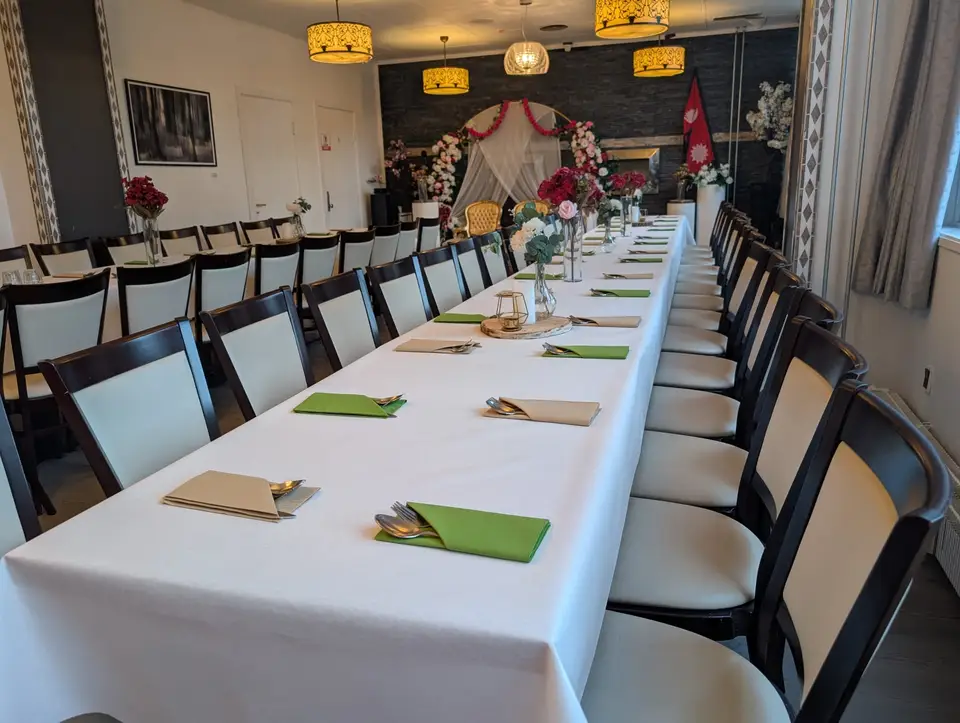
There is one hall here and one party in it at a time, so no other company's evening is going on next door, and there is no shared bar and no queue at the entrance. That is worth more to a work event than it sounds, because nobody is on display to strangers. The room takes 30 to 120 guests, and the fee covers decoration, sound system, projector, staff and cleaning, so no colleague ends the night stacking chairs.
Agree the finishing time in writing when you book, so the end of the evening is a fact rather than a negotiation at midnight. Tell us about every dietary need in one message rather than six: the kitchen is in this building, so a vegetarian line or a milder dish is a question for the cook, who is thirty steps away. Our page for company parties sets out how a December booking comes together, and what everything includes is on the prices page.
Send us a date and a rough headcount, or book a visit and see the room before you commit to anything.