
Can the whole party eat a vegetarian menu?
11 October 2026 · 5 min
Most hosts who ask this have already decided what they would like. One menu, served to everybody, with nothing carried out of the kitchen on a separate plate for the four people who gave notice. The uncertainty is not really about the food. It is about the table, and whether half the room will quietly take stock of the buffet and conclude that dinner was missing its main event.
So the social question is the one worth answering first. The kitchen question is quick: yes, the whole party can eat vegetarian.
The kitchen answer is yes, and nothing has to be removed
Every set menu at Maiya can be made fully vegetarian, and so can a menu put together from scratch. That sentence is true at plenty of venues, and at most of them it means the usual menu with the meat lifted out of it.
Here it means something different, because the kitchen in this building is a Nepali one and the plate it cooks from on an ordinary Tuesday was vegetarian long before anybody asked it to be. Dal bhat tarkari is lentil soup, rice and a vegetable curry, served together on one plate rather than in courses, with refills treated as the norm rather than as a request. That is not a vegetarian version of a meal. It is the meal, and a party menu built outward from it has nothing missing in the middle of it.
The set menus and what each one holds are laid out on the catering page, and any of them can be built this way without becoming a shorter list.
What guests actually notice, and it is rarely the meat
Watch a buffet queue and you can see what people register. Whether the plate they build has distinct things on it. Whether the food keeps coming. Whether they could make their own portion as mild or as fierce as they like it. Whether anybody had to wait.
Nepali cooking chops its vegetables rather than puréeing them, and keeps cream and sugar out of savoury dishes, so a plate ends up as separate components with their own colour and bite instead of three soft variations on the same brown. The heat sits mostly in the achar served alongside rather than cooked through everything, which means the guest who wants a gentle plate and the guest who wants to sweat a little are both served from the same counter without the kitchen having to guess.
Abundance does more work here than any single dish. A table that is visibly generous reads as a feast. A table that looks carefully rationed reads as a restriction, whatever is on it.
Where an all vegetarian party menu actually goes wrong
It goes wrong in three recognisable ways, and none of them is the absence of meat.
- Substitution thinking. A menu designed as a meat menu and then patched produces exactly the apology it was trying to avoid. Start from food that was always vegetarian and the problem never arises.
- Repetition. The same vegetable appearing in three dishes is what makes a guest feel short changed. Variety of texture, not quantity of trays, is what settles people.
- Silence. A guest who arrives expecting roast meat and finds none feels managed. A guest who was told in advance arrives curious. The difference is one sentence written weeks earlier.
The three cases where a split menu is the better call
Sometimes the right answer is two lines at the counter rather than one, and it is worth being honest about when.
The first is a guest list where meat carries meaning for part of the room. At a konfirmation or a julefrokost with older relatives, a serving dish of meat is read as hospitality rather than as food, and removing it says something you may not have meant to say.
The second is when you are hosting on somebody else's behalf. If the menu becomes the thing people discuss afterwards, it has taken attention that belonged to the person being celebrated.
The third is a mixed room where several guests have their own rules about what they eat. A single vegetarian line is often the simplest common ground, but not always, and that is a conversation to have with the kitchen rather than a decision to take alone.
If you do split it, split it properly. Two full lines of the same length, served from the same counter at the same moment, with the vegetarian one first. A single tray at the end of the run tells four people exactly where they came in the planning.
What to write on the invitation
One plain line is enough. "Dinner is a vegetarian Nepali buffet" does the whole job, with no explanation of the reasoning and no apology attached to it. Hosts who justify the choice invite a debate about it. Hosts who state it get agreement.
Keep the allergy question separate and ask it directly, because vegetarian and allergy free are not the same thing and a guest who reads them as one will not mention their nuts. Common questions from both sides of this are answered on the FAQ page.
Settle it in the room before you book
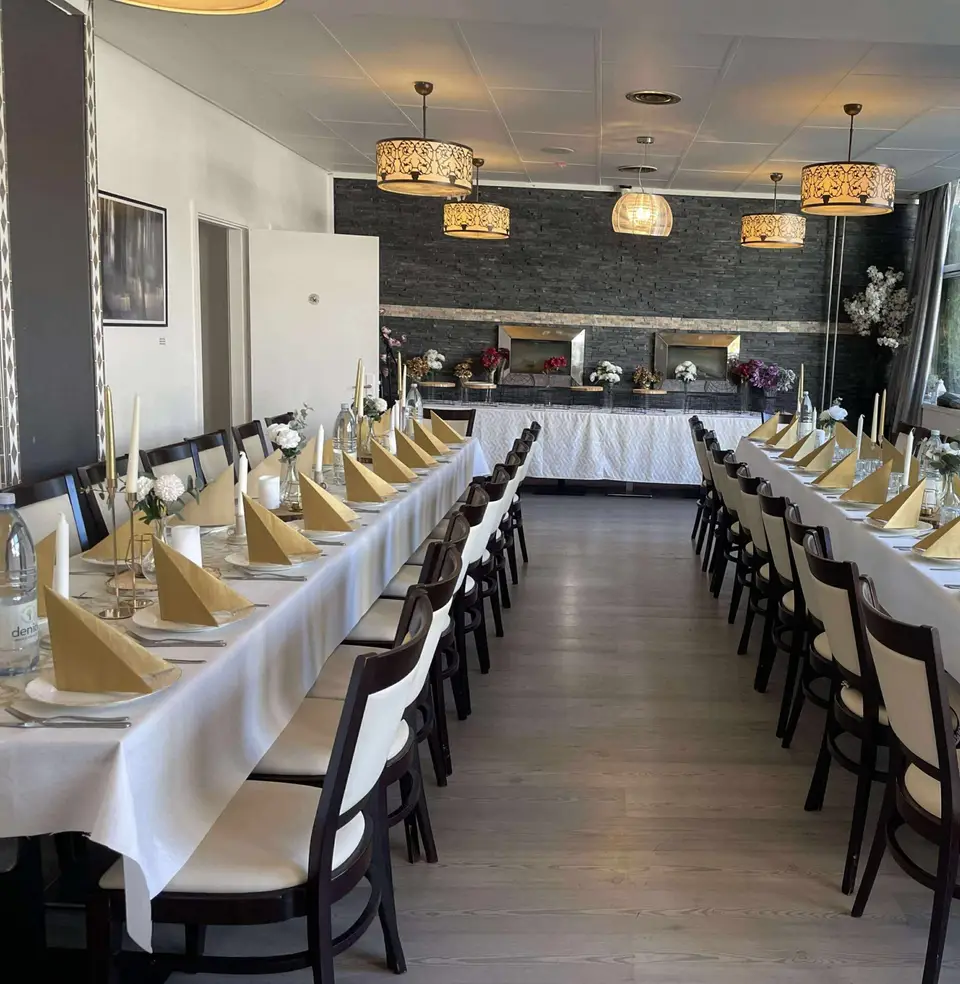
The hall on Højdevej holds one party at a time, somewhere between 30 and 120 people, and the cooks work a few steps away from it. If your numbers shift in the last fortnight, or three more guests turn out to be vegetarian, that is a short conversation rather than a change order. The buffet runs along one wall and the whole room queues at the same counter, which is quietly the point: there is no vegetarian corner, because there is only one line.
Come and look at it with your own guest list in mind. Book a visit, and the hall fee, the per person menus and what each one includes are all set out on the prices page.