What does the julefrokost dress code actually mean?
1 November 2026 · 5 min
Two words on a Danish invitation cause more trouble than all the rest put together: pænt afslappet. Everybody recognises them. Nobody agrees what they mean. One guest reads a shirt without a tie, the next reads clean jeans, and somebody arrives in a blazer to find half the office in reindeer knitwear.
If the julefrokost is yours to organise this year, that confusion is yours to prevent. Here is what the standard Danish wordings actually signal, and the sentence to write so nobody has to guess.
Why the dress code belongs to the host
Almost nobody worries about looking good at a work party. They worry about being the only person who misread it. Overdressed feels like trying too hard in front of colleagues. Underdressed feels like not caring in front of the same people. Both are small embarrassments that sit with someone for the first hour, which is exactly the hour you wanted them to relax in.
An invitation with no dress code does not free people. It makes them call the organised colleague the night before and calibrate to whatever that person says. You end up with a dress code anyway, decided by a group chat instead of by you.
So write a line. One line is enough, and it settles the question for everyone at once.
What the Danish wordings actually mean
These are the phrases that turn up on Danish invitations, roughly from the most relaxed upwards.
- Afslappet or hverdagstøj. Come as you are. Jeans are fine, trainers are fine. Usual for a lunchtime julefrokost or a smaller department doing something low key.
- Pænt afslappet. The most used wording and the least precise. In practice it means a shirt or a good knit, chinos or dark denim with no rips, a dress or a smart top. Nothing that needs ironing twice and nothing anyone would call a costume.
- Festligt. Dress for a party rather than for the office. This is where sequins, velvet and a bolder colour belong. It signals the evening is meant to feel like an occasion.
- Mørkt tøj. A real step up, and the one most often misjudged. A dark suit, usually with a tie, or a short dress or equivalent outfit in a dark shade. Reserved for a round anniversary, a jubilee or a company marking something properly.
- Galla or smoking. Formal evening wear. Rare for a julefrokost and almost never right for one, so if you write it, mean it.
- Julesweater or a theme. Not a dress code at all. It is an instruction to wear a costume, and it needs the same warning a costume party needs, in good time and with an escape route for anyone who does not own one.
Two notes worth knowing. Danish dress codes are read as a ceiling as much as a floor, so a guest who wants to be safe will land slightly under the line rather than over it. And dress codes drift with the hour: the same company can hold a pænt afslappet lunch in December and a mørkt tøj dinner for its jubilee in the same room three months later.
The line to put on the invitation
A useful dress code has three parts: the word, one plain example, and permission to stop worrying.
- "Dress code: pænt afslappet. A shirt or a good knit is plenty, no tie needed."
- "Dress code: festligt. Bring out something you never get to wear to work."
- "Dress code: mørkt tøj. It is our twenty fifth year, so we are doing it properly."
Name someone to ask. A line telling people to check with the organiser if they are in doubt costs you nothing and saves three of them an anxious evening. If you are running a theme, say what happens to someone who turns up without the sweater, because somebody will, and the answer should be nothing at all.
There is more to settle on an invitation than clothes, and the rest of the etiquette is worth a read while you are drafting it. We covered the wider question in workplace Christmas party rules and etiquette.
Let the room tell people how dressed to be
Guests take their cue from the venue long before they read the dress code, which is why the two should be decided together.
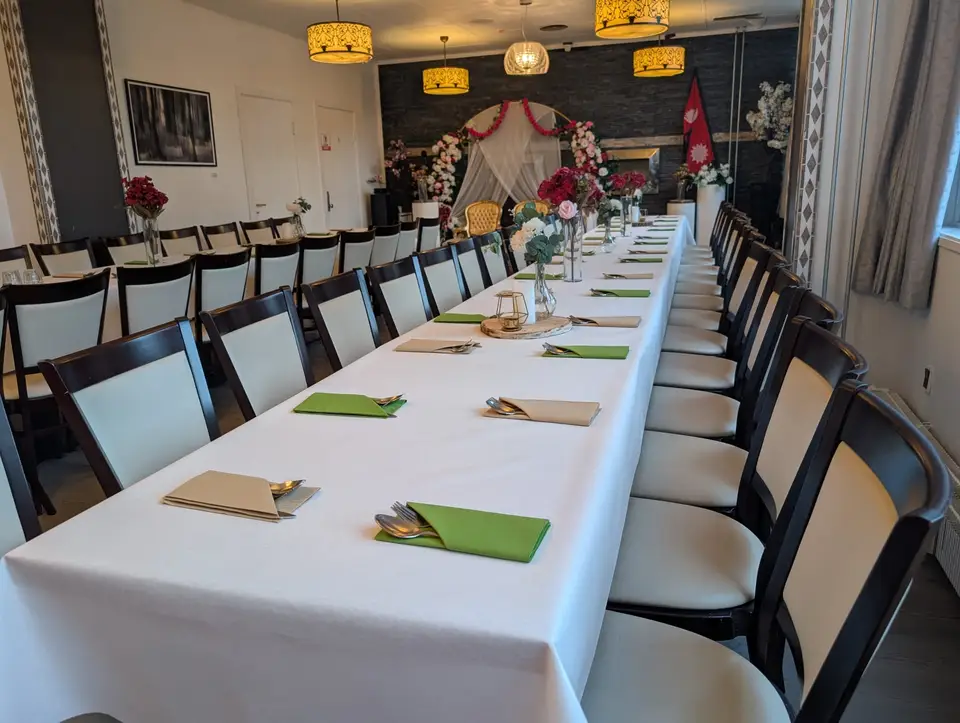
At Maiya Party Hall on Højdevej on Amager, the decoration is included in the hall fee, so how formal the room looks is something you choose when you book rather than something you discover on the night. A long table under white cloth with lit pendant lamps and flowers reads as an occasion, and people dress up to meet it. A relaxed layout with a shared buffet reads differently, and that is a perfectly good choice too. Say which one you have asked for, and the dress code explains itself.
Two practical details shape it further. The hall is one room for 30 to 120 guests, so there is no bar to slip off to and change the register halfway through: whatever people wear, they wear all evening. And there is free parking on site, which in December is the difference between arriving as you intended and arriving after a walk in the rain.
Food matters here as well. Our kitchen is in the same building, and a shared Nepali table with momo and dishes brought out to the room involves standing, passing and reaching. A dress code that makes people reluctant to get up is the wrong one.
Settle it when you settle the date
Write the dress code into the invitation the same week you confirm the room, while the decoration and the menu are still in front of you. It takes one sentence and removes the only question your guests were going to ask twice.
If you are still looking for somewhere to hold it, see what a Christmas party venue in Copenhagen includes here, or look at the room as a corporate event venue for the rest of the year. You are welcome to come and see the hall before you decide: book a visit and we will walk you through it.