
How to handle allergies and special diets at a party
5 August 2026 · 5 min
One line on an invitation saves more trouble than all the others put together, and it is not the dress code. It is the line that asks what your guests cannot eat, and gives them a date by which to answer.
Get that line right and the rest is ordinary planning. Get it wrong and you learn about the peanut allergy while eighty people are already standing in the queue.
Here is the order to run it in, from the invitation wording to the cards on the serving dishes, and an honest account of what a kitchen in the same building can absorb on the day.
What to ask on the invitation
"Any dietary requirements?" is what almost every invitation asks, and it is the wrong question. It collects opinions. People write back that they are not keen on fish, while the guest whose child carries an adrenaline pen writes nothing at all, because she does not think of that as a requirement. She thinks of it as her own business to manage.
Ask two questions instead, and keep them apart:
- Is there anything that would make you ill, and how badly?
- Is there anything you would simply rather not eat?
The first answer belongs to the kitchen and is a constraint. The second belongs to the menu and is a preference. They get solved in entirely different ways, which is why so many hosts arrive holding a note that says "3 vegetarians, 1 allergy" and no idea what to do with it.
Ask for names too. A number cannot be handed a plate. "Sara, dairy, gets properly ill" is an instruction anyone carrying a tray can act on. "1 lactose" is a riddle.
Preference, intolerance and allergy are three different jobs
A preference is answered by the spread. Put enough on the buffet and a vegetarian guest, a guest who does not eat pork and a guest who dislikes chilli all eat well without anyone being told anything.
An intolerance is answered by information. Someone who reacts to lactose or wheat can steer around a table perfectly well, so long as every dish says what it is.
An allergy is answered by handling. It is less about the recipe than about what touches what: the spoon that moved between two dishes, the crumbs on a board, the tray that carried something else first. That is a kitchen question, and it has to reach the kitchen before the day, not on it.
Here the food itself matters, and ours is specific enough to spell out. Momo are steamed dumplings in a thin wheat wrapper, so however good they look going past, they are not the dish for a guest avoiding gluten. Sel roti is the opposite, a ring of sweetened soaked rice batter piped by hand into hot oil. Choila is charred meat tossed in mustard oil with ginger, garlic and timur, which matters if mustard is on your list.
Two habits of Nepali cooking help more than people expect. It generally leaves cream out of savoury dishes, which quietly opens most of a menu to a guest avoiding dairy. And the heat usually sits in the achar served alongside rather than cooked through every dish, so a guest who cannot take chilli, or a table of six year olds, eats what everybody else eats and just leaves the achar where it is. Our catering page goes through the dishes properly, and any menu can be made fully vegetarian if that is simpler than counting.
Your reply deadline is really a kitchen deadline
Shopping happens before cooking, and cooking happens before your guests arrive. Every dietary answer that lands after the shopping is a favour rather than a plan.
So set the reply date earlier than feels necessary, chase the silent ones yourself, and then send us the whole picture in one message: the headcount and the diets together, with a fortnight of daylight before the party. Names against requirements, not totals.
The number will move after that, because it always does. Send the change when it happens rather than saving it up. A late vegetarian is nothing. A late severe allergy, arriving the same afternoon, is the one situation where the honest answer may be that we can keep your guest safe but not delighted.
Laying out a buffet so it does the work for you
Once you have the answers, most of the safety is in the arrangement:
- One serving spoon per dish, and no spoon that wanders between two.
- The vegetarian dishes at the head of the run, before any spoon has travelled, rather than tucked in at the end.
- A card on every dish naming what is in it, facing the queue, readable without picking it up.
- Gaps between the dishes, so a sleeve does not drag through the one next door.
- For a serious allergy, a plate made up in the kitchen and handed over directly, never queued for.
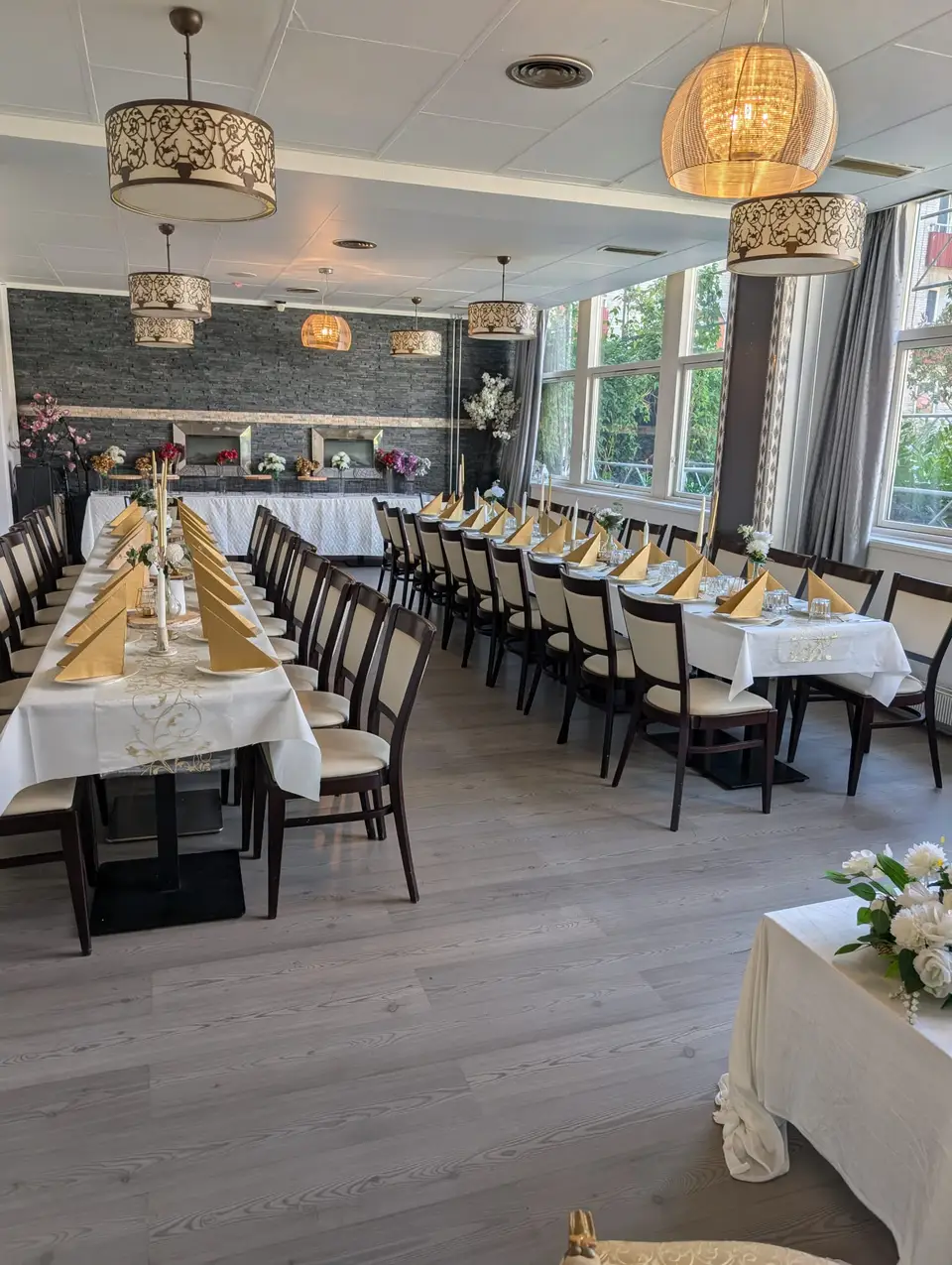
In our hall the buffet runs along the wall with the tables laid out in front of it, so the queue forms in a single line rather than closing in on the food from every side. That helps when someone needs a moment to read a label.
What we can fix on the day, and what we cannot
The kitchen is in this building, and the people who cooked your dinner are here while you eat it. That is worth more for allergies than for anything else. If a guest asks what is in a dish, someone can answer for certain instead of guessing from a delivery note. An extra vegetarian portion, a child's plate made up without the achar, a dish set aside before service opens: all of that is a normal Saturday for us.
What cannot happen at five o'clock is a menu rebuilt for ninety people, and we cannot promise a dish was kept away from an ingredient nobody told us about. Notice is the whole difference. Given a fortnight, almost anything on this page is straightforward. Given ten minutes, we are improvising with your guest's evening.
Tell us the diets when you tell us the number
Send both together and you have done the difficult part. Write to info@maiya.dk or ring +45 21 95 92 92, and we will tell you plainly which requests change the menu and which change nothing at all.
If you would rather see it first, book a visit and stand where the buffet goes. The prices page shows how the hall fee and the per person menus fit together.