
Is Nepali food spicy, and can you ask for it milder?
6 August 2026 · 5 min
Danish has two words where English has one. Krydret means seasoned, built with spices. Stærk means hot, the chilli kind. English squashes both into "spicy", and that is why the question so often gets an answer nobody can use.
The honest version is short. Nepali food is reliably krydret. Whether it is stærk is a setting, and at a party it is your setting rather than the kitchen's.
Most people who ask are not asking for themselves anyway. They are asking whether a grandmother, or a table of seven year olds, will sit through the whole dinner with an untouched plate.
Krydret is the promise, stærk is the setting
Seasoning and heat are separate levers, and this kitchen pulls them separately.
Most of what gives the food its character is not hot at all. Jimbu, a dried Himalayan allium, does nothing on its own and has to be bloomed in hot fat, after which it carries a whole pot of lentils. Timur, the Nepali relative of Sichuan pepper, is citrusy and sharp rather than burning. Ginger, garlic, mustard oil, cumin, turmeric: not one of them is chilli.
Chilli is a separate ingredient, added deliberately. Leave it out and the food does not turn bland, it simply stops being hot. People tend not to believe that until they have eaten it.
One more habit is worth knowing before you order for a nervous table. Savoury Nepali dishes generally go without cream and without sugar, and the vegetables are chopped rather than pureed. Nothing arrives as a smooth orange sauce. You can see what is in the bowl, which settles a cautious eater faster than any reassurance from the host.
The chilli lives in the achar, not in every pot
Achar is the pickled relish that comes alongside the meal, and it is where the heat usually goes. The dishes themselves are cooked to a level most of a room is comfortable with. The achar stands next to them and carries the fire.
That one arrangement is what makes this food work for a mixed guest list. Chilli stirred into a curry at nine in the morning cannot be lifted back out at seven in the evening. Chilli in a bowl at the end of a buffet is a question every guest answers privately, one spoonful at a time.
Your uncle takes three. Your mother takes none, eats exactly the same dinner as everyone else, and never has to announce anything across the table.
What the dishes are actually like
- Dal bhat tarkari: lentil soup, rice and vegetable curry served together on one plate, with refills the norm rather than something you ask for. The everyday backbone, and gentle.
- Momo: steamed dumplings in a thin wheat wrapper, commonly chicken, goat or vegetable. The dumpling is mild. The achar beside it is where the choice sits.
- Jhol momo: the same dumplings with a thin spiced broth poured over at the end. It is poured, not cooked in, so the broth can run hot or calm depending on what you asked for.
- Sekuwa: charcoal grilled marinated meat, associated with the Rai and Limbu communities of the eastern hills. Smoke and marinade do the work.
- Gundruk: leafy greens fermented without any salt. Sour and savoury, never hot.
- Choila: a Newar dish of meat charred and then tossed in mustard oil, ginger, garlic, chilli and timur. Chilli belongs to this recipe. Better to point it out on the table than to let someone find it.
- Sel roti: soaked rice, sweetened and beaten to a batter, then piped by hand in a circle straight into hot oil. It is not a doughnut, and there is no heat in it at all.
Six of those seven are yours to dial. Our catering page is worth reading with that ratio in mind.
The sentence to give the kitchen
Do not say "make it mild". It is the wrong instruction, and a kitchen trying hard to obey it can pull the seasoning out along with the chilli, which leaves you the one dinner nobody wanted.
Say this instead: keep it properly spiced, just not hot. Leave the chilli out of the dishes and put it in the achar, with a mild bowl and a hot bowl clearly apart.
If your room runs the other way, say that just as plainly: most of our guests grew up eating this, so please do not tone the dishes down. Just put out one mild achar for the guests who did not.
Either sentence belongs in the conversation where you give us the guest number, not in a corridor on the day. The shopping is done before the cooking, and the cooking well before the first car pulls in.
Feeding a hundred people who disagree about chilli
The buffet is what makes the disagreement vanish, and the order of the line matters. Achar goes at the end, after the rice and the curries, so a guest meets it with a plate already filled and treats it as an addition rather than a hurdle. Two bowls, visibly different, beat one bowl and a warning.
Any menu can be made fully vegetarian, which answers a second question in the same breath, while children aged 5 to 12 pay half the menu price. The prices page sets out the menus and the hall together, per person, so you can price the room and the food in one go.
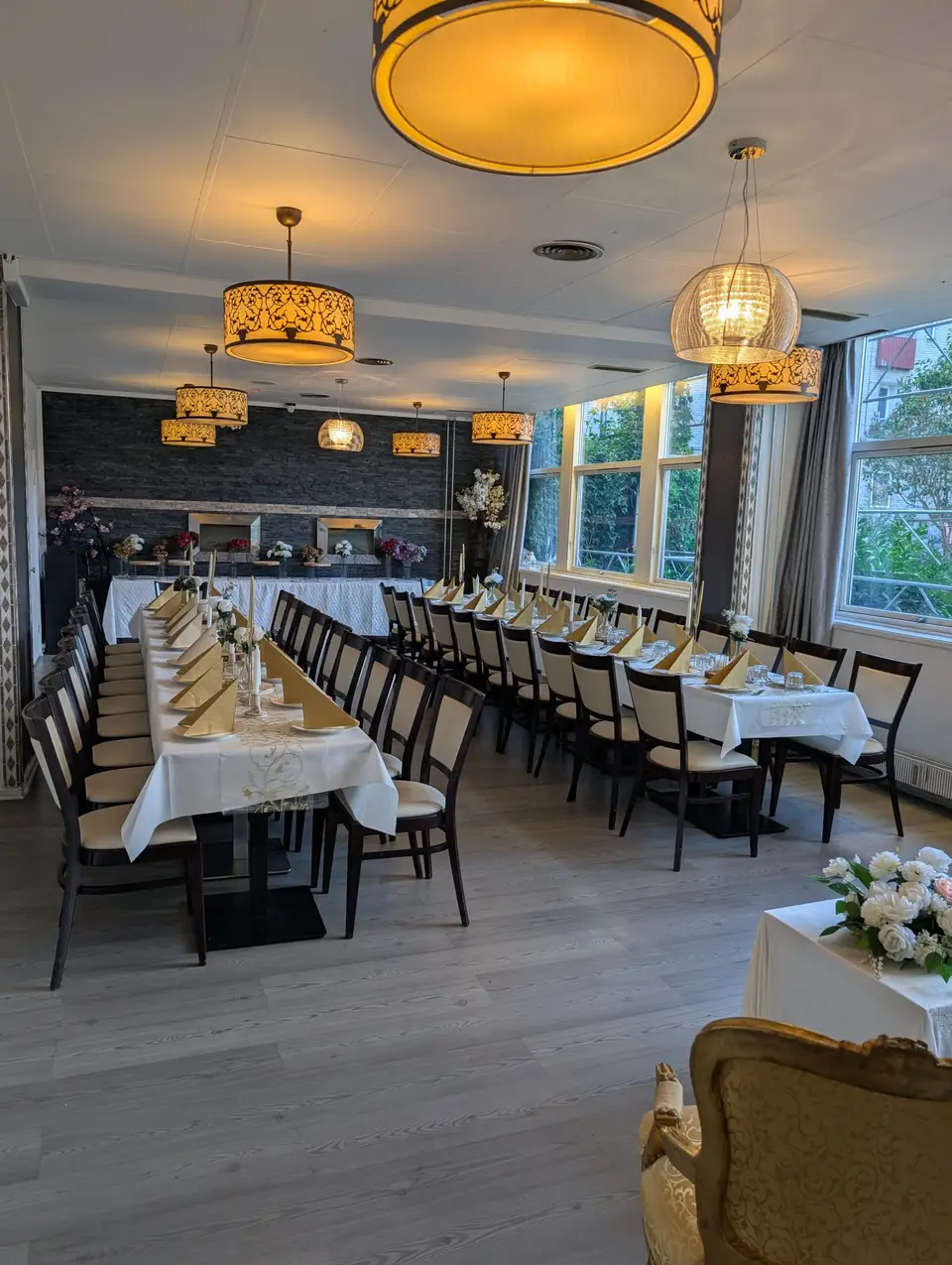
Here is the part that is genuinely unusual about this hall on Højdevej. The food is cooked in the same building it is served in, by the same team who then carry it out. Ask at the buffet how hot the red achar really is and the answer comes from the person who made it that morning, not from a label.
Tell us who is at the table
Give us the guest number, the dates you are weighing up, and one line about who will be eating: the toddlers, the grandparents, the colleague who orders the hottest thing on every menu. We will build the menu around that room.
Come and book a visit to see the hall, or send us the numbers and we will come back with a menu you can put in front of all of them.