
Reception or evening party for a milestone birthday?
3 August 2026 · 5 min
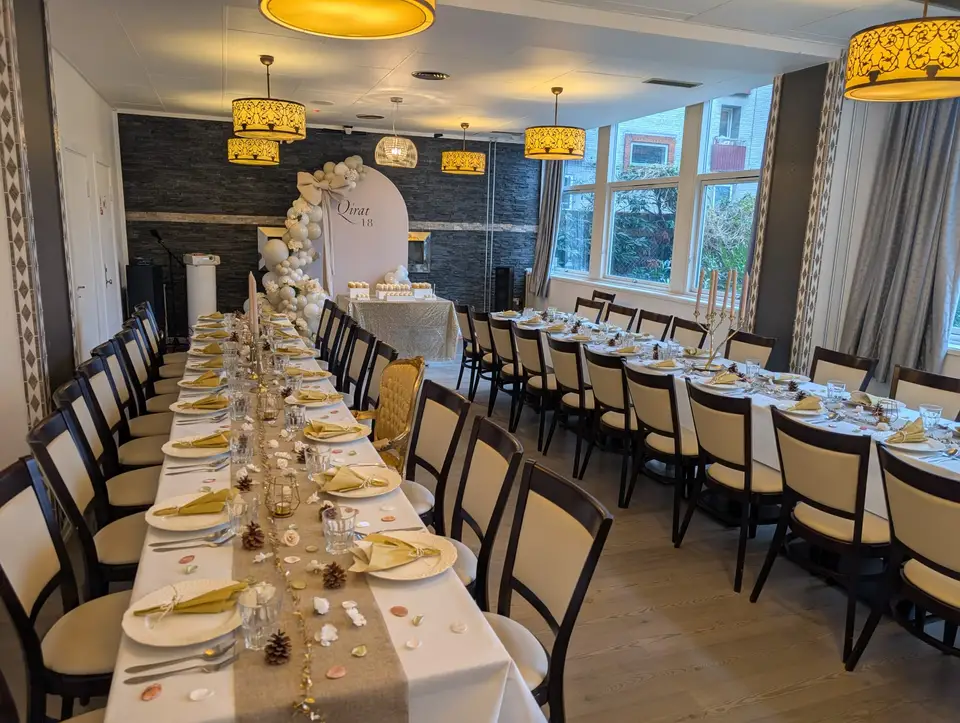
A round birthday is the one celebration where the format is genuinely open. A wedding is built around a ceremony. A confirmation is built around a church service that sets the hour. A 50th has whatever you decide it has, and the first real decision is not the menu or the music. It is whether your guests stand or sit.
That one choice sets the guest list, the length of the day, and what the day costs per head. Here is how the two formats differ once you are actually in the room, and what to do if you cannot choose between them.
What each format asks of your guests
A reception is an open window. You name a start and a finish, say four o'clock until seven, and people arrive when they can and leave when they need to. They stand, they circulate, they eat something that works in one hand. Speeches are short and belong near the middle, when the room is at its fullest. Nobody is seated, so nobody is stuck.
An evening party asks for the whole evening. There is one start time and everyone meets it. Guests sit where they were placed, eat a meal in the order the kitchen sends it out, listen to speeches in an agreed running order, and stay until it finishes. It is a bigger ask of every guest, and it gives back something a reception never can. Everyone experiences the same evening, in the same order, together.
Neither is the grander choice. A reception for 90 is a large event, a dinner for 30 an intimate one. What separates them is the demand made on the guest, and that is worth deciding on purpose rather than by habit.
The three differences that actually decide it
The list. A reception can carry a longer list than the room holds, because your guests are never all inside it at the same moment. That is the format's real advantage: colleagues, neighbours and the badminton club can be invited without being owed a chair for five hours. An evening party is capped by chairs instead. The hall seats 30 to 120 guests, and for a seated dinner that is a firm number, while for a reception it describes how many are present at the busiest hour rather than how many were invited.
The hours. A reception usually runs two to three hours and ends while it is still light in summer. An evening party begins roughly when a reception would be finishing, and runs late. Guests with small children, and guests travelling in from outside Copenhagen, answer those two invitations very differently.
The cost per head. Our pricing is built per person: a hall fee per person, and menus priced per person on top of it. Drinks are decided separately, with three settings running from a per guest soft drinks package to bringing your own against one size-banded flat sum. Children aged 5 to 12 pay half the menu price, which matters at a birthday that gathers three generations. The prices page lays out how the pieces fit together.
The arithmetic tends to surprise people. A reception costs less per guest, but the entire point of a reception is that you invite more guests, so the two totals land closer together than anyone expects. Pick the format for the day you want, then work out the number.
The hybrid: a reception at four, dinner at seven
You do not actually have to choose. The most common shape we set up for a round birthday is both, an open reception in the afternoon for the wide circle, then a seated dinner in the evening for family and close friends.
It works because it is honest about who is who. The wide circle gets a proper invitation and a real welcome, and nobody sits through four hours of speeches about a person they know from work. The dinner list gets the evening they actually wanted.
Two things make it practical in this hall. The room is turned around between the halves by our staff rather than by your family, because the hall fee already covers our people and the clearing up, as well as the decoration, the sound and the projector. Standing tables and clear floor at four become a laid dinner table by seven, while the guest of honour is somewhere having a coffee. And the kitchen is in the same building on Højdevej 59, so both halves come out of one kitchen at two different times, with nothing waiting on a delivery and nothing reheated after a journey.
Two practical notes. Send two invitations with two different times, so no guest ever has to be told to leave. And leave a genuine gap between the end of the reception and the start of dinner, because an hour of slack absorbs the guests who linger. Free parking on site quietly matters on a day like this, since people arrive and leave all afternoon instead of all at once.
Which format suits a 40th, a 50th or a 70th
There is no rule here, but there is a useful test. Look down your list and ask how many of these people you would happily seat beside each other for four hours. If it is most of them, hold an evening party. If it is about half, hold a reception, or hold both.
A 40th and a 50th tend to have the widest circles, because working life is at its busiest and the list fills up with colleagues and other parents from the school. Those are the years the hybrid earns its keep. A 60th or a 70th more often has a shorter, closer list, and guests who would rather not be driving home at one in the morning, which makes an afternoon reception or an early seated dinner the kinder plan. If the birthday sits near a work anniversary or a retirement, our reception page covers the daytime format in more detail.
Come and stand in the room before you choose
An empty hall settles this faster than any list will. You will know within a minute whether you are picturing people standing with a glass or sitting down together to eat.
Bring your guest list and we will walk you through both layouts, and the changeover between them if the hybrid appeals. Ring +45 21 95 92 92, send an email to info@maiya.dk, or book a viewing and see both versions of the room. Our birthday page carries the rest of the practical detail.