
Nepali wedding traditions, and what each one asks of the room
2 October 2026 · 5 min
A Nepali wedding does not begin quietly, and it does not begin indoors.
It begins with the janti, the groom's procession, somewhere down the street from where the bride's family waits. By the time anyone sits down to eat, the moments the family will remember longest have already happened. That order catches couples out while they are looking at venues, because a room that is lovely for the dinner can be the wrong shape entirely for the hour before it.
Below are the main parts of a Nepali Hindu wedding, in the order you meet them, and what each asks of the building.
The janti is a ceremony, not an arrival
The janti is the groom's side travelling to the wedding together: his family, his friends, musicians if there are any, and the groom somewhere in the middle of the crowd. It is loud deliberately. When it reaches the bride's family, the two sides greet each other formally at the threshold, with garlands and tika, and nobody goes in until that has been done properly.
In Copenhagen the travelling part usually shrinks to the walk from the cars. It is still the opening scene, and it still settles two practical questions.
The first is where fifteen carloads of people put their cars. A procession that spends twenty minutes hunting for a space has lost its own entrance. Parking on site, free and belonging to the building, is worth more on this one day than on any other booking we take.
The second is whether there is anywhere to stand outside the door before going in. When you visit, step out of the front door and look at that patch of ground. Half of a janti is the pause before it moves inside.
Swayamvar, and where the couple will actually sit
The swayamvar is the garland exchange, and it is the photograph that gets printed. The couple lift flower garlands over each other's heads in front of the whole room, often more than once, with a good deal of laughing and interference from cousins.
What it asks of a room is unglamorous. It needs a fixed place for the couple to stand, a background worth photographing behind them, and a clear line of sight from where the guests are sitting. If people are craning past a pillar, the moment belongs to the four rows who could see it.
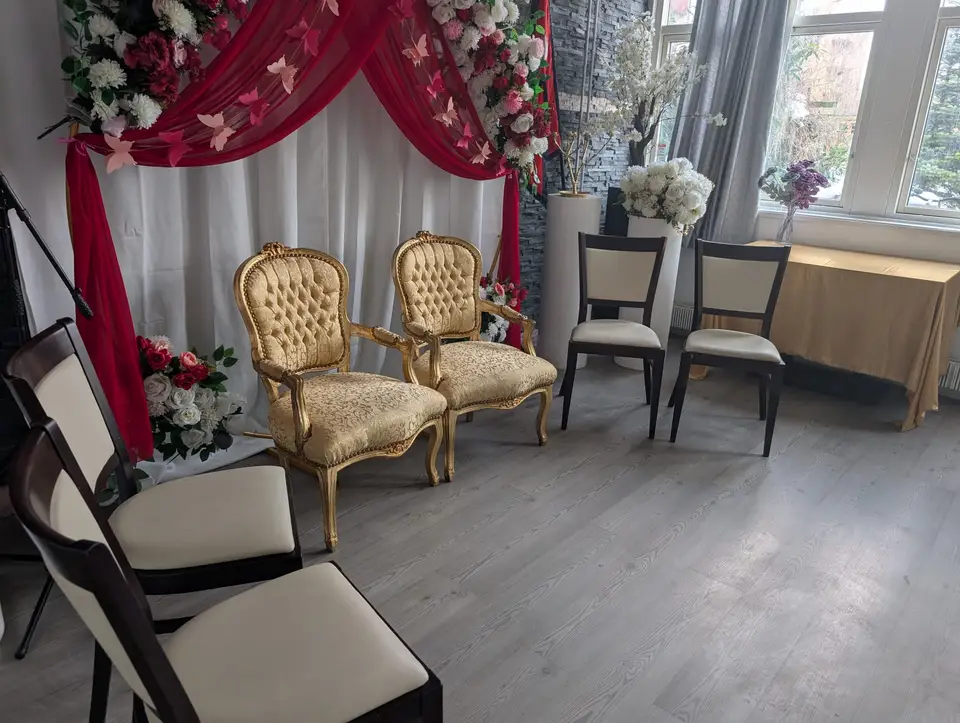
Here that end of the floor is a draped backdrop with two gilded armchairs in front of it, beside the tall windows. Decide early that it becomes the couple's end of the room for the whole day, because every later rite wants the same spot, and so does every guest holding a phone.
Kanyadaan, saptapadi and sindoor
These are the rites that make the marriage, and they are calmer than guests expect.
- Kanyadaan. The bride's family formally hands her into the marriage. For many families this is the heaviest moment of the day.
- Saptapadi. The couple take steps together, each one carrying a promise. In Nepali practice the circling and the steps happen around the sacred fire.
- Sindoor. The groom puts vermilion in the parting of the bride's hair, and the beads go round her neck. For the family watching, this is the point at which the two of them are married.
One of those three decides which venues are possible at all, so settle it before you fall for a floor plan. The fire is a real fire. Ask every venue by email rather than in conversation at a viewing: may a flame burn inside your room, and on what conditions? Keep the answer in writing.
Plenty of families in Denmark split the day instead. The rites take place somewhere they can be done properly, outdoors or at a temple, and the whole party moves to a hall afterwards for the feast. That second half is what we host, and the wedding page for Indian and Nepali celebrations sets out what a booking covers.
What the bhoj asks of the kitchen
The meal is not an afterthought bolted onto the ceremony. It is the part the guests travelled for.
Dal bhat tarkari arrives as one plate rather than as courses, lentils and rice and vegetable curry together, with refills as the norm instead of the exception. That changes how a buffet has to be staffed, because a line that moves past once does not serve a Nepali wedding. Newar families may want samay baji, the ceremonial platter of beaten rice, black soybeans, bara, choila, egg and ginger. Sel roti, the hand piped ring of sweetened rice batter, belongs to celebration in a way no bought dessert replaces.
A good share of the room will eat vegetarian that day, including guests who are not vegetarian the rest of the year. Any menu here can be made fully vegetarian, which is not the same as one meatless dish at the end of a counter. Our catering page goes through what the kitchen sends out. A wedding is also where one line counts most: children aged 5 to 12 pay half the menu price.
Tell your guests where the heat lives. In Nepali cooking the chilli sits mostly in the achar beside the plate, not cooked into every pot, so whoever reaches for the hot jar is choosing it knowingly.
Fitting the whole day into one hall on Amager
Maiya Party Hall is one room on Højdevej in København S, for 30 to 120 guests, with the kitchen in the same building as the floor you eat on. One room is a constraint, and also what makes the day workable: ceremony and dinner share the same floor, so the afternoon is a turnaround rather than a move, and the staff doing the turning are already inside the hall fee alongside decoration, sound, a projector and cleaning.
When you have a running order, ask us two things directly: how long the turnaround needs, and what the sound system will take from your own musicians. What the room holds on Amager has its own page.
Come and walk it from the door inwards
Send the running order as far as you have it, even while two families are still arguing over half of it. We will tell you honestly which parts fit under this roof.
Book a visit and walk the route a janti would take, from the car park to the garlands, or see what the hall fee and the menus actually cover on the prices page.