
How to hold a naming celebration without a christening
10 November 2026 · 5 min
The name goes on the record in a few minutes on borger.dk, and that is all that is asked of you. No Sunday is offered. No parish office rings back. Nobody enquires how many will be sitting down to lunch.
That freedom is the appeal of naming without a christening, and it is also the planning problem nobody warns you about. A barnedåb lunch is easy to picture because the service has settled half of it already: when the day begins, where everyone stands still for ten minutes, and what the journey afterwards is for. Take the service out and none of that arrives. You are left with a guest list, a room and an afternoon with no shape in it yet.
All of it can be built. It just has to be built on purpose.
What the church was quietly doing for the day
Three things, worth naming before you replace them.
It fixed a start time nobody argued with. No guest asked whether half past ten suited them. The parish had chosen, and the family turned up.
It gave the day one moment of undivided attention. The room fell silent and the child's name was said aloud in front of everybody. That silence is what made the meal afterwards feel like a celebration rather than a Sunday lunch with better napkins.
And it supplied a running order every Danish guest knows by heart: service, photographs outside, the drive to the hall, lunch, speeches, cake, home before dark.
Remove all three at once and the party drifts. Guests trickle in across an hour. The baby goes round the table. Food appears. Somebody taps a glass, half unsure whether they are allowed to. Afterwards nobody can say quite when the celebration happened.
Choose the hour, then tell people where it ends
The baby is the only guest whose timetable cannot be negotiated, so build outwards from it. A naming celebration belongs in the middle of the day, in daylight, and it should be shorter than you think. Three or four hours properly held beats seven hours of waiting.
With no service to assemble everyone, the invitation has to do work a christening invitation never does. Write both ends of the day on it, not just the first, and give arrival a narrow window. Guests who know something starts at one o'clock arrive before one o'clock.
There is no rush to decide any of it. The deadline in Danish law attaches to the name and not to the party: the child must be named before it turns six months, and borger.dk satisfies that on its own. We have written about how that deadline shapes the calendar, so you can name in February and celebrate in May, when the grandparents can travel and the baby can sit up.
Build the ceremony moment, and give it somewhere to stand
This is the part families skip, and it decides whether the day felt like a naming or like a lunch.
Keep it to roughly ten minutes, and hold it once everyone has arrived and has a glass in hand, before the first food goes out. Once people start eating you will not get the room back.
What goes in it is yours, which is the point. The versions that work share a few bones:
- The name said aloud, with the reason behind it. Where it comes from, who else in the family carried it, what it means. It is the sentence the afternoon is built around, so do not leave it unsaid.
- A short reading. A poem, a passage, a few lines from a children's book, chosen because you like it rather than for tradition.
- The adults who will be around. Many families without a christening still ask two or three people to stand up and say they intend to be in this child's life. There is no church word for them, and they do not need one.
- Something the guests make. A book passed down the table for a line from each person, or sealed letters to open at eighteen. Quieter relatives can take part without speaking.
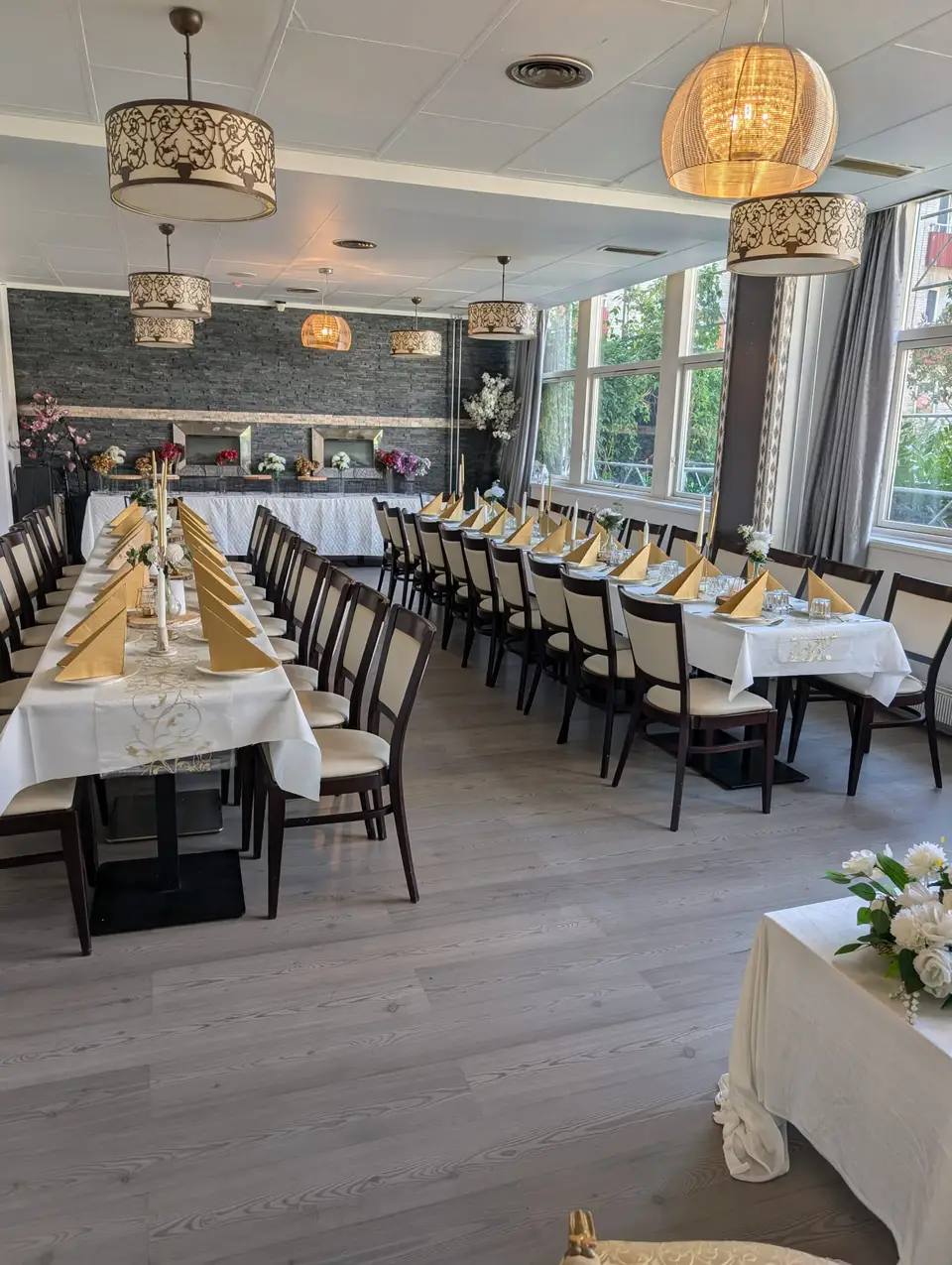
Give the moment a fixed place, so people know where to look when it starts. Our hall at Højdevej 59 is one room, so the focal point is wherever you put it: a backdrop, a chair, flowers, the pram standing beside it. Decoration and the sound system both sit inside the hall fee, which means a grandfather with a quiet voice has a microphone without anybody hiring one.
A running order that holds without a service
A daytime start, with the clock times left to you:
- Guests arrive inside a half hour window. Coats, prams, a drink, the baby admired in turn.
- The ceremony moment, about ten minutes, standing, in the place you chose.
- Food immediately afterwards, while the room is still warm towards you.
- Speeches between courses rather than all at the end, so nobody waits their turn until four o'clock.
- Cake and coffee, then a clear closing hour so families with small children can leave without apologising.
What to ask a room for when there is no church in the day
Different questions from a christening lunch, because the whole event now lives in one building.
Ask whether the room is genuinely one space. Ours seats 30 to 120 guests in a single hall, and for a naming that matters more than it sounds: a party split across two rooms has no front, and a ceremony moment without a front does not work. Ask about daylight too, because these are the photographs the child will see later, and tall windows do more for them than any lighting hired in.
Ask where the kitchen is. Maiya Nepali Kitchen cooks on the premises rather than delivering to them, so if the reading overruns or the baby needs twenty minutes, the food waits on a word from you instead of on a delivery slot.
Ask what arriving is like. Free parking on site sounds like a small thing until half your guests are holding a car seat in one hand and a changing bag in the other. And ask what the hall fee includes: ours carries a projector, so baby photographs can run on the wall through the meal.
Planning one for the spring? See how the hall works for a christening or a naming, read what is included on our prices page, or book a visit and stand in the room where the name will be said.