
A vegetarian buffet, written out dish by dish
30 September 2026 · 5 min
You can usually spot the vegetarian part of a Danish party buffet from across the room. It is the tray at the far end of the counter, or the plate that arrives separately, ten minutes after everyone else has sat down. The food is often good. The arrangement still tells four guests that the evening was planned around everybody else.
That is a solvable problem, and the way to solve it is not to find a better substitute. It is to start from food that was vegetarian before anyone asked.
The everyday plate is already the whole menu
The standing order in a Nepali kitchen is dal bhat tarkari: lentils, rice and a curry of whatever vegetable is in season, landing on one plate at the same moment, and a second helping assumed rather than asked for. That is not the meatless option. It is the plate the whole cuisine is arranged around, and meat, when it turns up at all, is the thing put beside it.
That changes what a vegetarian buffet can be. You are not removing a centrepiece and filling the hole. You are serving the food the way it is normally eaten, and letting anyone who wants meat take a dish of it as an extra. The whole room eats the same spread, and nobody is queueing at a separate tray.
Any menu can be made fully vegetarian here. The catering page covers both the set menus and the ones we build from scratch.
The buffet, dish by dish
Here is a lineup that feeds a room properly. It is not a list to choose between: it is one buffet, and every dish does a job the others do not.
- Dal. Lentils cooked down to a pourable soup, finished with jimbu. Jimbu is a dried allium from the Himalaya, and it stays mute until it meets hot fat, so the last thirty seconds of the pot carry most of the flavour. Guests pour dal over their rice instead of spooning it from a bowl, so it needs a ladle and elbow room on the counter.
- Seasonal tarkari. The vegetable curry, built from what is good that month. Cauliflower and potato in the winter, green beans and tomato when they are worth cooking. Vegetables are chopped rather than pureed, so the dish stays a plate of vegetables and not a sauce.
- Saag. Greens cooked down with garlic. It is the darkest, plainest thing on the counter and the one people go back for, because it is the counterweight to everything that has been fried.
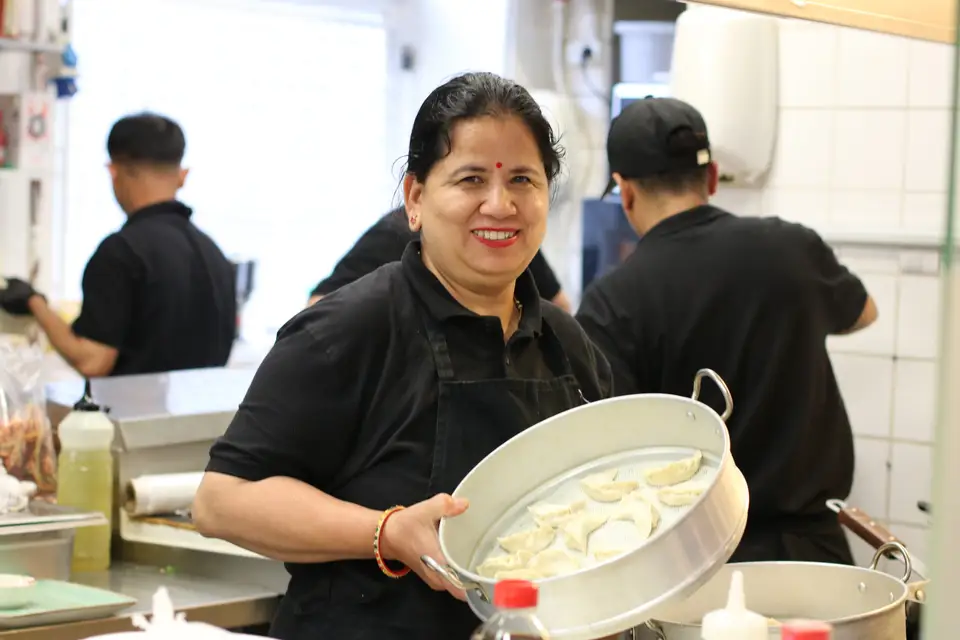
- Vegetable momo. Steamed dumplings in a thin wheat wrapper, folded by hand in the kitchen here. Momo are commonly filled with chicken or goat, but the vegetable version is not the understudy, and at a buffet it is the dish that disappears first.
- Bara. A soft savoury lentil patty, cooked in batches, and one of the things that sits on a Newar samay baji platter at a ceremony. It gives the buffet something with an edge and a bite to it.
- Rice. Plain, hot and in quantity, because it is the floor the rest of the plate is built on rather than a side dish.
- Two achar. One mild, one properly hot. This is where the heat of the meal lives.
Seven dishes, and not one of them is a version of something else.
Is it spicy, and what is in it
These are the two questions Danish guests ask, and they deserve a direct answer.
The chilli lives in the achar. It is not stirred through every pot before the food reaches the room. That is why this buffet genuinely suits a party that runs from a five-year-old to a grandparent: dal, tarkari, saag and rice are warm with spice rather than sharp with heat, and the two jars at the end of the counter let every guest set their own level.
As for what is in it, Nepali savoury cooking generally leaves out cream and sugar, so the richness comes from the tempering rather than from dairy. Timur, which is related to Sichuan pepper, lands citrusy and sharp instead of heavy. If somebody at your table expects the thick, sweetened sauces of a takeaway menu, say in advance that this is not that. They will enjoy it more.
Where a vegetarian buffet still needs a decision from you
Vegetarian and vegan are not the same brief, and the difference is worth settling before you send the invitation. Most of this buffet is vegan as it stands. Dal, tarkari, saag, rice and achar need nothing changed. Where dairy appears, we can tell you exactly which dish it is in, and cook it out.
Gluten is the other one. The momo wrapper is wheat, so a guest avoiding gluten needs the rest of the counter to be genuinely good rather than politely available, which is another argument for putting seven dishes out instead of three.
Send us the diets at the same time as the guest number, not the week before. A kitchen that knows in advance builds the menu around those guests. A kitchen told on the day improvises, and improvising is what produces the lonely tray at the end of the counter.
What this looks like in the hall on Højdevej
The kitchen and the hall share a building at Højdevej 59 on Amager, so nothing you eat has been driven anywhere. Momo are steamed in batches through the evening instead of all at once and left to go soft, and a dish that runs low is topped up from a pot twenty metres away.
The hall takes 30 to 120 guests as one room, which means one buffet line and one sitting, not a party split between two spaces. Put the rice and the dal at the start of the counter, the vegetables in the middle, the momo where the queue has room to pause, and the achar at the very end so nobody commits to the heat before they have seen the plate.
The shape of what this costs is a hall fee plus menus priced per person. Children aged 5 to 12 pay half the menu price. It is laid out on the prices page. What the room itself holds is on the party hall page.
If you are planning a party where some or all of the guests eat vegetarian, book a visit and tell us who is coming. We will build the buffet around them rather than around everyone else.