
What do you eat at a Nepali wedding?
13 October 2026 · 5 min
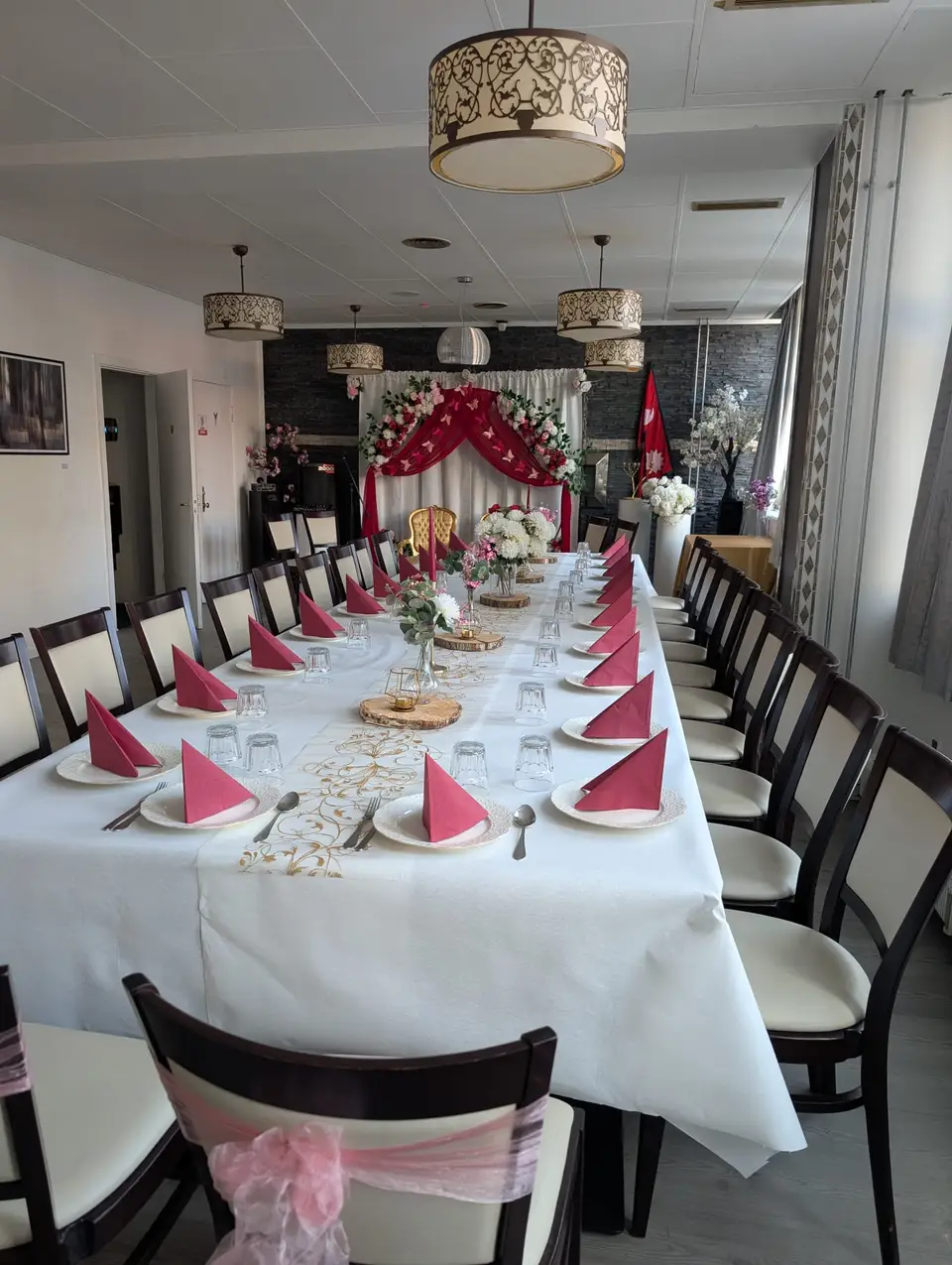
If you have been invited to a Nepali wedding in Copenhagen and you are working out whether to eat something first, the answer is no. Come hungry, and pace yourself.
Guests at a Nepali wedding rarely sit down at an agreed hour and eat one meal. They arrive, something is put in their hand almost immediately, the ceremony takes the time it takes, and the real plate comes when the ceremony is finished rather than when the invitation suggested. The food arrives in two waves, usually hours apart, and knowing that is most of what a first time guest needs.
The eating starts long before the dinner does
The first wave is khaja, the word for the eating that is not the meal. Small plates, carried round or set along a counter, there to keep a full room fed while the ceremony runs.
Momo is almost always on it. Steamed dumplings in a thin wheat wrapper, traditionally water buffalo and commonly chicken, goat or vegetable, served with achar. Sekuwa often appears beside it, charcoal grilled marinated meat that belongs to the Rai and Limbu communities of the eastern hills. A Newar family may put out choila, where the meat is charred over a flame first and dressed afterwards in mustard oil and timur, or samay baji, the Newar ceremonial platter built around beaten rice, with black soybeans, bara and egg set around it.
None of this is a starter in the Danish sense, because nothing is being held back for the course that follows. It is food to stand up with, in one hand, while a relative you have never met explains who everybody in the room is.
The bhoj, and why the whole plate lands at once
The main meal is the bhoj. It is built on dal bhat tarkari, which is not one dish but a plate: lentil soup, rice and vegetable curry, all served together rather than in sequence, in a form where a second helping is assumed rather than asked for.
Around that core a wedding plate usually carries more.
- Masu, the meat, which at a wedding is most often goat cooked on the bone. The bone is not an oversight. It is where the flavour of the curry comes from, and guests who grew up with the dish will go looking for those pieces.
- Saag or gundruk, greens either fresh or fermented. Gundruk is lactic fermented leafy greens, and unlike sauerkraut it carries no salt, so it tastes sour and green rather than briny.
- Achar, the pickles and relishes, in more than one jar if the family is serious about it.
- A second tarkari or two, because the vegetables are cut into pieces instead of blended smooth, and the plate is meant to have distinct things on it.
Nothing is plated in courses, and nobody waits for the table to finish together. You build a plate, you eat it, and somebody comes past to put more rice on it before you have decided whether you wanted more rice. That is the hospitality, and declining takes a little practice.
A good number of guests will eat an entirely vegetarian plate that day, so a wedding menu has to work in both directions. What the kitchen can build is set out on the catering page.
Is it spicy, and where does the heat actually sit?
This is the question Danish guests ask first, so it deserves a straight answer. The food is not as hot as people expect, because in Nepali cooking the chilli largely lives in the small bowl of achar beside the plate rather than cooked through every pot.
That is why a single buffet can serve a grandmother and a seven year old from the same trays. Each guest sets their own level with a spoon, and the one who reaches for the fiercest jar has chosen it knowingly.
What carries the flavour instead is timur, a citrus relative that tastes of grapefruit peel with a resinous edge, and jimbu, a dried Himalayan allium that smells of nothing at all until it is bloomed in hot fat and poured over a finished dal. Neither is a chilli. Turn the heat down and the food still tastes of something, which is the part people do not expect.
The sweet end, and why sel roti is not a dessert
Sweet things come with the meal as often as after it, and one of them is worth naming.
Sel roti is a ring of sweetened rice batter, soaked and ground rather than mixed from flour, piped by hand straight into hot oil. It is not a yeast doughnut. It is made for Dashain and for Tihar, by hand, in quantity, and because it belongs to celebration it is worth asking for by name when you plan a wedding menu rather than hoping it turns up.
If you want it at your own wedding, say so early. It is made, not ordered.
Feeding a hundred people from one counter, in one room
A Nepali wedding meal is not a line that guests walk past once. It refills, repeatedly, for two or three hours, for a room that may be a hundred strong.
That is the practical argument for how the hall on Højdevej 59 in 2300 København S is arranged. The cooks work in the same building as the room, a few steps from the tables, so a tray that runs empty is replaced by one that left the stove a few minutes earlier rather than a few hours earlier. Only one party is in the hall at a time, and the room seats 30 to 120 guests, so the counter is being cooked for rather than rationed to see the evening out.
It also means the menu stays a conversation rather than a contract. More goat and less chicken, a milder achar at the children's end, sel roti made because the bride's mother asked for it: those are questions for the cook, and the cook is on the premises. Parking is free on the site too, which takes one argument out of a day that will have enough of them.
So bring your guest list and walk the room. Book a visit and ask the kitchen what a bhoj for your numbers would actually look like. What the hall fee covers, and how the menus are priced per guest, is set out on the prices page.