
When is the Danish bridal waltz danced?
12 August 2026 · 5 min
Somewhere around eleven at a Danish wedding, a guest you have barely spoken to all evening starts quietly carrying chairs to the wall. That is the bridal waltz being made room for, and it is usually the first sign that the night has a clock on it.
Brudevalsen has a fixed place in the evening, an unwritten rule about midnight, and one practical demand that catches couples out far more often than the steps do. It needs floor. Here is when it is danced, and what has to move before you can.
When is the bridal waltz danced?
Before midnight. That is the whole rule, and it is the part of a Danish wedding that almost nobody bends.
The waltz belongs to the wedding day, so it has to be danced while the wedding day still exists. Guests know this without being told. Somewhere before twelve the room starts looking for it, and if you have not called people onto the floor by then, an uncle will do it on your behalf.
Aim for roughly half an hour before midnight rather than five minutes before. Getting eighty people out of their seats takes longer than anyone expects, and you should not be turning on the floor while a table at the far end is still being asked to stand up.
Everything else then arranges itself in front of that point. Dinner, speeches, cake and coffee all have to finish before the waltz, which is why a meal that starts late costs you speeches rather than the dance.
What happens while you are dancing it
You start alone. Within a few bars the guests come out and close a ring around you, and then the ring starts walking inwards.
It closes slowly, a step at a time, and it keeps closing. By the end you are turning on a patch of floor barely bigger than the two of you, which is exactly the point. The dance finishes because there is no room left to dance in. Nobody announces it. The circle decides.
In many families what follows is the groom lifted off his feet while somebody cuts the toes out of his socks, leaving the bride something to mend. Whether it happens at yours is a question for your family rather than for the venue, but warn your photographer that it might, because it is over in under a minute.
Two things are worth settling weeks ahead. Choose the tune early and dance to it once at home, because a waltz played into a full room sounds faster than it did in your kitchen. And if neither of you waltzes, learn one square step and stop there. The last minute is a slow shuffle in a shrinking space anyway.
How much clear floor does it actually need?
More than the dance suggests, and this is where the planning usually goes wrong.
The two of you need very little. The circle needs a great deal. Guests standing two and three deep around a ring take up more room than the dancing does, they arrive holding glasses, and they do not pack together the way a plan on paper says. The circle also has to be able to walk inwards, so the space has to start big enough to be worth shrinking.
Our post on how much space you need per guest works through the standing and seated figures behind that.
The surface matters as well. A waltz wants a floor that is hard, smooth and level. Ours is pale wood the whole way through the hall, the sort of thing nobody looks at during a viewing and everybody notices the moment a long dress turns on it.
Making a dance floor in a room that was full of tables at nine
We are one hall for 30 to 120 guests, so your dance floor is not a separate room you file into. It is made on the night out of the room you have been eating in. That sounds like a compromise and is mostly the opposite: the circle forms out of the seats it was already sitting in.
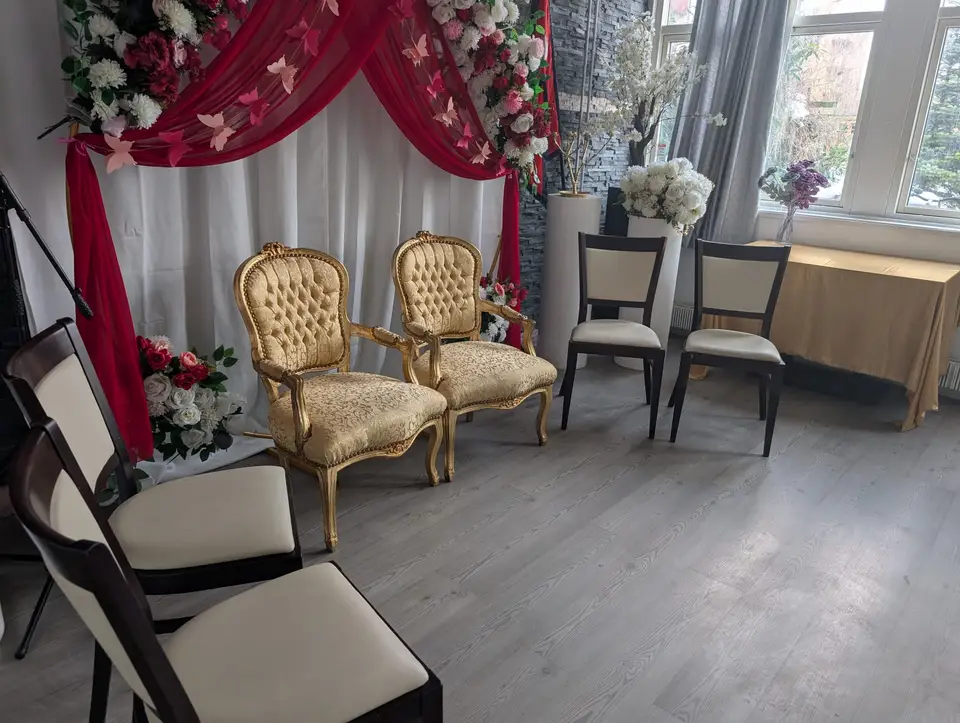
The clearest floor in the hall is the end where the draped backdrop and the couple's chairs stand, so that is usually where the waltz lands. Depending on your layout we lift out a run of tables or push two long tables outwards, and the room opens up in about the time it takes to pour coffee. The wedding page shows the hall laid for dinner, the state it is in an hour beforehand.
Our staff do the moving, and the sound system is already in the room. Both sit inside the hall fee along with decoration, projector and cleaning, and the shape of that fee is on the prices page. It matters more than it sounds on the night: your waltz plays through the hall's own speakers at a volume the whole circle can hear, with no hired rig and no telephone propped in a bowl.
The kitchen is in the same building, which is what gives the evening its give. If the speeches run twenty minutes long, coffee moves twenty minutes later, because someone walks down a corridor rather than ringing a supplier who left at nine.
Fitting it into your running order
Work backwards from midnight and the evening plans itself.
- Put the waltz at about half past eleven and treat that as fixed.
- Coffee, cake and the last of the dessert plates clear before it.
- The final speech ends well before eleven, so your toastmaster needs the running order in writing, not in their head.
- Tell whoever is handling the music which track it is, and hand it over before dinner rather than during it.
- Ask your venue what time the music has to stop, and settle it when you book rather than on the night.
Guests who want to stay to the end usually can. The metro runs around the clock here and parking on site is free, so the last hour does not quietly empty out.
The honest way to know whether the circle will fit is to stand in the room and look at the floor. Book a visit and we will show you where the tables go and where they end up, or send us your date and we will tell you what the room does at half past eleven. We are at Højdevej 59, 2300 København S, on +45 21 95 92 92.