
When the christening party starts after the church service
3 August 2026 · 5 min
The church sets the first time of your day, and you get no vote on it. Everything after it is yours, and that is where a christening either flows or stalls in a car park.
When does the party start, and who gets in first?
Not straight afterwards. Plan about an hour between the end of the service and guests sitting down to eat, and leave more if the church is across the city. Your own parish sets the exact time, and it moves from Sunday to Sunday, so ask there first.
Very little of that hour is travel. It goes on photographs by the church door, on grandparents holding the baby first, on a feed and a change, and on the two guests who left the metro at the wrong exit.
Set the serving time first and work backwards. Say the service ends at midday. Doors at half past twelve, everyone seated by one o'clock, food on the table at a quarter past one. That is a calm start. Opening the doors at midday is not a plan. It is a queue in coats.
Ask the venue for two arrival times rather than one. The family needs the room before anybody else: the cake out of its box, the gown somewhere safe, a table for the gifts, and somebody deciding where the prams go before there are eleven of them.
Settle one more thing now: who is in the room while the family is at church. If the cake is delivered, or an aunt brings the flowers, give that person the access time too. Otherwise somebody stands outside with a cake box while everyone with a key is singing a hymn.
Nobody has to leave the table to move a car
Højdevej is on Amager in 2300 København S, and the venue has free parking of its own. That counts most at the start of the day, when one car holds the cake, the gown, the flowers and a folded pram, and all of it has to be indoors before the first guest arrives. The family pulls up at the door and carries everything a few metres into the room.
Once the car is there it stays there, with no clock running on it. Nobody puts down a coffee cup halfway through the speeches to go out and move it. How parking works on the street around us is set out in our post on parking for party guests.
The car stays put, but guests who arrive half an hour early need somewhere to be while the room is still being laid. Sundby Kirkegård, at Kastrupvej 51, is a few minutes on foot. Its oldest western half no longer takes new plots and is kept as a public green space called Eftertænksomhedens Oase, the oasis of reflection: old trees, wide paths, benches, and room to walk a pram in circles until a baby settles. It is a burial ground and reads as one, so it asks for quiet voices.
A christening peaks at the table, not at the end
An evening party builds slowly. A christening does the opposite: it peaks at the table and then softens. Speeches early, while the child is still awake and going from arm to arm, because they are about someone who will be asleep within the hour. A family that plans a christening like a wedding spends the afternoon keeping a party alive that is really over.
After that the room changes register: quieter talk, coffee, the cake, and older guests finding their coats while it is still light. Drinks follow the same curve: a lunch ending in the afternoon rarely needs more than the soft drinks package, and bringing your own costs one flat amount graded by group size.
Because the hall is one room for 30 to 120 guests, you shape that curve with the furniture instead of saying it out loud: tables at one end, the quiet end left clear, so a pram stands away from the speakers.
Turn the day into three times and book it
A venue does not need your full running order. It needs three lines:
- Access time. Two, really: when the family can be in with the cake and the gifts, and when the guests follow.
- Serving time. When the food goes on the table, with a note on how late the service could run.
- End time. When the last coffee is poured, and the latest hour you have to be out.
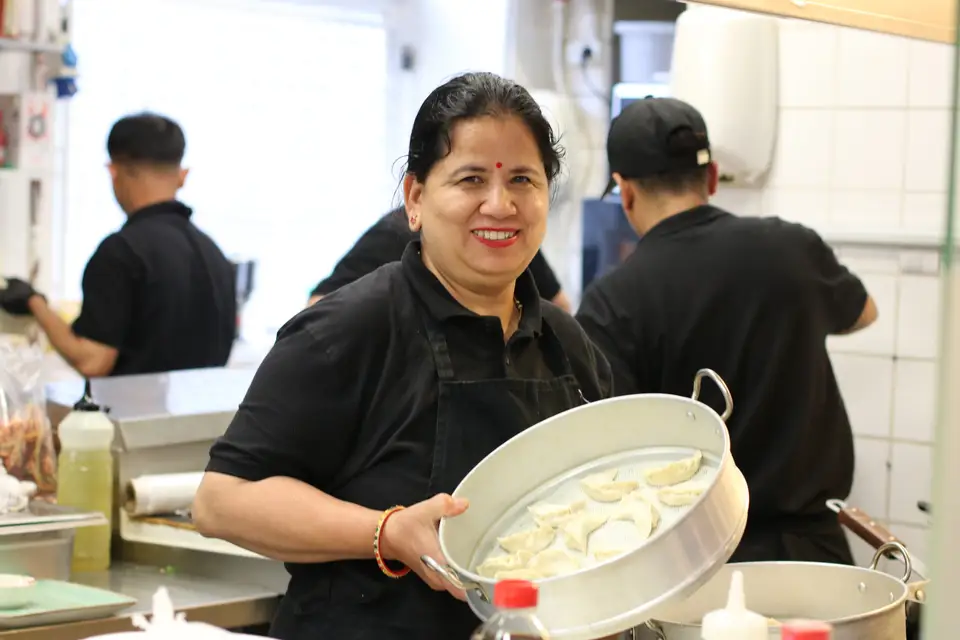
The middle line is where a kitchen in the building earns its keep. Maiya Nepali Kitchen cooks on the same site as the hall, so if the service overruns by twenty minutes, a tray of momo dumplings waits twenty minutes and still goes out hot. Food that arrives in a van left its own kitchen at a fixed hour and cannot wait for a long hymn, so the waiting is handed to your guests.
Say how many children are coming, because they shape the meal as much as the clock. Children aged 5 to 12 pay half the menu price, and any menu can be made fully vegetarian. Cleaning is in the hall fee, with decoration, the sound system and the projector, so your end time is the hour you leave, not the hour you start tidying. The prices page shows what else that fee covers.
The child's age sets your deadline
A wedding can wait for the month you want. A christening cannot: a child in Denmark must be named before it turns six months old, so the booking window is the first half of one short year.
Book the hall in the same week you agree the date with the church. A family that waits until the child is four months old is choosing from whichever Sunday is left.
Register the name on borger.dk without a church ceremony and the date is yours, so the lunch can go on a Saturday, which is usually easier for relatives travelling in. The day runs the same either way, and the christening venue page sets out the layouts and what comes with the room.
Three times, one phone call
Bring the time of the service, a rough headcount, and the hour your oldest guest wants to be home. Call us on +45 21 95 92 92 and ask which Sundays are still free in the month you need, then book a visit and walk the room in daylight, the light the day happens in.