Christmas party games that survive a whole department
21 October 2026 · 5 min
The julefrokost game that goes wrong most often is the one everybody already knows. Pakkeleg is wonderful around a dining table of ten. Put the same dice and the same pile of presents in front of a department of sixty, and the first round alone can run an hour while most of the room waits for a die that never arrives.
Nothing is wrong with the game. It was built for a family, and you are running a company evening. Almost every julefrokost decision follows from one question: how many people can play at the same moment.
Decide when the games happen before you decide what they are
The first hour belongs to the food and to colleagues who have not spoken since the summer. A game started while people are still finding their seats competes with the conversation you were hoping for.
Put the big game in the gap between the warm course and the coffee, when everyone is fed and the plates have gone. Keep a shorter one in reserve for later, and be willing not to use it.
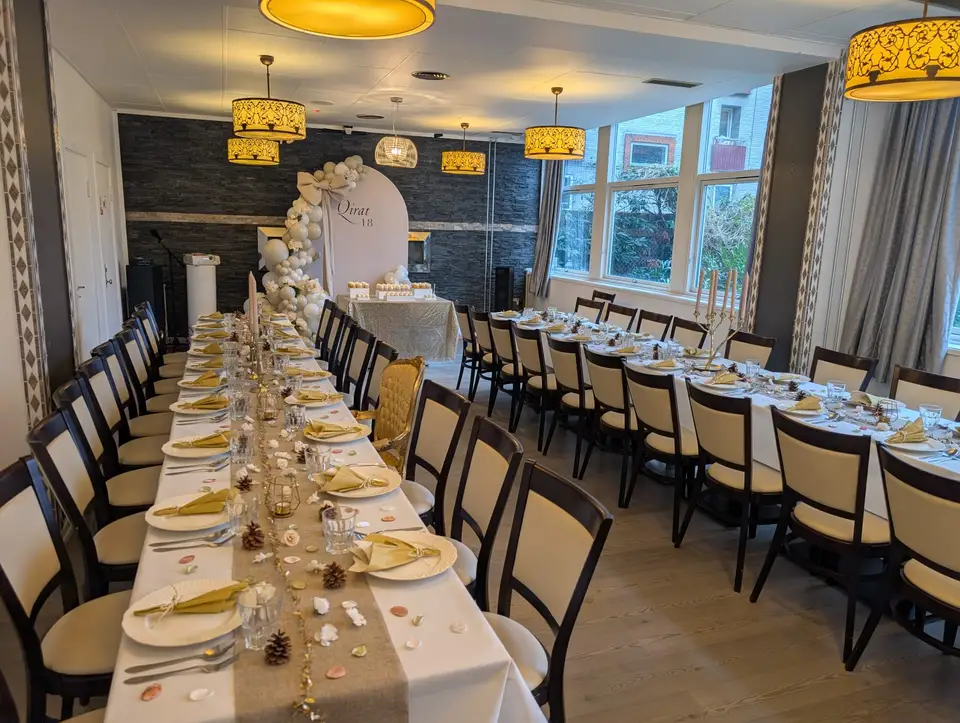
Agreeing that gap is easier here, because the kitchen is a few steps from the hall. If the speeches overrun, the team cooking your food is standing on the other side of the same wall, and the coffee waits with them. Ask about that wherever you compare rooms for a julefrokost in Copenhagen.
Pakkeleg is the game everyone expects, and the one that scales worst
Pakkeleg is the dice game where everyone brings a wrapped gift, sixes win a parcel from the pile, and a timed second round lets people steal from each other. It is the heart of a Danish julefrokost, and your colleagues will ask for it.
Three changes make it work for a whole company.
- Run it per table, not per room. Each table gets its own dice and its own pile, so sixty people play at once instead of sixty people watching one person roll.
- Put a clock on it. Announce that round one lasts a fixed number of minutes and the stealing round half as long. A pakkeleg without a stated end does not have one.
- Say in the invitation what the spending cap is, and whether the gift is a joke or something real. Half the awkwardness comes from colleagues who guessed differently.
Then there is the part nobody plans: forty wrapped presents have to get into the building, usually in a box too big to carry far. Parking is on site here, so whoever has them in the boot parks by the door. Stack the pile on a side table, not on the dining tables.
Games that run at the tables while the plates are still out
The most reliable julefrokost games never ask anyone to stand up.
- Kims leg. A tray of small Christmas objects goes round, everyone looks for half a minute, the tray is covered, and each table writes down what it remembers. It works with thirty people and with a hundred.
- A written quiz answered by table, one sheet per table. One sheet is what makes the quiet colleague join in, because the loud one has to write the answer down.
- A letters game. Give the room a Christmas phrase and ask each table for the longest word made from its letters in three minutes. It costs a sheet of paper and starts an argument.
Anything passed from hand to hand along a long table loses its energy before it reaches the far end, so let every table play its own round in parallel.
The one or two games worth clearing floor for
The hall is a single room for 30 to 120 guests, and the floor you have is the aisle between the table runs plus the open space at one end. Chairs stay where the staff set them unless you ask in advance, so a game needing the whole company on its feet is wrong for a room laid for eighty.
Choose one floor game, and the kind where a handful play while everybody else watches and heckles. Two volunteers per table wrapping a third in a roll of paper takes four minutes and produces every photograph that ends up in the group chat. A relay down the open aisle, one runner per table, does the same job.
Run it once. The second floor game of an evening always drags.
What the projector and the microphone are actually for
Both belong to the room, so nobody rents a screen for a December evening. The hall fee already includes decoration, sound system, projector, staff and cleaning.
A screen changes three games. A slide quiz keeps its own pace, because the question stays visible and nobody asks for it twice. A picture round of colleagues as children, collected by one person who then cannot play, is the most popular thing many workplaces do all year. And a name that Christmas tune round through the sound system beats humming, which only the nearest three people hear.
Bring your own laptop and the adapter it needs, and test the file in the room on the day rather than at home the night before. Then give the host the microphone. In a hall of eighty in full conversation, an unamplified host loses the room by the third question.
Prizes, hosts and the colleagues who would rather not play
Ask someone other than the most senior person to host. The job wants someone who can be interrupted cheerfully and still reach the end of a running order kept on paper.
Several small prizes beat one large one, and they keep the evening from becoming a contest.
And make it visibly fine not to play. Somebody is driving, somebody started last week, somebody dislikes standing up in front of colleagues. A julefrokost where opting out is normal is one more people stay at, which is the instinct behind the rest of the unwritten rules of the workplace julefrokost.
Come and stand in the room before you plan an evening around it. Walk the aisle, look at where the screen goes, and work out where forty presents will sit. You can book a visit, see what the hall fee includes on the prices page, or ask us about a company party in Copenhagen. You will find us at Højdevej 59 in 2300 København S. Ring +45 21 95 92 92, or email info@maiya.dk with the date you are holding.