
How many guests do you invite to a confirmation?
3 August 2026 · 5 min
Write the names before you write a number. A confirmation guest list is made of four groups, and the four can come to anything from close family only to both sides of the family plus the whole class. What the total decides is how the afternoon is arranged.
How the four groups add up to your number
Group one is the people it is not a celebration without: grandparents, siblings, godparents, the aunt who will cry during the speech. Count only them and you have the smallest honest version of the day. Plenty of families stop there and have a lovely afternoon.
Add group two, the rest of the family you see at Christmas, and the total roughly doubles. Uncles, aunts, cousins and their children arrive as whole households, which is why the number climbs so quickly at this step. A family with three siblings on each side lands somewhere very different from an only child of two only children, and neither of those families is unusual.
Group three is the confirmand's own guests, and it has the widest range of the four. A few close friends barely register. The whole class is a second party arriving inside the first. Decide on purpose whether the friends' parents are invited too, because that one choice can double group three by itself.
Group four is everybody else: neighbours, close colleagues, the family who invited you to their confirmation last spring. Add it and your total sits at the high end. Our page on confirmation parties sets out how an afternoon that size is arranged.
Add the groups in that order and write the running total beside each one. That is your number, and it is worth more to you than any average, because it is made of names you can picture at a table.
Settle the friends question first
The confirmand is the one guest of honour in Danish family life with firm opinions and no diplomacy at all. Four friends and the whole class are two different afternoons: they change the seating, the food order and the noise level of the day. Get that decision made before the list goes any further, because it is the hardest one to reverse once a class group chat knows about it.
Then draw the line once. When a total stops working, cut back to a group boundary rather than arguing over individual names for a month. A boundary can be explained to a disappointed relative in a way that a single name never can.
What 40, 60, 80 and 100 guests each do to the room
The hall seats 30 to 120 in one room, so nothing across this span changes the venue. It changes the layout, the queue at the buffet and the running order.
40 guests
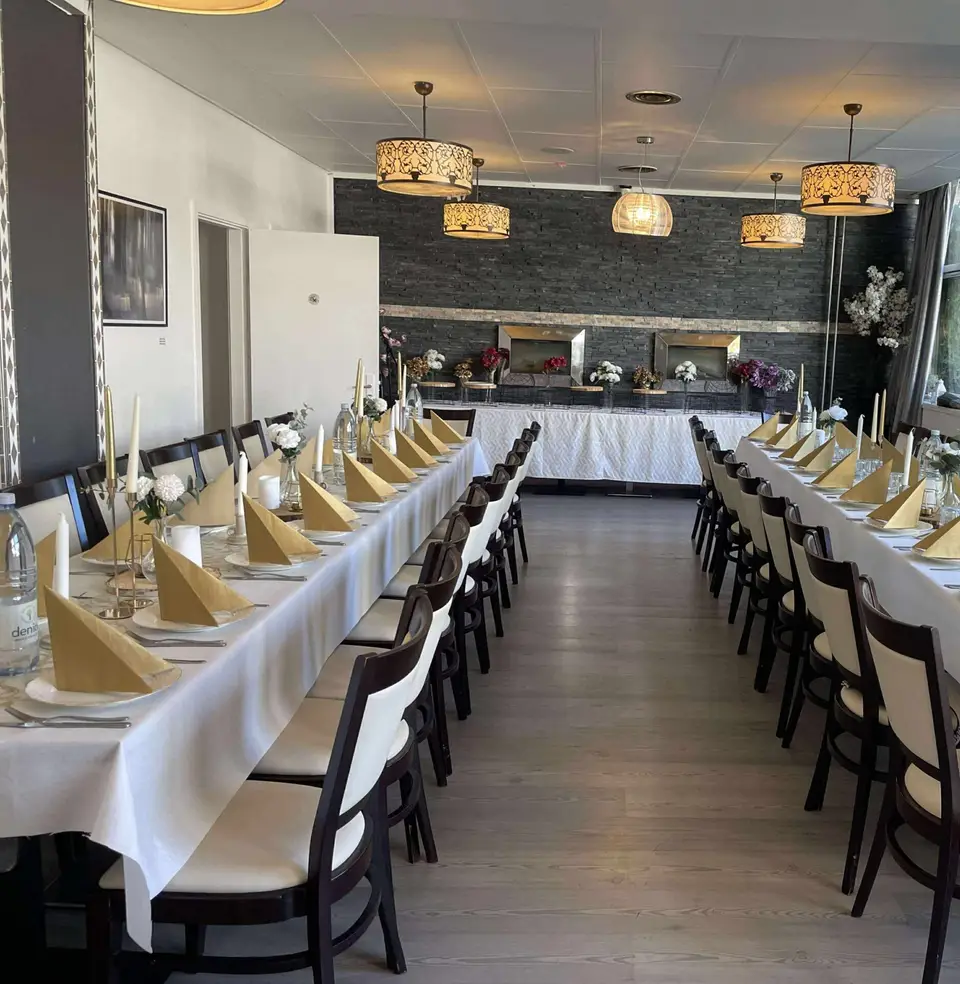
Two long tables facing each other down the length of the room leave plenty of floor over. Everyone hears the speeches from where they sit, and one buffet is plenty. The risk at this size is a room that reads half empty, so give the spare floor a job: tables at one end, cake and gifts at the other, the middle kept clear.
60 guests
60 is the easiest number to lay a table for. Long tables still work, the confirmand can see every face from the head of the table, and one buffet serves everyone without a queue along the wall. It is also where a seating plan earns its keep, mostly to keep the friends together and the loud uncles apart.
80 guests
Round tables usually beat long ones from here. A single long table for 80 means the two sides of the family never speak to each other for the length of the meal, while round tables keep a conversation going at every one of them. The sound system included with the hall stops being decoration once the speeches start, and the buffet is worth opening from both sides.
100 guests
100 fills the room, and what changes is the timetable. Seating 100 takes longer than seating 60, the speeches need a running order agreed in advance, and the food goes out in more than one round. Less of the day is spontaneous, and all of it still works. If you are near this number, our page on hosting 100 guests goes through it properly.
What the count changes about the food and the gift table
The guest count also decides how the food reaches the table. Our kitchen is in the same building and the team that cooks is the team that serves, which counts for most at the top of the range, where 80 people want to eat at roughly the same time.
Count the children separately. Children aged 5 to 12 pay half the menu price, so a list of 100 with eleven children on it is a different order from 100 adults, even though both lists say 100. The prices page sets out where that half price applies and how the hall fee and the menus are built per person.
The gift table grows with the list, and so does the chance that someone arrives having left the envelope at home. Amager Centret, Reberbanegade 3, is about 1.3 km from Højdevej, a walk of roughly 15 to 16 minutes, which makes that a quick errand instead of an apology.
Book the Saturday before the list is finished
Your list can keep changing until the invitations go out. The date cannot. Store Bededag has not been a public holiday since 1 January 2024, which squeezed the spring confirmation season into fewer Saturdays, and there is real competition for the ones that are left. Families who would rather celebrate in the autumn usually look at mid to late September, a good distance from the spring peak.
Come and see the hall
Bring the list. Stand at the head of the table and see what your own 40 or 80 looks like with chairs around it.
Before the invitations go out, we are glad to sit down with your four groups and work through them with you, whichever way the total lands. Call +45 21 95 92 92, write to info@maiya.dk, or book a visit and bring the list with you.