
Golden wedding party ideas, planned around the guests
20 October 2026 · 5 min
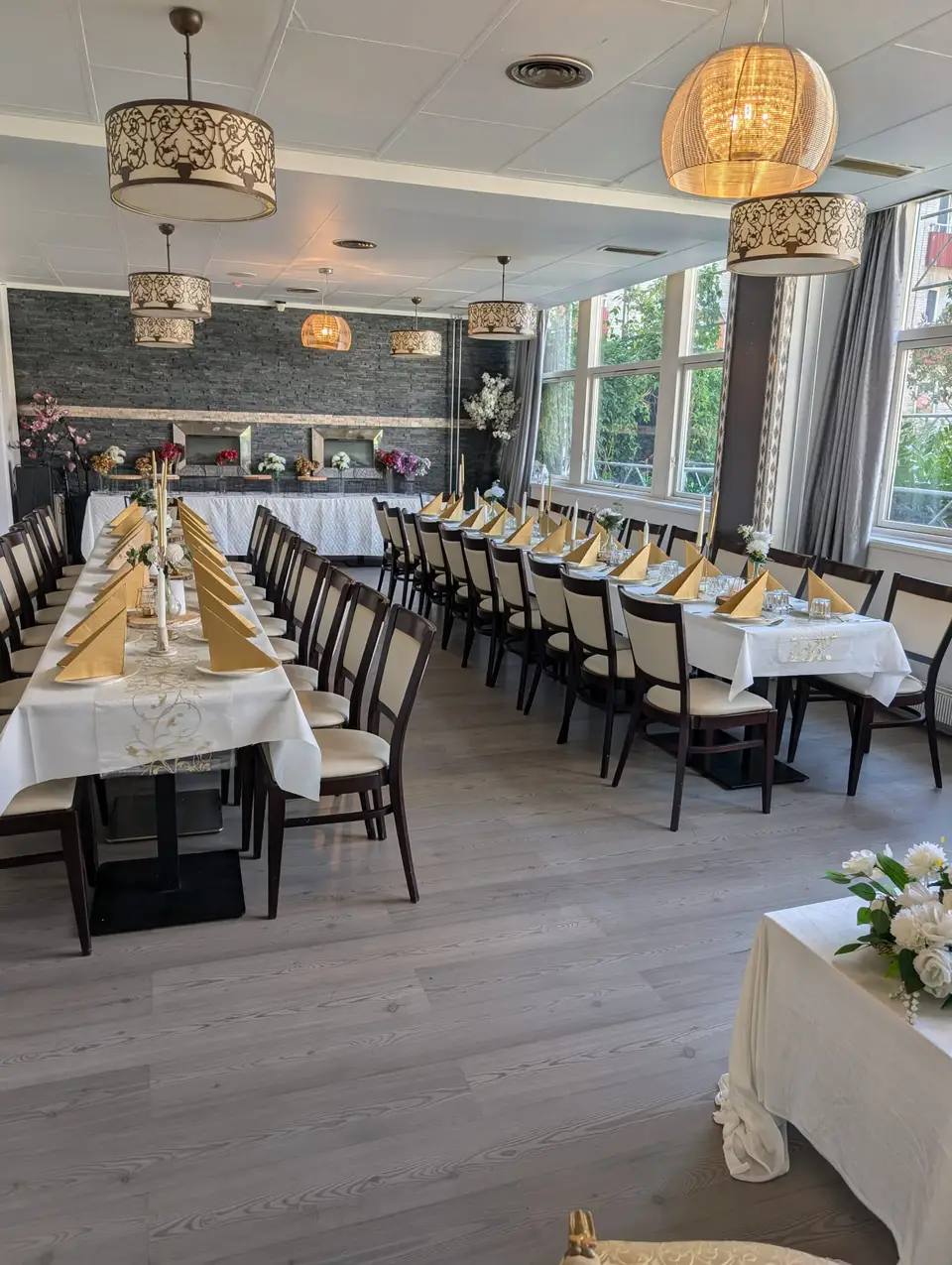
Fifty years of marriage produces a guest list with an unusual shape. The couple's closest friends are the couple's own age. Their children are usually the ones organising the day, the grandchildren are old enough to write a speech, and somebody's toddler will be asleep in a pram by four in the afternoon.
Almost every good decision about a guldbryllup follows from that one fact. The question is not what a party ought to look like, but what this particular room full of people can enjoy for five or six hours.
Hold it in daylight and let it finish before the evening
A wedding reception runs late because most of the people at it are in their twenties and thirties. A golden wedding often borrows the same shape without anyone asking whether it suits the room, and then a third of the guests leave quietly during dessert.
Move the whole thing earlier instead. A start around midday, the meal in the early afternoon, coffee and the cake a couple of hours later, and the last guests going home while it is still light outside. Someone in her eighties who would politely decline an evening ending after midnight will say yes to a lunch without a second thought.
An afternoon also solves a problem families rarely see coming. If yours keeps the old morning tradition at the house, with relatives in the garden before the couple are properly awake, then the pair being celebrated have already been on their feet for hours by the time lunch is served. Asking them to start again at six in the evening is asking a great deal.
Not every venue sells the afternoon, so make it the first question when you compare rooms for an anniversary in Copenhagen.
Plan the arrival before you plan anything else
For a guest list in its seventies and eighties, the party begins at the kerb rather than at the door, and how the arrival goes sets the mood for the first hour.
Free parking on site is the detail that matters most here, and it is not a given anywhere in Copenhagen. A guest who cannot walk far is set down at the door by a driver who then parks a few steps away instead of circling the neighbourhood. If half your guests are driving in, our post on parking for party guests is worth reading before the invitations go out.
Guests who do not drive have an easier time than they expect. Line 8A runs along Kastrupvej day and night, and the Sundby Kirkegård stop is roughly two minutes' walk away. The metro is a different proposition: every M2 station near the hall is more than a kilometre off, which is nothing to a grandchild and a real undertaking for someone with a walking stick. Arrange lifts from the station instead of hoping.
Then ask each venue, in writing and before you book, what the route from the car to the chair looks like. Our post on arrival for guests with limited mobility sets out the questions, and they apply to every venue on your list, this one included.
Seat three generations at the same tables, on purpose
The instinct is to put the children together at their own table in a far corner. At a fiftieth anniversary that wastes the day. The whole reason four generations travelled to be in one room is the thing a children's table quietly prevents.
Mix the tables by age, then fix the two problems mixing creates.
- Seat the oldest guests at the end furthest from the speakers and the music, and nearest the way out to the toilets. They will hear every speech perfectly well and they will not spend four hours under a loudspeaker.
- Give the children the end nearest the open floor, so that when they stop sitting still, which they will, they have somewhere to go that is not between the staff and the tables.
The hall holds 30 to 120 guests in a single room, and that is the constraint to understand before you draw a plan. There is no second space to send anybody to, so seating is the only tool you have for managing noise. It turns out to be a very good one.
Keep the programme short enough to finish well
Fifty years generates more speeches than any afternoon can hold. Three is usually right: one from the children on behalf of the family, one from a friend who was at the wedding itself, and one from the couple. Everyone else who wants to say something can write it in a book that is handed over with the coffee. Keep the whole programme inside an hour and it will end while people still want more of it.
The one piece of entertainment that works across three generations is photographs. Fifty years of them, in order, on a screen, with the oldest guests supplying the commentary nobody under forty could provide. The projector and the sound system come with the room here, inside a hall fee that also covers decoration, staff and cleaning, so a slideshow costs you the evenings you spend sorting pictures and nothing else. Test the file in the room on the day, not on your laptop the night before.
What to serve when the ages run from four to ninety
Any menu can be made fully vegetarian, which solves most of what a four generation family will throw at a kitchen. Pricing runs per head, with a reduced rate for children, and the prices page sets it out in full.
The kitchen sits inside the building, which is worth more at a long daytime party than it sounds. Second helpings reach the table hot, and the people who cooked the food are the people carrying it out.
If a Nepali menu is new to half of your guests, start them on momo. A steamed dumpling needs no explanation at any age, and a tray of them will cross a table of grandchildren faster than anything else you order.
A golden wedding is one of the few parties where the guests of honour know exactly what they want the day to feel like. Ask them first. Then come and see the room with their answer in your head: book a visit, walk the floor, and work out where you would seat your grandmother. We are at Højdevej 59, 2300 København S, on +45 21 95 92 92 or info@maiya.dk.