
How many guests come to a wedding on average?
24 August 2026 · 5 min
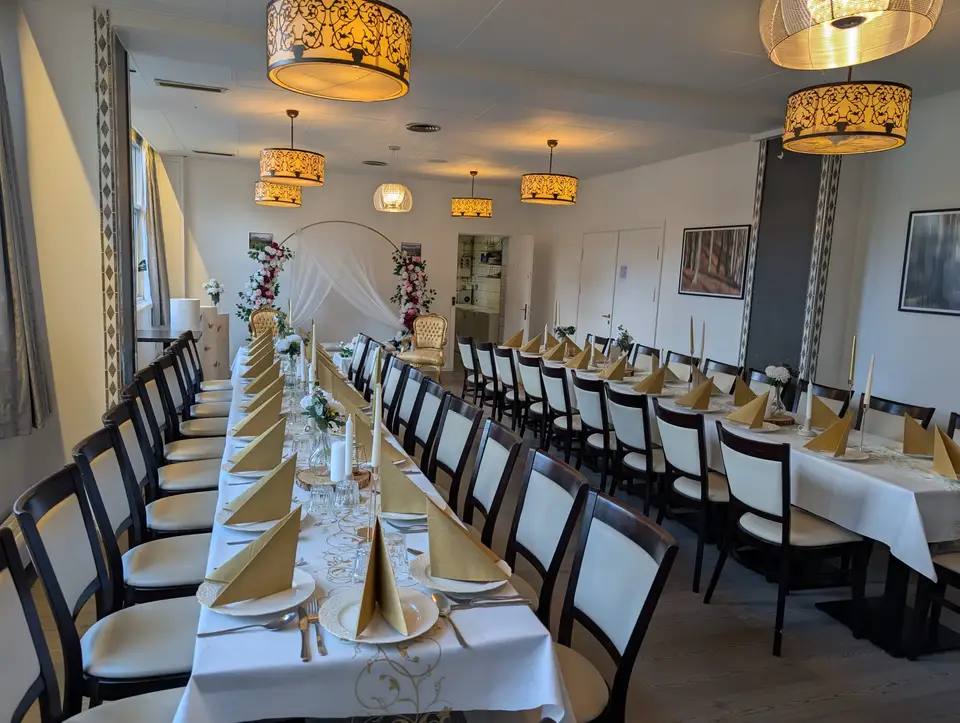
Couples ask us this in the very first email, usually phrased exactly that way: how many guests come to a wedding on average? It is a fair question, and the honest answer is that no national figure is worth planning around. Danish weddings run from a lunch for the two closest families to a full hall of a hundred and twenty, and the spread is so wide that an average would tell you nothing true about your own day.
So this post answers the more useful version of the question. Not what other couples invite, but how the number you settle on changes the seating, the flow of the evening and the cost per head at a hall like ours on Amager. Once you see what each size actually does to a room, the guest list stops being a guess.
The room decides, not the wish list
Every wedding list starts longer than the room it will sit in. You write down the people you cannot leave out, then the people it would be awkward to skip, and by the third pass you are at ninety before you have thought about where they sit.
That is why the room is the more honest starting point. Our hall on Højdevej 59 seats 30 to 120 guests, one space rather than a warren of small ones, so the ceiling is firm and known before a single name goes on the list. Working from the room down is calmer than working from the wish list up. You decide how full you want the space to feel, and the number follows.
What 60, 90 and 120 guests do to the hall
The same room reads completely differently at each of these sizes, and it is worth picturing before you commit.
- Sixty guests leave the hall generous. Two long tables run the length of the room with space to walk behind every chair, a clear stretch of floor for the first dance, and no pressure on the buffet line. This is the size where nobody queues.
- Ninety guests is the comfortable middle. Three long runs, or a head table with two banquet rows, fill the room warmly without crowding it. There is still an obvious dance floor and a clean path from the kitchen to the far tables. Most weddings we host land somewhere near here.
- A hundred and twenty is the full room, and it is our ceiling for a reason. Every table is in use and the space looks marvellous in photographs, but circulation gets tighter, so the buffet and the dance floor need to be planned rather than assumed. If your list is heading this way, our page for a venue built for up to a hundred guests walks through the layout in detail.
The point is that 60 and 120 are not the same wedding scaled up. They are different evenings, and knowing which one you want makes the guest list easier, not harder.
What the guest count does to the cost per head
This is the quiet reason the number matters, and it does not work the way people expect. Our hall fee is charged per person, but it carries a 30-guest minimum. A wedding of twenty is welcome, and it will be lovely, but the hall is billed as if thirty attended, so the effective cost per actual head is highest at the very small sizes. Once you are past thirty, the maths settles down and stays roughly proportional.
The menus are also per person, every set menu has a fully vegetarian version, and for children between 5 and 12 the menu is charged at half, which softens the total when a family wedding brings a crowd of young cousins. Drinks are per guest too. We do not print prices in a blog post, because the owner keeps them current in one place. You can see the full shape on the services and pricing page, where the figures come straight from the system rather than from a post that might have gone stale.
Two things at our venue quietly help the per-head sum: the kitchen is inside the building, so the food is not trucked in with a delivery charge, and parking on site is free, which spares your guests a cost that adds up over a whole family.
The number most couples actually settle on
If you want a rule of thumb rather than a statistic, most weddings we host on Amager land in the middle of our range, comfortably full without feeling packed. That is not a law of nature. It is simply where the family you must invite tends to meet a room that still feels warm at the last table.
One timing note worth saying out loud: since 1995, no month has drawn more Danish weddings than August, with June the runner-up, so the best high-summer Saturdays go early. If your date is in that window, decide your rough size and book the room before the guest list is final. The number can flex by a table or two right up to the week before. The date cannot.
When you are ready, come and stand in the empty hall and picture your own count in it. That single visit settles the question better than any average could. See how the space works for a wedding, then book a viewing and we will walk it with you.