
What order should the wedding speeches go in?
18 October 2026 · 5 min
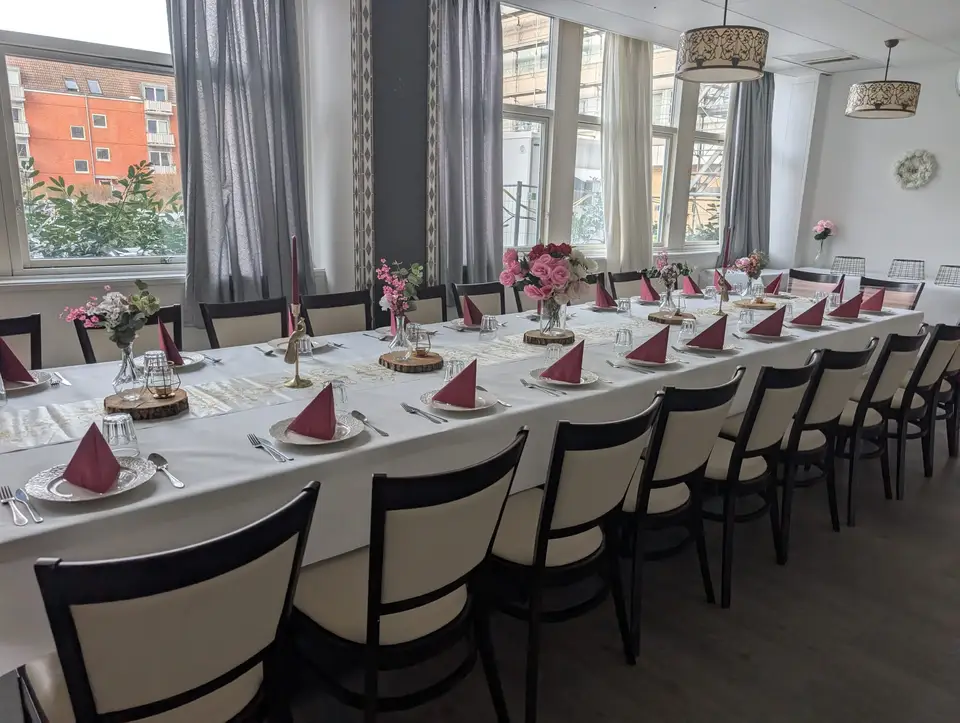
A toastmaster's hardest half hour is the one where the main course is standing ready in the kitchen and the third speaker has just unfolded a second sheet of paper. Nobody has done anything wrong. The speeches were put in an order weeks ago without anyone asking what time the food would be ready.
Danish weddings have a sequence that most families follow, and the sequence itself is rarely what fails. The placing is. So here is the order, and then the harder question of where in the evening each speech should land.
The order most Danish weddings follow
If you have a toastmaster, their first job is to gather the speeches weeks ahead. It is the single most useful thing anyone does for your evening. The sequence they will usually build looks like this:
- The welcome on behalf of the hosts, traditionally from the bride's father, once the starter is on the table.
- The parents from the other side, so neither family sits all night waiting for its turn.
- The couple to each other, in whichever order suits the two of you.
- The siblings and the close friends, who are funnier and longer than they promised to be.
- A short last word from the couple together, usually around the coffee.
The reasoning under the list is worth more than the list. The order runs from the most formal voice towards the closest one, and from the oldest generation towards the youngest. A grandmother placed at half past eleven has not really been given a speech at all.
Plenty of couples have no bride's father who wants to open, or no family shape that fits the old pattern. Keep the reasoning and drop the labels. Decide who speaks on behalf of the hosts, then work outwards from there.
Why a speech belongs between the courses and never inside one
This is clearer from the kitchen side of the door.
A plated main course leaves the kitchen at the warmest it will ever be, and everything after that is loss. A speech that starts while plates are going out costs the room twice over. The food cools in front of guests who feel rude eating during it, and the speaker is competing with cutlery and with staff moving behind their shoulder.
Treat the gaps between courses as the slots, then fill them one speech at a time. Tell the toastmaster when each course is due out of the kitchen and let them place the speakers in between. A three course dinner gives you three natural gaps, and the coffee gives you a fourth.
A buffet changes the shape rather than the rule. There, the queue is the service, so a speech goes either before the buffet opens or after the room has been round it. Never while sixty people are standing up with a plate in their hands.
How many speeches, and how long each one gets
Five speeches make a comfortable evening. Seven make a long one.
Ask every speaker for a length in advance, and give them a number rather than a feeling. Four minutes is a real speech. Eight is an endurance test for everybody not related to the speaker. Most people write to the time they are given, so giving no time is what produces the long ones.
Count the songs as well. A festsang written to a borrowed melody takes about as long as a short speech and asks more of the room, because everyone has to join in. Two songs and six speeches is eight items on your running order, not six.
Then give the toastmaster permission to move things. If the starter ran late, or a speaker has gone on, the last speech before dessert can wait until the coffee instead. A plan that cannot bend is only a list of things that will now happen late.
Counting backwards from the bridal waltz
The brudevals is the fixed point of a Danish wedding evening, danced before midnight while the guests close a circle in around the couple. Every other time on your sheet hangs from it.
So build the evening backwards. Midnight is the waltz. Before the waltz comes the cake and the coffee, before that the last speech, before that the dessert, and so on back to the welcome at the starter. Every speech added after the main course pushes the waltz nearer to midnight, and a waltz danced at five past is a different memory from one danced at half past eleven with the room still full.
Write the whole thing on one sheet with a time against each line, then hand the same sheet to three people: the toastmaster, the kitchen and whoever is running the music.
What a single room on Højdevej does to your speech list
Maiya Party Hall is one room for 30 to 120 guests at Højdevej 59 in København S, and that shapes a speech list before you have written it.
One room means one audience. A speaker at the window end is heard at the far end without working for it, and there is nowhere for the guests who would rather be somewhere else to drift off to, which keeps speeches honest and short. A microphone is already in the room, and so is the projector, both carried by the hall fee, so a slideshow of childhood photographs costs you nothing but an afternoon of choosing pictures. The prices page lists what else that fee carries.
The kitchen is in the same building, a few steps from the tables. That is the detail that counts most on a night of speeches, because your running order will slip. When the toastmaster leans through the door to say that the last speech has run eight minutes long, the message lands in seconds and the main course waits where it is warm.
If some of your guests follow Danish and some do not, the order needs one more decision, and speeches at a bilingual party works through that one on its own.
Send us the running order
A speech list makes more sense in the room it will be heard in. Tell us when the ceremony ends and roughly how many people want to speak, and we will build the courses around them.
Book a visit to see the hall, or read more about weddings at Maiya first.