Speeches at a party where not every guest speaks Danish
30 August 2026 · 5 min
The moment that decides a bilingual party arrives about twenty minutes into the meal. Someone stands, taps a glass, and begins a speech in Danish that has plainly been worked on for weeks. Half the room settles in. The other half smiles, looks at the tablecloth, and waits for the applause so they know when it has finished.
Nobody has done anything wrong. It happens because the language question was never answered, only postponed until the evening answered it badly. Højdevej sees plenty of these rooms: a Danish family and a Nepali one seated at the same tables, a christening with grandparents who flew in for it, a company party where the working language stops being Danish the moment people leave the office.
The fix is not to translate everything. It is to sort the speeches in advance.
Not every speech has to be translated, and choosing is most of the work
Speeches at a Danish party do three different jobs, and only one of them needs the words carried across.
Some speeches carry information: the welcome, the practical notes, the thanks to whoever cooked or drove or decorated, the announcement of what happens next. Every guest needs these, so they get said in both languages, briefly.
Some speeches carry a relationship. A father talking about his daughter, a friend of thirty years, a colleague leaving after a long stretch. These need to be understood in substance, not word for word. A guest who knows this is the bride's father and that he is talking about her childhood has most of what the speech is for.
Some speeches carry a form. The party song sung to a borrowed melody, the toast, the tradition that everyone born here recognises and nobody explains. These need one sentence of context before they start, not a translation while they run.
Write your speech list out and mark each one. That single exercise removes most of the problem.
Four ways to run a speech in two languages
The speaker does both. Good when the speaker is genuinely comfortable in the second language. The rule is to cut the written speech by a third first, because it is about to be delivered twice.
A short spoken summary afterwards. The speech runs in full in one language, then someone agreed in advance stands and gives the gist in the other in under two minutes. It works best when the summariser is briefed and does not improvise.
A printed translation on the table. The long, prepared, emotional speech is translated in advance and laid at each place. Guests read as they listen. This is the only option that costs no extra minutes at all, which is why the father of the bride usually belongs here.
Explain the frame, skip the words. Songs, toasts and set pieces get a line in the programme and nothing more.
The mistake is using all four at random. Pick one per speech, and make sure the toastmaster knows which.
The programme sheet does more work than any interpreter
One sheet at each place setting, Danish on one side and the second language on the other, is the cheapest thing you can do and the most effective. Put on it:
- The running order, with each speech named. Guests relax once they know how many are coming.
- One line on every Danish custom the evening will contain: the festsang sung to a tune everybody already knows, the toast, the glass that gets tapped, and, at a wedding, when the bridal waltz is danced and what the guests are meant to do while it happens.
- Who the toastmaster is, so a guest with a question does not have to find one in a language they are unsure of.
- The dishes, with a line each. A guest who can read that momo are steamed dumplings and that the achar beside them is the hot part does not have to stop a member of staff to ask.
Brief the toastmaster, because they are what makes it bilingual
The toastmaster in a two language room is doing a different job from the usual one, and they need to be told so. Give them:
- The final speech list, in order, with names and the language each will be in, closed the week before rather than assembled at the table.
- A sentence of their own in both languages between every item. Something as plain as naming the next speaker, saying which language they will use, and pointing at the printed version is enough to keep the whole room oriented.
- A ceiling on the total speech time, agreed with you. This is the part that gets forgotten. A bilingual block should not run longer than a monolingual one, it should contain fewer speeches.
- Permission to move a speech to after the main course if the room has gone quiet, and permission to say no to a guest who wants to add one on the night.
What the room itself settles
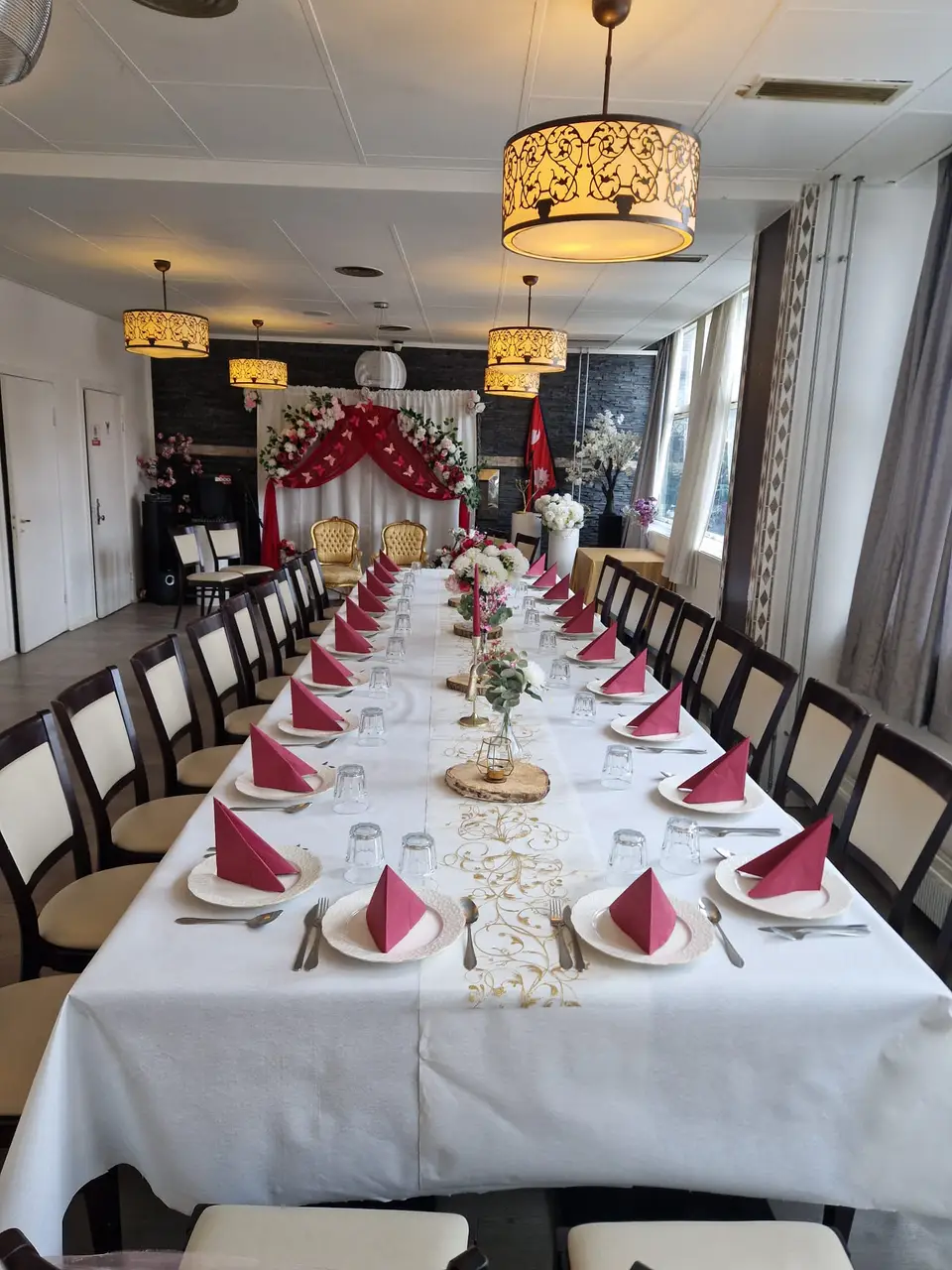
Our hall takes 30 to 120 guests in one space. There is no overflow room and no second sitting, which matters more for speeches than for anything else: a translated speech dies the moment a third of the audience is standing in a corridor with a coffee.
The sound system and projector are part of the hall fee, along with decoration, staff and cleaning, and both are worth planning into the speeches rather than discovering on the night. A microphone that reaches the far end of a long table is what lets a summary be given quietly instead of shouted. The projector will hold a running order, or the second language version of a speech, at a size the back table can actually read. A phone passed around does not travel.
Maiya Nepali Kitchen cooks on site rather than elsewhere, which is why service can bend around the speaking. A course can be held back for five minutes until the applause, instead of arriving in the middle of a toast. Guests who need to step outside to take a call in their own language will find free parking and a quiet street.
If you are planning a wedding across two languages, our wedding page sets out how the room is usually laid out for one. Otherwise book a visit to Højdevej 59 in 2300 København S, bring the speech list, and we will walk the room with you and work out where the microphone should stand. You can also call us on +45 21 95 92 92.