One table for Danish guests and guests from abroad
2 November 2026 · 5 min
Your guest list has your mother's side from Jutland, two colleagues who moved to Copenhagen last year, an aunt flying in for the weekend, and a neighbour who has eaten momo most weeks of their adult life. Some of them will recognise everything on the counter. Some of them will recognise the rice.
That is the ordinary shape of a party in this city, and it is a solvable problem. It is solved by how the table is built and labelled, not by ordering two different dinners.
What actually goes wrong at a mixed table
It is almost never that somebody dislikes the food. It is hesitation.
A guest who does not recognise a dish takes a polite spoonful. If that spoonful happens to be the sharpest thing on the counter, they stop there and spend the rest of the evening on bread and salad. Nobody complains. You find out when you see the plates coming back.
The other failure comes from the host trying to prevent the first one. Somebody orders a separate tray of familiar food and sets it at one end for the guests presumed to need it. It never reads as hospitality. It reads as a line drawn through your own guest list, and the people on the wrong side of it notice immediately.
One table, properly explained, beats two tables every time. Your family came to eat with each other.
Build the table around jobs, not nationalities
Stop thinking of the counter as a cuisine and start thinking of it as four jobs that have to be filled.
- Something nobody has to ask about. Rice, a grilled meat, a green salad, bread. This is the anchor. A guest who is unsure can build a full plate from the anchor alone and still be eating properly, which means they can be adventurous with everything else without risking dinner.
- Something mild that carries the plate. Dal bhat tarkari is the Nepali everyday plate: a lentil soup, rice and a vegetable curry that arrive together and get refilled as a matter of course. It is gentle by nature. It fills the middle of the plate for the cautious guest and it is what the Nepali guests will quietly be pleased to see done properly.
- Something worth having come for. Momo, steamed dumplings served with achar, or sekuwa, charcoal grilled marinated meat from the eastern hills. These are the dishes people photograph and talk about on Monday.
- One sweet thing to end on. It does more work than it looks like it does, because it is the last taste anyone has of your party.
A plate where every single dish is a question is exhausting. A plate where nothing is a question is forgettable. You want roughly a third of the counter to be new to the guest who knows nothing, and the rest to be obvious.
Write the dish names down
This is the cheapest thing on the list and the one that changes the evening most.
Put a card at the head of the counter, or small cards beside each tray. Each dish gets three things: its name, one short line saying what it is, and an honest word about whether it carries heat. "Momo: steamed dumplings with chicken, served with achar on the side." That is enough. Bridge once and then let the dish be itself.
Credit a dish where the credit belongs. Choila is Newar. Sekuwa comes from the Rai and Limbu communities of the eastern hills. Being precise about where something is from reads as confidence, and it tells the guests who do know the food that the kitchen knows it too.
If half the room reads Danish and half reads English, print both. It takes one extra sheet of paper and it removes the only reason anyone was going to stand at the counter looking uncertain.
Put the heat where people choose it
On a Nepali counter the chilli usually lives in the achar beside the dish and not stirred through the pot it came out of. For a mixed party that is a gift. Each guest sets the level on their own plate, and the kitchen never has to choose one level for a whole room that disagrees. We went through this dish by dish in is Nepali food spicy, including the sentence to give a kitchen before a party.
Lay the counter out in the same spirit. Plates first, then the anchor and the mild dishes, then the ones that need a line of explanation, and the achar last, next to its card, so nobody loads a spoonful blind on the way past.
Say who is coming before you say what to serve
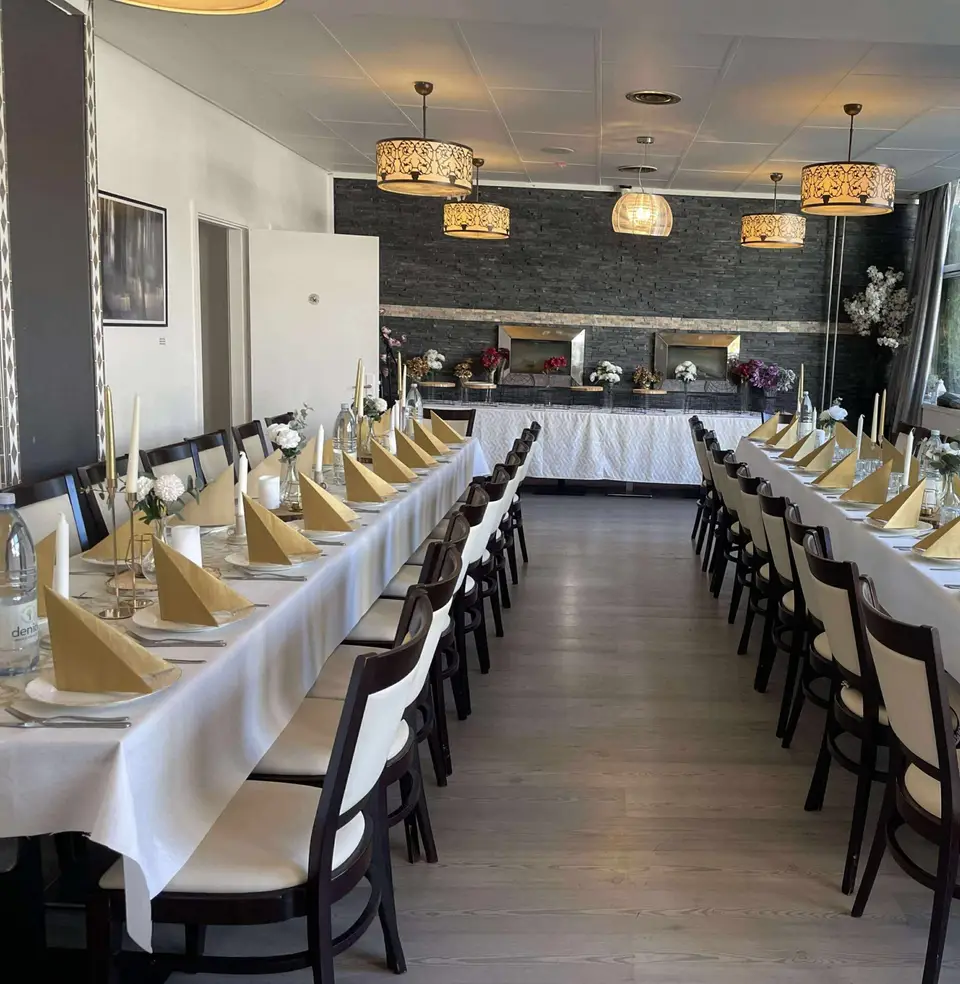
At Maiya Party Hall on Højdevej on Amager, the buffet counter runs along the dark stone wall at the end of the hall, with the tables facing each other down the room. One room, 30 to 120 guests, so there is no second room to hide a second menu in, and nobody queues out of sight of the party.
Our kitchen sits inside the venue rather than somewhere across the city, which counts for more at a mixed party than at any other kind. A tray can go back and return refilled while people are still eating, and the staff carrying it are the people who cooked it, so a guest who stops to ask what is in a dish gets a straight answer on the spot. Vegetarian guests are no afterthought either, since a set menu can be built without meat from the start rather than stripped of it afterwards.
Tell us who is at the table before you choose a menu: how many have eaten Nepali food, how many are cautious, what the allergies are. That conversation is worth more than any menu name.
Have a look at what the Nepali kitchen can cater and what each menu includes on the prices page, then come and see the room. Book a visit and we will walk the counter with you.