
Round tables or long tables, and which fits more people
19 August 2026 · 5 min
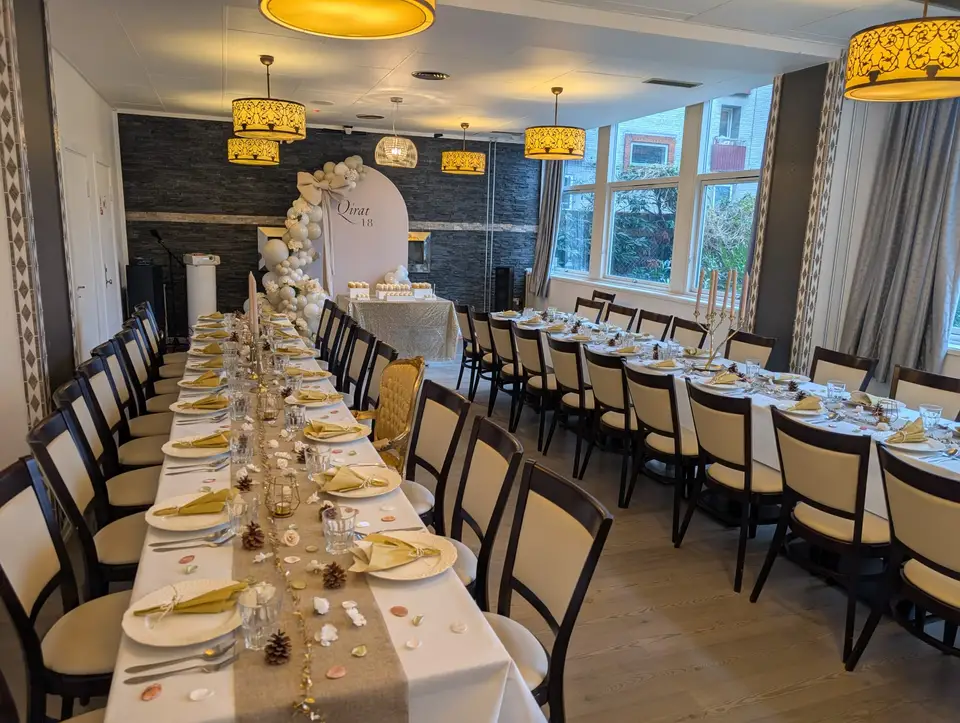
Every photograph in our gallery shows long tables. Once a guest list passes forty, though, somebody in the family usually asks whether we could set rounds instead, the way a hotel would.
It is a fair question with a real answer rather than a matter of taste. The two layouts differ on four things that show up on the night: how many people fit, who can talk to whom, who can see the speaker, and how fast the food gets to the table.
Which layout fits more guests in the same room
Long tables, and by more than most people expect. Three things stack up.
A rectangular table gives both of its long sides to guests, and it butts against the next one without losing a seat at the join. Push three together and the joins cost you nothing. A round table arranges its guests on a circle, and a circle set into a rectangular room leaves four unusable corners at every single table.
Then there is the floor between tables. Rounds need clear space on all sides, so each one carries its own ring of aisle. Two long runs share one lane down the middle and one along each wall, and that is the entire aisle budget for thirty or forty guests.
Last, rounds only move in whole steps. Eight sits well and ten fits, so a list of sixty-two becomes eight tables laid for eight with two chairs standing empty. A long run absorbs an extra cousin by shifting everyone along a few centimetres. Our post on space per guest sets out the arithmetic behind that.
In a room shaped like ours, the gap usually comes to about one whole table's worth of people. If your list sits near the top of what a room takes, that is the difference between everyone getting a seat and a difficult phone call.
What sixty guests looks like in each layout
Set long, sixty is two runs down the length of the room, thirty to a run, fifteen a side, facing each other across a service lane. The end wall stays free for the top table and for whatever the evening points at, an arch, a cake table or a screen. That is roughly what you are looking at in the gallery.
Set round, sixty is eight tables of seven or eight, in two rows of four, each needing about a metre of clearance all the way round. On paper the plan looks generous. In the room, the tables have taken the middle of the floor, and the dancing has to happen somewhere that is not the middle of the floor.
Who each guest can actually talk to
This is where rounds earn their reputation, and they do earn it.
At a round table of eight, everyone can see everyone, and the table can hold a single conversation. Nobody is stranded. For a company dinner, for a christening where two families are meeting each other properly for the first time, or for any evening built around people who do not yet know each other, that is worth real floor space.
A long table hands each guest a smaller world: two neighbours, and the two or three faces opposite. The far end of a run is socially a different party. That is not a fault. For a family that already knows exactly who belongs beside whom it is the point, because you can put the loud end near the music and seat the grandparents where they can slip out early.
Speeches, songs and who has to turn round
A Danish party is not a quiet dinner. There are speeches, usually a printed song, and somebody minding the running order.
Long tables face along the room, so a speaker standing at the end is visible to almost everybody without a chair being moved. The guests on one side turn their heads. That is the whole cost.
At rounds, half of every table has its back to the speaker. They swivel, they end up watching past somebody's shoulder, and the ones who sat facing away from the room all evening are the ones who miss the toast. Four or five speeches, a song sheet and a toastmaster settle the question on their own.
If you want rounds anyway, set them so that nobody sits on the far side of the table. It costs you seats, and every face ends up pointing the right way.
Service, the buffet queue and the floor you get to keep
For plated service, rounds are marginally quicker, since a server works one table from the outside and moves on. For a buffet, the shape of the tables matters far less than where the queue forms.
Ours helps here. The serving counter is built into the far end of the hall against the dark slate wall, so a queue forms along the length of the room and passes the ends of the runs instead of squeezing between them. The kitchen is in the same building, so dishes are refilled while people are still eating.
Spread eight rounds across that same floor and the queue has to thread between them, which means every guest who stands up is standing in it.
Then there is the end of the evening. Two long runs can be moved back against the walls by our staff in a few minutes, and the floor opens up. Eight rounds have nowhere to go. If there is dancing after the cake, that outweighs anything on the table.
What we would set for you
Tell us the headcount, whether there are speeches, and whether the evening ends with dancing, and we will tell you honestly which way we would lay the room out. Speeches and dancing point to long runs. A room full of people who have never met points to rounds, and to accepting a shorter guest list for them.
Our hall takes 30 to 120 guests, so if you are planning near the upper end, the page for parties of about a hundred walks through what fits. The prices page covers what the hall fee includes, and moving tables is part of it.
Better still, stand in the room and pace it. Book a visit and bring the guest list. We are at Højdevej 59, 2300 København S, with free parking on site, and you can reach us on +45 21 95 92 92.