
The order of a traditional julefrokost menu
7 September 2026 · 5 min
A julefrokost is the one Danish meal where the running order matters more than the menu. Leave out the sylte and nobody complains. Send out the frikadeller before the herring and the whole room notices.
The sequence is not ceremony for its own sake. It is how you feed forty or eighty people across a whole afternoon without anyone feeling hurried at the start or stranded in the middle. Here is the order a Danish Christmas lunch usually runs in, what each stage is doing, and how to keep it intact when the food comes out of a Nepali kitchen.
The rounds, from the sild to the ris a la mande
One, the herring. Marinated sild and karrysild on dark rye, with butter, raw onion and capers. Small portions. This is where the snaps belongs if snaps belongs anywhere, and it sets the pace for everything after it.
Two, the rest of the cold fish. Fried plaice fillet with remoulade and lemon, prawns on white bread, boiled egg. Still cold, still on bread, still a few bites at a time.
Three, the cold cuts. Leverpostej, warm, on rye, with bacon and mushrooms on top. Rullepølse, sylte, ham, mustard, pickled beetroot. This is where the meal starts to feel like a meal.
Four, the warm table. Frikadeller, medisterpølse, brunede kartofler, rødkål, often flæskesteg with crackling. The heaviest food lands well into the afternoon, once everybody has been sitting and talking for a while.
Five, cheese. With crispbread, and something sweet beside it.
Six, dessert. Ris a la mande with warm cherry sauce, and the whole almond hidden in the bowl.
Plates change between rounds. That is not fussiness. Herring brine, remoulade and cherry sauce sharing one plate is the detail people remember afterwards, and not fondly.
Why the sequence exists at all
The palate runs one way. Sharp and salty first, rich and warm in the middle, sweet at the end. Serve the dessert early and the herring that follows it tastes like an error.
The pauses are the real point. At a julefrokost the meal is the entertainment, so each round doubles as a natural break for a speech, a song, a walk outside or a change of seat. A party that puts all its food out at once has spent the whole afternoon in the first hour.
And the kitchen can only be in one place at a time. Everything cold can be laid out before the first guest arrives. Only the warm round has to be cooked to a clock, which makes it the one timing worth agreeing in advance.
How to serve it as a buffet without losing the order
Most julefrokost in a rented hall is a buffet, and a buffet flattens the sequence unless somebody runs it. Six rounds collapse into one long queue and a plate with pickled fish sitting next to pork.
Four habits keep the order intact:
- Release the buffet in rounds instead of opening it once, and say out loud which round is now open.
- Clear plates between rounds, so nobody carries the fish into the frikadeller.
- Hold the cheese and the dessert back until the warm table has gone.
- Put the buffet where the queue does not walk past seated guests.
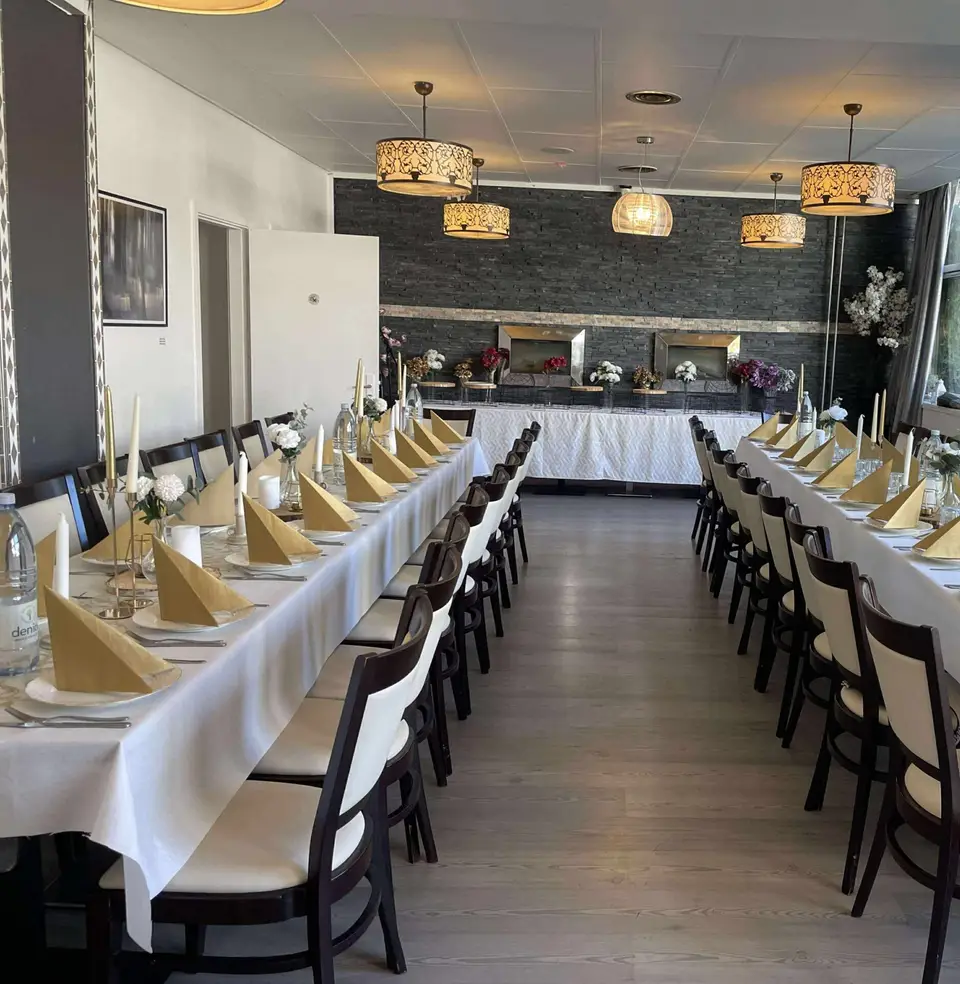
Ours stands along the dark stone wall down one side of the room, which leaves the floor clear for two long tables facing each other, so a queue never crosses anybody's chair. One room, laid for 30 to 120 guests, also means a round is announced once and heard by everybody.
A kitchen on the premises counts for most at exactly this point. The warm dishes leave the pass minutes before they are eaten rather than standing in trays waiting for a room to be ready. Our julefrokost page covers what a December booking includes, and if the date is still open, which day of the week to hold it is the other half of that decision.
The same rounds, cooked in a Nepali kitchen
A julefrokost from Maiya Nepali Kitchen keeps the rhythm and changes the dishes.
Cold and sharp to open: achar, and choila, the Newar dish of charred meat tossed in mustard oil, ginger, garlic, chilli and timur. Eaten in small amounts at room temperature, it does the same job the herring does.
Steamed next: momo, with achar, or jhol momo with a thin spiced broth poured over. A single momo is one mouthful, and another tray follows a few minutes later, so the round lasts exactly as long as the talking does.
Then the warm table: sekuwa, the marinated grilled meat of the eastern hills, and dal bhat tarkari, lentil soup with rice and vegetable curry on one plate, refills expected rather than requested.
Something sweet to close: sel roti, a ring of sweetened rice batter piped by hand into hot oil, which Nepali families make for Dashain and Tihar.
Two practical notes. Any menu can be made fully vegetarian, so a vegetarian colleague eats the same six rounds as everyone else. And the heat lives in the achar served alongside rather than cooked into every dish, so one plate can be mild and the next sharp. Nothing stops you running both traditions in one afternoon either, with the Danish cold rounds first and a Nepali warm round in the middle. Our catering page sets out how the menus are built.
What to settle before you print the menu
- How many rounds you want, and roughly when the warm one should land.
- The vegetarian count and any allergies, by name rather than as a number.
- Whether children are eating. Children aged 5 to 12 pay half the menu price.
- Who announces each round, you or our staff.
- Whether you want cheese at all. Dropping it buys a longer warm table.
Come and see where the rounds land
Højdevej 59 in 2300 København S, on Amager, with free parking on the site, which counts for more in December than in most months.
Send us a date and a rough headcount and we will write your rounds out as a menu you can print. The prices page sets out what the hall fee includes and how a menu is charged per head. If you would rather see the room first, book a visit or ring +45 21 95 92 92.