
What is dal bhat?
29 August 2026 · 5 min
Ask what dal bhat is and the answer usually comes back as lentil soup with rice. That is accurate in the way that calling smørrebrød bread with something on top is accurate. It gets the ingredients right and misses the point, which is that dal bhat is not really a dish. It is a plate, a set of things that arrive together, and a way of eating them that has its own internal logic.
Nepali households eat it most days, sometimes twice. On our menus at Højdevej it does quieter work: it is the spine of what the kitchen sends out when a party is vegetarian. That second thing only makes sense once the first is clear, so start with the plate.
What is actually on the plate
The full name is dal bhat tarkari, and it names three things.
- Dal is the lentil soup, cooked down soft and finished at the last moment by pouring hot fat with bloomed spice into the pot.
- Bhat is the rice. Plain, in the middle, and the largest thing there.
- Tarkari is the vegetable curry, which changes with the season and with whatever came in that week.
Those three are the fixed part. Around them sits whatever the household or the kitchen adds: achar, the pickle, which is sharp and usually the hottest item present; leafy greens, sometimes gundruk, which is fermented without any salt at all and tastes nothing like sauerkraut for that reason; a piece of meat or an egg when the plate is not vegetarian.
Nothing on it is a garnish. Every component is there to be eaten with the rice, and the proportions are the eater's business rather than the cook's.
Why it all lands at once, and why the refill is the point
A Danish meal runs in sequence. Forret, hovedret, dessert, each cleared before the next arrives. Dal bhat has no sequence at all. Everything reaches the table together and the meal becomes a run of small combinations you assemble yourself: rice with dal poured over one corner, rice with tarkari at the next mouthful, a scrape of achar when you want the heat back.
The second thing that defines it is the refill. More rice, more dal, more tarkari, offered as a matter of course rather than as a favour granted. Nobody has to ask and nobody has to be persuaded. In Nepal that is simply how the meal ends, when it ends.
This is the part that is easiest to lose when the food travels, and the part most worth protecting. A plate assembled in a kitchen somewhere else, driven across the city and set down once, can be excellent food and still not be dal bhat, because the arrangement has been frozen into a portion.
Is it hot, and what is in it
Two questions come up before any others, so here are both answers plainly.
The heat generally sits in the achar beside the food rather than cooked through every pot. The dishes themselves are seasoned all the way through with turmeric, cumin, coriander seed, ginger, garlic, green chilli and mustard oil, and they are not timid, but the burn is a separate item you reach for or leave alone. Two people can eat from identical trays at completely different strengths.
As for what is in it, less than people expect and nothing hidden. Savoury Nepali pots avoid cream and sugar, and vegetables are chopped rather than blended, so a tarkari still looks like the vegetables it was made from. Two ingredients are worth naming because you will taste them and not place them: jimbu, a dried Himalayan allium that has to be bloomed in hot fat before it gives anything up, and timur, the Nepali relative of Sichuan pepper, citrusy and sharp. There is a longer treatment of the heat question in our post on how hot Nepali food really is.
Why a vegetarian dal bhat menu is the original rather than the substitute
Vegetarian catering in Denmark is usually built by subtraction. Take the standard menu, remove the meat, put something else where it was, and hope the plate does not look emptier than everyone else's. The result is a version of a meal.
Dal bhat was never assembled that way round. Lentils, rice, vegetables and pickle are the complete meal on their own terms, and meat is what got added on the days a household had it. So when the whole guest list eats no meat, our kitchen is not compensating for anything. It is cooking the thing as it was designed, and the buffet does not get shorter.
That also settles the awkward middle case, which is far more common: ninety guests of whom six are vegetarian. They are not sent to a separate dish parked at the end of the counter. They eat the centre of the same buffet as everybody else, which is a better evening for them and a shorter conversation for you.
What changes when there are ninety of you in the hall
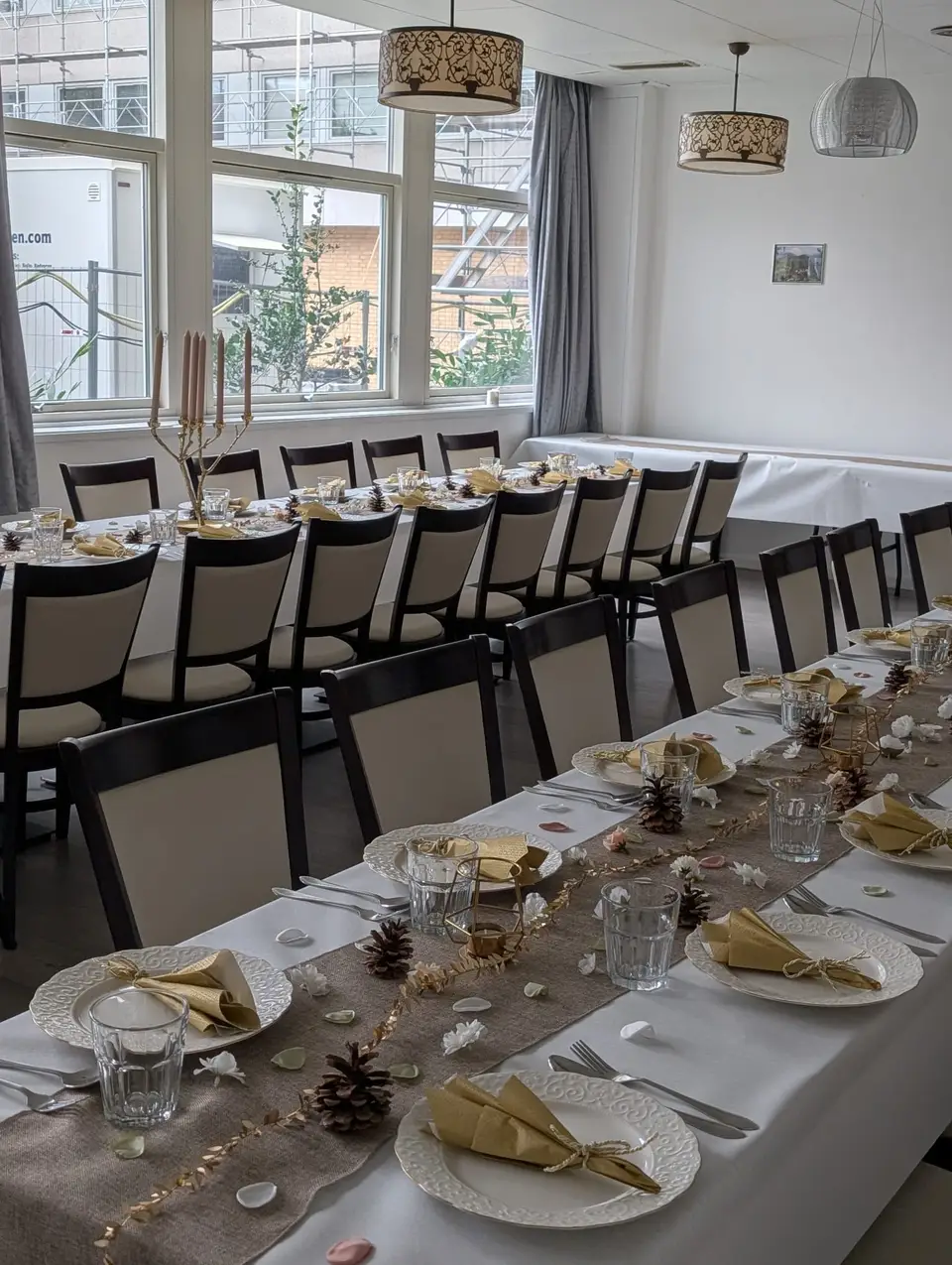
Our kitchen, Maiya Nepali Kitchen, sits inside the same building as the hall, which is the reason any of the above survives contact with a party of ninety. Trays come back and go out full again through the evening, because the cooks can watch the counter emptying. The food has no journey to make, and nothing is portioned out hours in advance.
A buffet suits this food better than plated service ever could, for exactly the reason the plate works at home. Every guest assembles their own, goes back for more of whatever they liked, and sets their own strength with a spoon of achar. The room takes between 30 and 120 people, a range that one kitchen can cook for properly in a single evening.
Our catering page lists the dishes on each set menu, and the prices page shows how a menu is charged per person, at a reduced rate for children between 5 and 12 years old.
Tasting it is the only honest way to choose. Book a visit, bring the guest list, and we will build a menu around it, vegetarians and cautious relatives included. You will find us at Højdevej 59 in 2300 København S, and you can call us on +45 21 95 92 92.