
What should a Danish guest wear to an Indian wedding?
24 October 2026 · 5 min
A Danish guest looking for something to wear to a party reaches for black. At an Indian wedding that is the one instinct worth leaving in the wardrobe, and it is also the easiest thing to put right.
Most of the worry here is about respect rather than style. People want to get it right, and they fear two opposite mistakes: looking underdressed, or looking like they have put on somebody else's culture for the evening. Neither is hard to avoid.
Ask the couple, because only they know which wedding this is
India holds many regions and several religions, and a wedding in Copenhagen is usually two families bringing their own version of the day into one room. A Hindu ceremony, a Sikh ceremony, a nikah and a South Indian wedding each ask something different of the people watching. A Nepali wedding is its own thing again, close to its neighbours without being the same.
So write to whoever invited you and ask two short questions. Is there a religious part of the day, and is there anything you should wear or avoid? No one has ever taken offence at that message. It takes a few seconds to answer, and it settles more than an evening of searching will.
If the invitation names several events over more than one day, you are invited to the ones printed on it. A mehndi evening and a reception are different parties with different crowds.
Colour decides more than cut does
The garment can be something good you already own. The conventions sit in the colour.
- Wear colour, and plenty of it. Pink, teal, green, coral, mustard. An Indian wedding is built to be bright, and a guest in colour reads as part of the day rather than as an onlooker.
- Leave black at home. Many families read black at a wedding as the wrong note entirely. This is the single most common mistake a Danish guest makes, because black is exactly what works at every other party.
- Avoid an outfit that is all white. In Hindu tradition white belongs to mourning. White in a pattern, or a white shirt under colour, is a different matter.
- Go carefully with red. Brides in many traditions wear red and heavy gold. Neither is banned for guests, but a full red outfit says something you did not mean to say.
- Shine is welcome. Silk, embroidery, sequins at four in the afternoon. The Danish instinct to tone it down does not apply here.
Do you have to wear Indian clothes?
No. A suit, or a dress in a good colour, is a complete answer and always has been.
If you would like to wear a sari, a lehenga or a kurta, that is usually met with real pleasure, and it is worth mentioning to the couple first. Buy or borrow from a shop that dresses the community rather than from a fancy dress rail, and ask someone to show you how the drape sits. Wear it as clothes. What people mind is not the fabric, it is a guest treating the day as a theme.
A large scarf or shawl earns its place whatever you wear. It covers your shoulders for the ceremony, it goes over your head if you are asked to cover it, and a hall full of people is warm at the top of the evening and cool by the end of it.
Shoes, shoulders and a day that runs long
The practical list is short.
- Shoes may come off for the ceremony. Wear socks or hosiery you are happy to be seen in, and shoes you can step out of without sitting down.
- Cover shoulders and knees for the religious part of the day, then wear what you like for the party.
- Heads are covered in a gurdwara, and scarves are normally there for anyone who needs one.
- You may be sitting low, on the floor or on cushions, for part of a ceremony. Pick something you can fold your legs in.
- Dress for hours, not for the photograph. The day is long and much of it is spent standing.
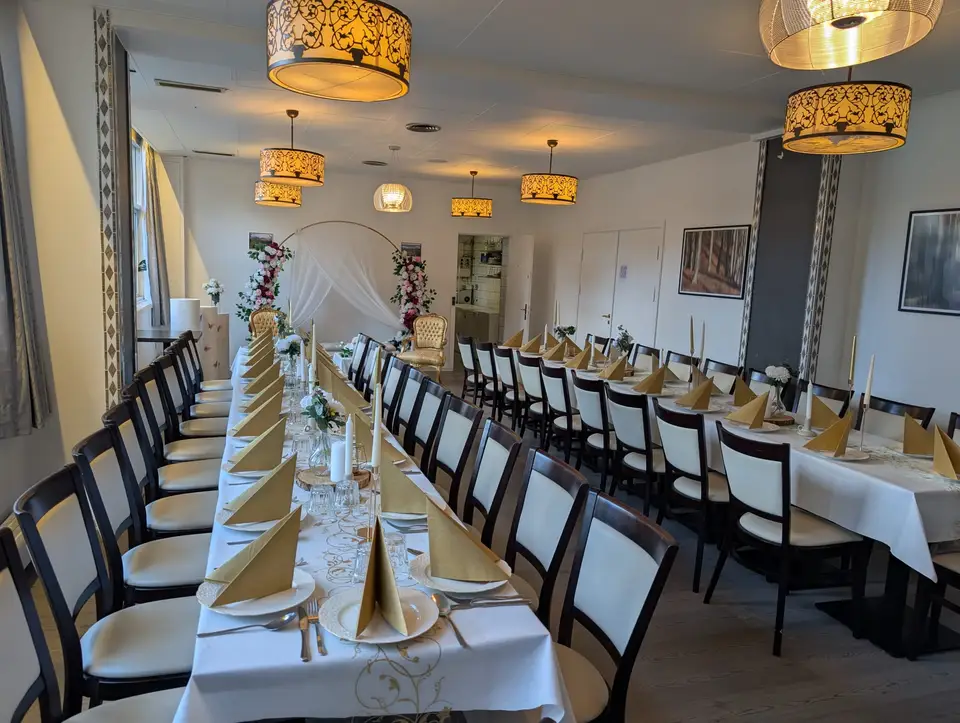
One thing is specific to a wedding at Højdevej 59. The whole day happens in a single room: the ceremony at one end in front of the draped backdrop, the tables laid and waiting behind it. There is no second venue and nowhere to slip away and change, so if you plan to swap heels for flats, keep them in the car. Parking is free and on site, which makes that a few steps rather than an expedition.
The envelope, and when to turn up
Money in an envelope is the usual gift, handed to the couple or left in the box by the entrance. The custom is for the sum to end in a one rather than a round figure, so the gift reads as a beginning rather than a closed account. Gifts are generally not opened in front of the room. If you would rather give an object, ask first.
On timing, arrive for the hour on the invitation and expect the ceremony to take longer than you would guess. Dinner tends to land later in the evening than a Danish guest is used to, so eat something in the afternoon rather than planning around a six o'clock meal. Here the cooking happens inside the building rather than at the end of a delivery route, so the food waits for the ceremony rather than the ceremony hurrying along for the food.
If this wedding is yours to plan
Guests ask about clothes. Couples ask about everything else, and we have written the rest of it down: what happens at an Indian wedding, in order, how many days it traditionally runs, and what the kitchen puts on the table at a Nepali wedding.
Our hall takes 30 to 120 guests on Amager, and it sits almost exactly halfway between Copenhagen Central Station and the airport, which matters when half the guest list is flying in. See how the room is set for an Indian wedding in Copenhagen, then book a visit and stand in it, or get in touch.