
What to write in a party invitation
17 November 2026 · 5 min
Count the questions that reach you in the week before a party. Most hosts get the same five. What time does it really start, can I bring my husband, where do I park, is there food, and when will it be over. Every one of those could have been answered on the invitation, and was not.
An invitation is not a decoration with a date printed on it. For most of your guests it is the only briefing they will ever get about your party. It has more work to do than the size of the card suggests.
What a guest should be able to do after reading it
Hold your draft up against four jobs. A guest should be able to:
- Say yes or no, to one named person, by a date.
- Reach the right address at the right time, by car or without one.
- Dress about right.
- Plan the rest of the day around it, including how they get home.
If the text does those four things, the tone can be as formal or as daft as you like. A printed card, a letter and a message in the family group chat all work. The wording carries the information. The paper carries the mood.
Give three times, not one
The commonest fault in a party invitation is a single time and nothing else. A bare start time tells a guest when to turn up and nothing at all about the shape of the evening.
Write three instead:
- When the doors open, which is when you actually want people in the room.
- When the food is served. Otherwise half your guests eat at home first and the other half arrive starving at what turns out to be a cake table.
- Roughly when it ends. "We finish around midnight" is plenty.
That third line is the one hosts leave out and guests need most. It decides whether a babysitter is booked until eleven or until one, whether friends travelling in need a bed for the night, and whether the people who did not drive can work out a way home. If guests are coming from further away, a line about places to stay nearby saves everyone a round of messages.
The practical lines most invitations leave out
Write the address in full, then add two sentences about getting to it. Hosts skip this because they know the way, and forget that half the guest list does not.
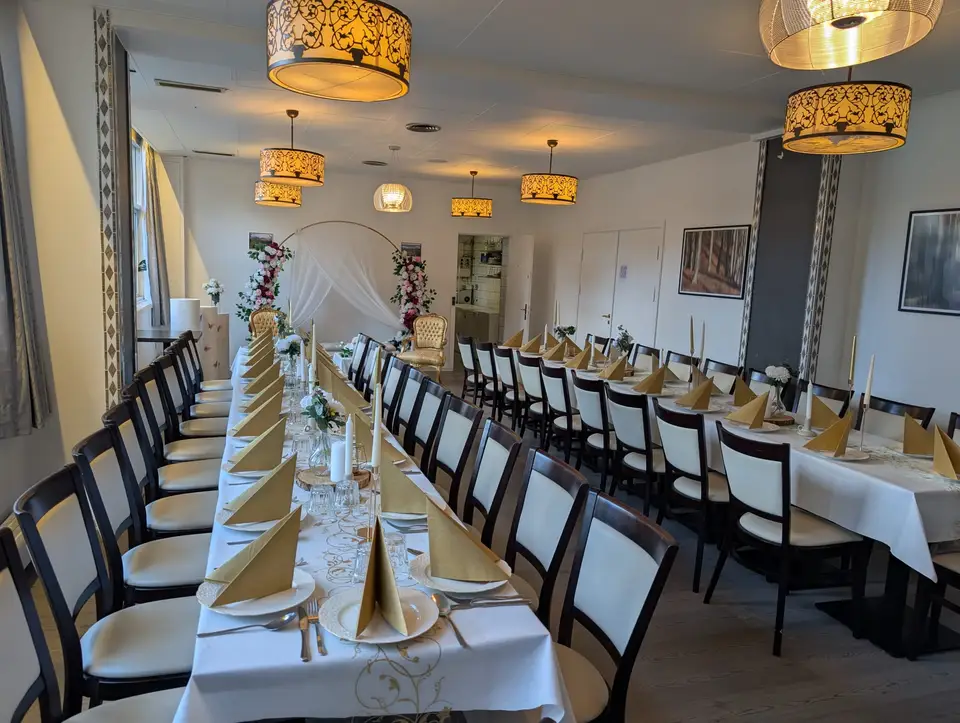
Here that reads well, because the facts are good ones. The hall is at Højdevej 59 in 2300 København S, on Amager. Parking on our own site costs nothing, which is a rare line to be able to put in a Copenhagen invitation, and guests who would rather leave the car at home have a bus stop about two minutes from the door and several metro stations on the M2 within an easy walk. The full route guide is worth a link in a digital invitation.
One more thing is worth saying plainly: we are one hall behind one door. Your invitation never has to explain a second floor, a side entrance or which room out of four. Guests walk in and they are there.
Ask one question, and make it easy to answer
Every invitation should carry a line about food, and the phrasing decides whether you get useful answers.
"Any allergies?" collects allergies. "Please tell us if there is anything you cannot eat" collects allergies, the vegetarians, the pregnant guest avoiding certain things and the uncle who has been told to lay off dairy. That is the list the kitchen actually needs. Our guide to allergies and special diets covers what to do with the answers once they come in.
Put the reply deadline next to it, with one name and one way to reply. Two contact routes mean two half lists. If you expect the usual silence from a third of the list, the post on replies and cancellations has the chasing schedule.
A text you can copy and change
Six lines is enough for almost any party:
> You are invited to [name]'s 50th birthday. > Saturday [date]. Doors from 17:30, dinner at 18:30, and we finish around midnight. > Maiya Party Hall, Højdevej 59, 2300 København S. > Free parking on site, and the bus and metro are close by. > Please reply to [name] on [phone] by [date], and say if there is anything you cannot eat. > Dress: whatever you would wear to a good dinner out.
Change the occasion, keep the order. It reads as a complete briefing and still fits on a card.
What to leave off
Plenty of things feel important to the host and mean nothing to the guest.
- The seating plan. That is your problem, and it will change twice.
- The menu in detail. "Nepali buffet" or "three courses" sets the expectation. The rest is a lovely surprise.
- What anything costs. A guest who reads a figure on an invitation starts wondering whether they are supposed to contribute.
- The long story of why you chose this date. Save it for the speech.
- Gift wishes buried in a paragraph. If you have a request, give it its own line, politely and briefly.
Cut those and the invitation gets shorter, clearer and easier to answer, which is the whole point.
If you are planning the party that goes with the invitation, come and book a visit to see the room on Højdevej first. It is easier to write "doors from 17:30" once you have stood where your guests will stand, and we can tell you what the evening usually looks like in the hall for a group your size.