
Buffet or plated dinner, and how to actually decide
16 August 2026 · 5 min
The question usually arrives as a worry: is a buffet good enough for something this important? Underneath it sits the idea that a served dinner is the serious choice and a buffet the shortcut.
That framing settles nothing, so drop it early. What separates the two is how people move through the room, who is on their feet while the food is served, and where your speeches fall. Get those three right and either one gives you a good evening.
What each one asks of the floor
A plated dinner needs aisles. Somebody carries plates to every seat, two or three times over a meal, so there has to be a clear run behind each row of chairs, wide enough for a person holding two plates and turning around. That is floor the tables cannot have.
A buffet wants the opposite shape. It needs one concentrated stretch of wall for the counter, and enough clear floor in front of it for a queue to stand without folding back into the seating.
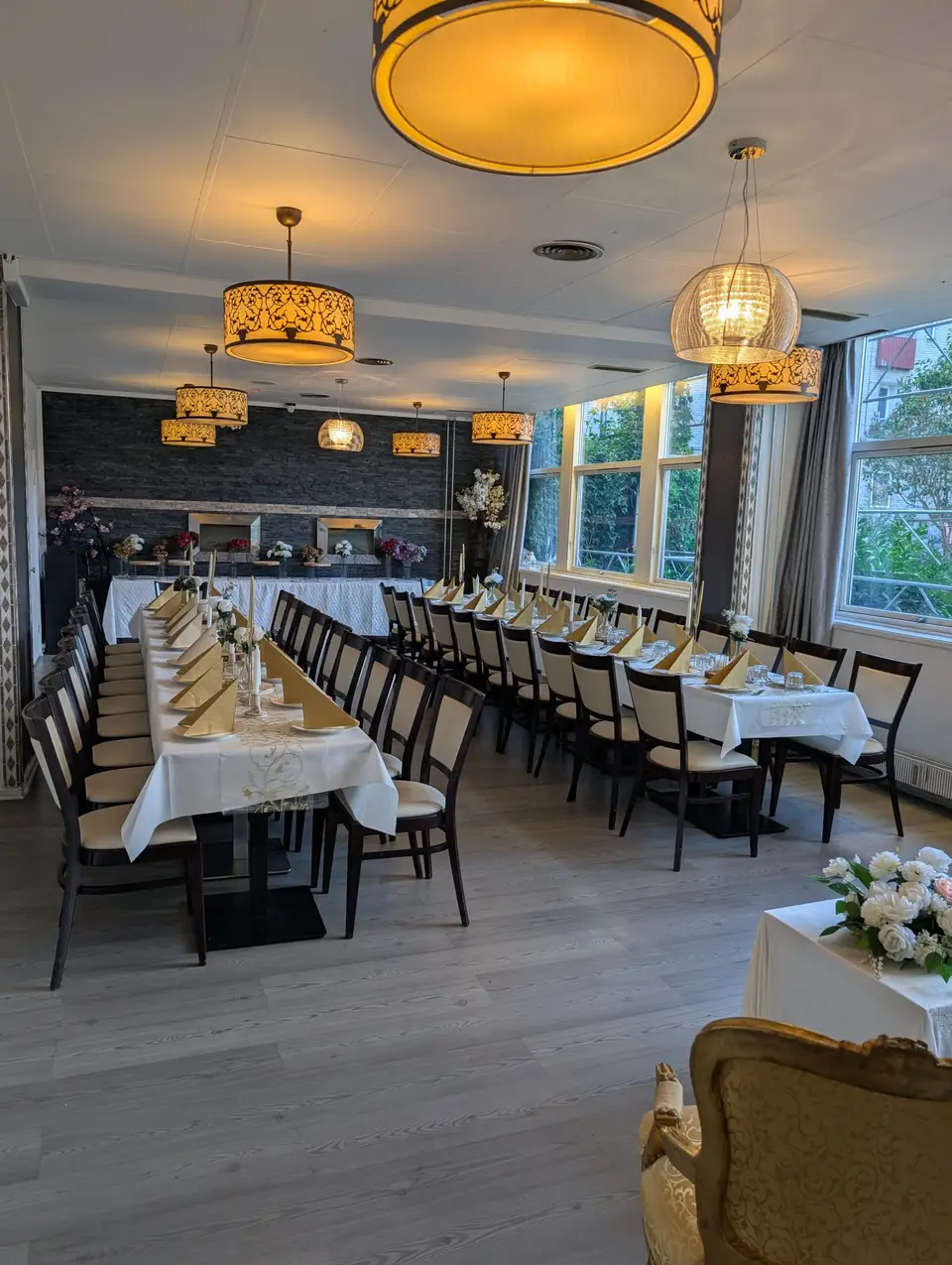
We have one room, and the counter stands along the dark stone wall at the end of it. The queue therefore forms down the length of the hall rather than across it, past the ends of the tables instead of between them. At eighty or ninety guests that is the difference between a quick service and a bottleneck. The numbers behind it sit in our post on floor space per guest.
Below roughly fifty the point is close to moot, since both layouts fit with room to spare. Nearer the top of our range, where the hall seats 30 to 120 guests, a buffet buys back the floor a seated service would have spent on aisles, and that floor is usually wanted later for dancing.
Who is on their feet during the meal
A plated service arrives in waves. Plates go out, plates come back, and for twenty minutes either side of every course there is staff moving through the room. It looks handsome. It also means guests are interrupted on the kitchen's schedule instead of their own.
A buffet redistributes that. Each guest walks once per course, takes what they want, sits down again, and the room sets its own pace. Nobody receives a portion they did not choose, which quietly solves the plate that comes back untouched.
Neither version is unstaffed. Our people lay up, keep the counter stocked, clear between courses and clean the room afterwards, and all of that already sits inside the hall fee alongside decoration, sound and projector. The prices page shows how the hall line and the menu line fit together.
Guests who should not be queueing are not asked to. Someone at the far table is asked what she would like and it is carried to her, which is worth saying out loud to the relative who is quietly worrying on her behalf.
Where the speeches fall
This is the test most families apply last and wish they had applied first.
A plated dinner hands you fixed gaps. The starter clears, somebody speaks, the main arrives. That is a genuine advantage when there are four speeches and a good reason to space them out, which is why a wedding dinner so often stays seated. The cost is coordination. Every speech that runs ten minutes long is a main course held ten minutes in the kitchen, and somebody has to be in touch with the kitchen all evening.
A buffet hands you one long block instead. Once the room has eaten, nothing further has to happen on a timetable, and the next hour and a half is yours outright. Speeches land where they land, and nobody walks past a speaker carrying anything.
If you take the buffet and there are speeches, keep one rule: let everybody get their first plate before anyone stands up. A room that has eaten listens. A room still watching the queue does not.
Why a Nepali menu leans towards the buffet
We should be straight rather than neutral here. Our kitchen is Maiya Nepali Kitchen, it is in this building, and the food it cooks was built to be eaten as a spread.
Dal bhat tarkari is the clearest case. Rice, a lentil soup and a vegetable curry all reach the plate at once, and a second helping is normal rather than a favour. Portioning that in the kitchen and walking it out to a seat works against the dish. So does the achar, the pickle set beside it, which is where most of the heat lives instead of being cooked through everything. On a counter, each guest sets their own level by how much they take. On a plate, somebody in the kitchen has guessed on their behalf.
The same holds for momo, the steamed dumplings, and for sekuwa, marinated meat cooked over charcoal, a dish of the eastern hills. Several good things at once, in whatever combination each person prefers.
Any menu can be made fully vegetarian. Set menus and custom menus are priced per person whichever way the food reaches the table, so service style is not what moves the figure. Children aged 5 to 12 pay half the menu price either way. The catering page covers what comes out of the kitchen.
One practical consequence of the kitchen sitting a corridor from the counter: the trays get topped up because the cooks can see them going down.
When a plated dinner is the better answer
Sometimes it genuinely is.
- A small formal dinner, thirty or forty at one long table, where the meal is the event and its pace is the point.
- A lunch with a hard finish, a confirmation with an afternoon after it, or a reception that must release people on time.
- A menu of few components, where there is nothing to combine and choosing is not part of the pleasure.
- An evening where the programme between the courses matters more than the food, and you want the room seated and still.
Outside those four, a buffet is usually the better use of this room, and of these menus.
Send us the number, the date and whether there are speeches, and we will tell you which way we would lay the room. Better still, come and stand in it. Book a visit and we will walk you through where the counter goes and where a queue would run. We are at Højdevej 59, 2300 København S, on +45 21 95 92 92.