
How long between the wedding ceremony and the dinner?
7 October 2026 · 5 min
The church gives you an hour. The kitchen needs to know when to start plating. Between those two fixed points sits a stretch of the day that nobody books, nobody prices and nobody puts on the invitation, and it is the stretch where a Copenhagen wedding either holds its shape or quietly loses it.
There is no correct number of minutes. There is a correct way to arrive at your own, and it starts at the opposite end of the day from where most couples begin.
Work the gap out backwards, from the photographs
The gap is not a decision. It is a sum, and you cannot choose it until you know what has to fit inside it.
Four things do. The slow unwinding outside the church, which always takes longer than anyone expects once rice has been thrown and every guest wants a word. The photo session. The journey to wherever dinner is. Then a margin, because something will run late and it is rarely the thing you planned for.
So ask the photographer before you ask anyone else: how long do you need, and where do you want to be? An hour in one place near the church is a completely different day from two hours spent moving between harbour, park and hall. That single answer sets most of your timing, and it is worth getting in writing early.
Add the drive to that. Add twenty minutes you have no intention of spending. What you are left with is your gap, and it is a far more honest number than one picked in advance because it sounded about right.
If the dinner itself is still unplanned, a timeline for a party with a three course menu covers what happens after the gap closes.
Three gaps that work, and who each one suits
About an hour. This suits couples photographed at or very near the venue, and couples married in the hall itself rather than in a church. Guests move almost straight from one part of the day to the next, which keeps the energy up and nobody waiting. The cost is that there is no slack anywhere in it, so a service that overruns by twenty minutes lands on the first course.
Two to three hours. This is the shape that fits a church service and a separate reception venue, and it is the one we see work most often. There is room for a real photo session, for the transfer, and for guests to reach the hall and be given a drink before anyone sits down. Build your margin in here and you will probably never need it.
Four hours or more. Usually the result of a morning service and an evening dinner. It can be lovely, but be honest about what it is: two events with a long interval, not one event with a pause. It only works if the interval has a plan of its own.
The guests are the part that gets forgotten
You will experience the gap as the busiest, most photographed hour of your life. Your guests will experience it as waiting, and the two feelings are nothing alike.
Picture the specific people. A grandmother in good shoes with nowhere to sit down. A family whose four year old has now been quiet for ninety minutes and has reached the end of it. Cousins who flew in last night and are standing on a pavement wondering whether there is time for a coffee. None of that is solved by telling them the dinner starts at six.
What solves it is giving the gap somewhere to happen. Open the room before you get there. Let the first guests arrive to a hall that is lit, laid and staffed, with something in their hand, so the waiting turns into the beginning of the party rather than a hole in the middle of it. How to plan a wedding reception in Copenhagen goes further into what that opening hour can hold.
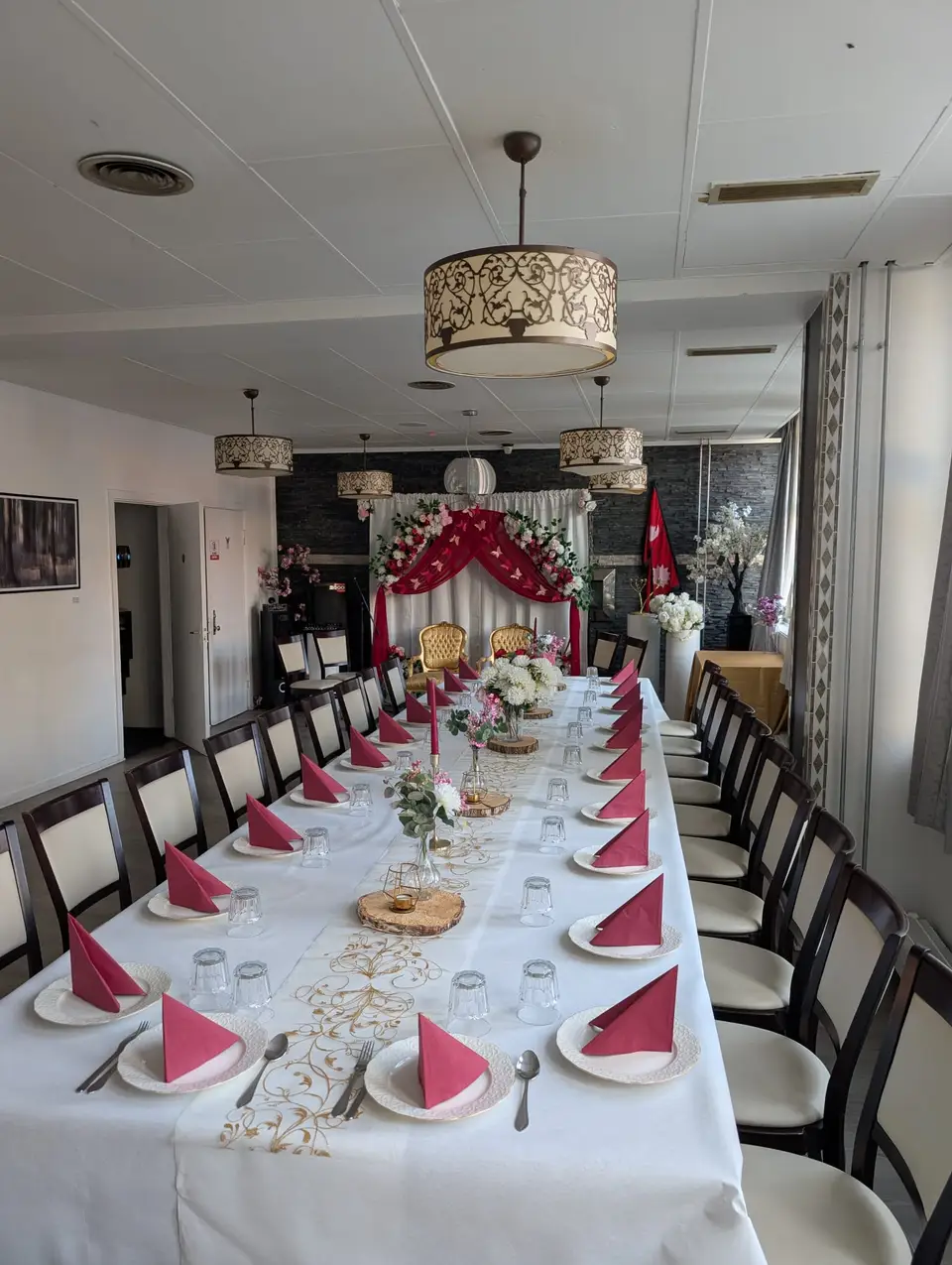
One thing worth knowing about this hall specifically: it is a single room for 30 to 120 guests. That means the welcome and the dinner share a floor, and there is no flipping a second room behind closed doors while nobody is looking. In practice it works in your favour, because the tables are already laid when the first car pulls up. We set the welcome at the door end and leave the laid tables alone, so your guests walk into the finished room instead of a half built one.
Parking helps here more than it sounds like it should. Parking on site is free, so a guest who drives over from the church parks once and is done with it. Nobody is counting minutes or slipping out during the speeches to deal with the car.
What the gap does to the kitchen
This is the part that catches couples out. A photographer running forty minutes behind is not a photography problem by the time it reaches dinner. It is a kitchen problem.
Ours sits a few steps away under the same roof, and the people who cook your meal are the people who carry it out to you. When you ring from the church steps to say you are leaving later than planned, that reaches the kitchen in one step and the service moves with you. A meal that has to be finished somewhere else and brought to the party has far less room to absorb your afternoon.
The gap should also steer what the menu does early. A long one means guests arrive genuinely hungry and something substantial should meet them. A short one means the opposite, and a heavy welcome blunts the first course you chose so carefully. Read our menus and what the hall fee includes next to your timings, not separately from them.
Pin your own timing down in the room
Timings stop being abstract the moment you stand in the room and say them out loud. Where the drinks go, how long the room takes to seat, what happens if it rains: ten minutes on the floor settles all of it.
Come and see the hall, tell us the hour your service ends, and we will walk the afternoon through with you from there. Book a visit whenever suits you, or read more about weddings at the hall first.