
A timeline for a party with a three course menu
31 August 2026 · 5 min
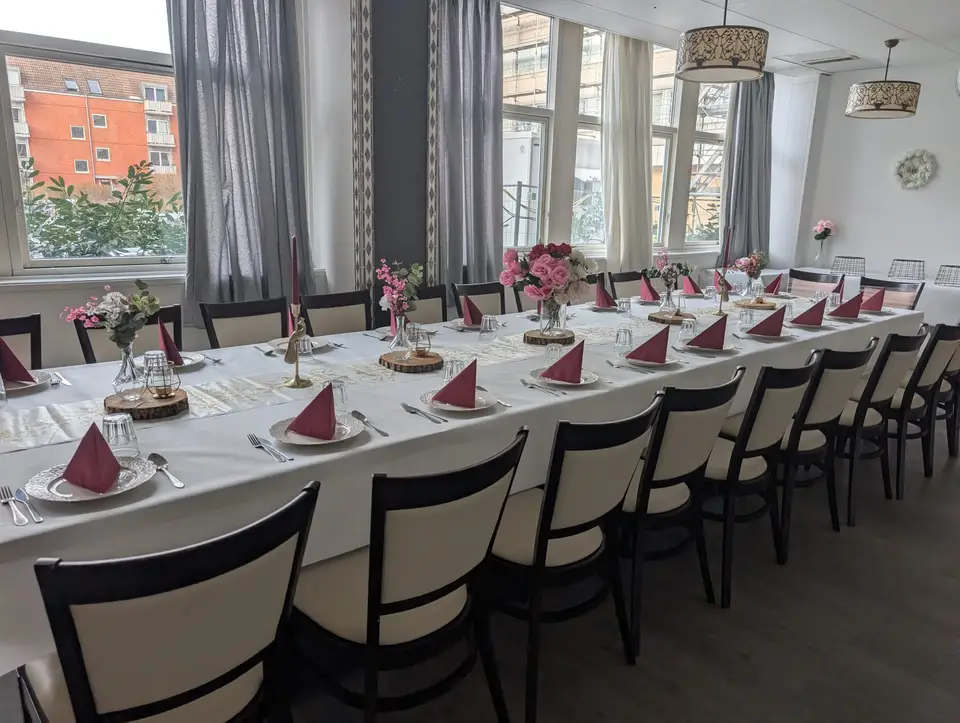
A three course menu is not three events. It is three events with two gaps between them, and the gaps are what your guests will remember. Nobody goes home talking about the starter. They go home saying it was a lovely evening, or that it dragged after the main course.
Most people planning a dinner for eighty or a hundred guests write down a start time, a rough finish, and nothing in between. The kitchen can only cook. It cannot decide when the speeches happen, when the tables get cleared, or how long a seated room is willing to hold still. That decision is the host's, and it takes ten minutes with a sheet of paper.
Here is the shape we would suggest for an evening at Højdevej 59, and what to move if your party is not the average one.
The running order, hour by hour
Written for an invitation that says 18:00. If yours says something else, move the whole column by the same amount rather than squeezing one part of it.
- 18:00 Doors. Arrival drinks, standing, no seating plan yet.
- 18:30 Call the room to table. Expect this to take a quarter of an hour.
- 18:45 Welcome from the host, three minutes at most, then the starter.
- 19:20 Starter cleared. First speech slot.
- 19:35 Main course.
- 20:30 Main cleared. Speech block, two speakers.
- 20:55 Dessert and coffee together.
- 21:30 Tables moved back, lights down, music up.
- 22:00 Cake, first dance, or whatever your evening turns into.
Nine lines. That is genuinely the whole plan, and only four of those times are fixed. Everything else is room to talk.
How long a course really takes when there are a hundred of you
The number that surprises people is not the cooking. It is the distance between the first plate leaving the kitchen and the last guest putting a fork down.
For a plated meal, food goes out in waves. With a hundred covers, the last table starts eating several minutes after the first, and courtesy means most people wait. Allow about half an hour for a starter from first plate to cleared, closer to an hour for a main, and around forty minutes for dessert with coffee, which nobody wants hurried. That is well over two hours at table before a single speech is counted.
A buffet reverses the arithmetic. Service is quick for the kitchen and slow for the room, because a hundred people past one serving line is a long queue and the last guest sits down as the first is finishing. Two lines running from both ends of the table roughly halves it, and calling tables up in turn beats letting the whole room stand at once. If you are weighing the two formats, buffet or plated goes through the rest of the trade.
The clearing is the other forgotten stretch. A hundred plates leaving a room takes minutes, and it is not quiet. Put something in that space on purpose, or the room will fill it with the sound of stacking.
The two timings that break a dinner
The gap between the invitation time and the first plate. Stretch this beyond an hour and you have a room drinking on an empty stomach, at its loudest before the food has arrived. Thirty minutes of arrival drinks and fifteen to get everyone seated is plenty. Guests who are still standing at 19:15 have stopped being excited and started being hungry.
The gap after the main course is cleared. This is where evenings die. The speeches are done, the plates are gone, the dancing has not started, and eighty people are sitting in chairs facing the wrong way with nothing in front of them. Dessert and coffee belong here, arriving within about twenty five minutes of the main going out, because they are what carries the room from dinner into the rest of the night.
Where the speeches go, and how many fit
Speeches sit in the gaps, never during a course. A speaker competing with cutlery loses.
Three natural slots come out of a three course meal: the welcome before the starter, one between starter and main, and a block of two between main and dessert. That is four speeches, which is the right ceiling for an evening that also wants a dance floor.
Count them honestly. A speech that runs five minutes at the kitchen table takes seven in a full room, once you add the glass being tapped, the standing up and the applause. Four speeches is therefore closer to half an hour than twenty minutes, and half an hour of sitting still after a main course is a lot to ask.
Give the list to one person who is not the guest of honour, close it the week before, and tell the kitchen. If the evening runs in more than one language, how to handle bilingual speeches covers what that adds to the clock.
What this hall in particular does to your timings
We have one room, seating 30 to 120 guests, and no second space to move to for coffee. That sounds like a limitation and is mostly the opposite: nobody gets lost between rooms and no guest sits out half the party in a corridor. It does mean the change of gear at 21:30 has to be made inside the same four walls, with the tables pushed back, the lights lowered and the music raised. Allow ten minutes for that, and let the staff do it while people are on their feet with coffee. Clearing and staffing are part of the hall fee rather than an extra, along with decoration, sound and projector, so the reset is already bought and paid for. The pricing page sets out what else that fee covers.
Maiya Nepali Kitchen is inside this building, which is what makes the running order above bend rather than break. A course can be held back five minutes because a speech overran, instead of arriving in the middle of it. If your menu ends in dal bhat tarkari, plan the main as a stretch rather than a moment: the plate lands complete and the refills keep coming, and rushing it would miss the point of the dish.
Bring your draft running order. See the hall, book a visit to Højdevej 59 in 2300 København S, and we will walk it through against the kitchen's own timings before you print it.