
What is momo? The Himalayan dumpling, explained
7 August 2026 · 5 min
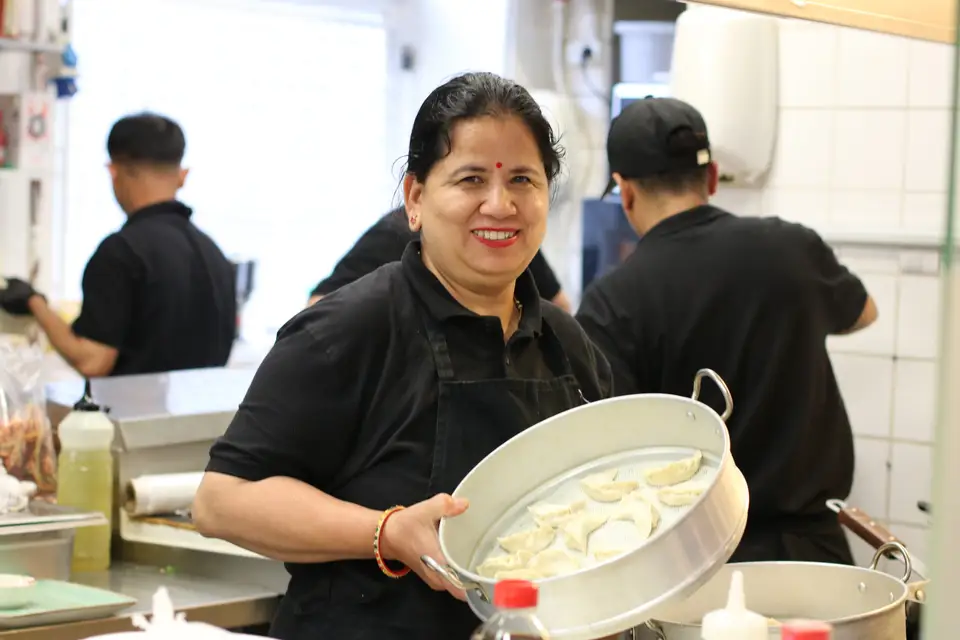
A momo is a dumpling. Thin wheat dough closed by hand around a seasoned filling, steamed in a perforated tray, and eaten with a sharp sauce called achar. That is the whole answer in two sentences.
The rest of this is for the version of the question people usually mean, which is the one asked with a plate already on the table.
Where momo come from
The origin is genuinely contested, and it is worth saying so, because a lot gets asserted about it. What most accounts have in common is the route. The dumpling belongs to Tibetan and wider Himalayan cooking, and it reached the Kathmandu Valley along the trade road that ran between Kathmandu and Lhasa.
The Newars, the valley's indigenous people, kept trading families living in Lhasa for centuries. They brought the dish home and changed it on the way, using buffalo and their own spice cupboard. The name momocha is Newari.
From there it turned into ordinary food. Momo is what you buy on the street in Kathmandu, what a household makes when visitors arrive, and the first thing Nepalis abroad say they miss. No single country invented it on its own, but Kathmandu made it its own.
The wrapper and what goes inside it
The dough is flour and water, rolled thin enough that you can see the filling as a shadow through it. It is closed by hand, either as a crescent with pleats down one edge or as a small purse twisted shut at the top. This is handwork, and it takes as long as it takes.
The filling is minced meat or vegetables mixed with onion, spring onion, ginger, garlic, fresh coriander and cumin. Buffalo is the classic in Kathmandu. In Europe the two you meet most are chicken and vegetable, with goat also around.
What matters is that the spicing sits in the filling rather than in the sauce. The mixture is seasoned raw and finished before the dough closes over it, and the juice stays inside while it steams. A momo has to taste of something before it ever meets achar. The sauce is an addition, not a rescue.
Achar, and why it carries the heat
Achar is the dipping sauce, and it is the part most people remember afterwards. The version made for momo is built on tomato and sesame. The tomatoes are charred until the skin blackens, the sesame seeds are toasted dry in a pan, and both are ground with garlic, ginger, chilli and timur, a Nepali pepper with a citrus note.
What comes out is sour, nutty and usually hot. That is exactly the point. The heat sits in the achar rather than in the dumpling, so a momo on its own is mild enough for a six-year-old and for an eighty-six-year-old. Put the achar beside the plate instead of over it and the two eat the same dinner without eating the same thing.
There is more on that in our piece on heat in Nepali food, which is the question we field most often.
Five styles worth knowing by name
Momo is a family rather than a single dish. Five names cover most of what you will run into:
- Steamed momo. The base form, and the one everything else is measured against. Cooked in a perforated tray and served hot with achar alongside.
- Kothey momo. Steamed first, then fried on one face so the bottom crisps while the rest stays soft. Two textures in the same mouthful.
- C-momo. Short for chilli momo. Fried momo tossed through a hot tomato and chilli sauce, so they arrive already coated. This is the hot one.
- Jhol momo. Jhol means soup. Steamed momo sitting in a thin warm sauce of tomato and sesame, eaten with a spoon. Nothing is boiled in it.
- Sadheko momo. Sadheko means tossed or mixed. The momo are cooled and turned through onion, tomato, coriander, chilli and mustard oil, closer to a salad.
How to eat them, and what counts as a portion
With your fingers. Fork users exist, and they are missing something. Pick one up, bite a small hole in the side and draw the juice out before you dip. Otherwise it lands in your lap, which it will do the first time anyway.
As a starter, four to six each is enough. As a main course, count on eight to ten, and more if no rice is following.
If you are meeting momo for the first time, the nearest reference points you already have are gyoza and dim sum. The shape and the principle are shared, since the dumpling exists across Asia. The difference is the seasoning inside and the achar outside, which is sharper and far more sesame heavy than anything a dim sum trolley brings. That is one comparison, and then the dish is better left to be itself.
Momo at a party rather than a plate for two
Something changes between two people and sixty. Each momo is closed by hand, one at a time, so a party is a calculation in hours and pairs of hands rather than in pots. A kitchen needs to know that well in advance, not on the day.
In return they behave well in a crowd. They are eaten with the fingers, which means they work standing up while guests are still greeting each other, and that is precisely what a reception needs. They sit equally happily on a buffet as one hot dish among several. Any menu can be made fully vegetarian, and a vegetable momo is not a substitute version, it is a momo in its own right.
Heat is a decision the kitchen takes rather than a fixed property of the dish. Ask for the achar on the side and every guest settles it privately.
Our kitchen on Højdevej is in the same building as the hall, and the folding happens that morning. What ends up on your menu is agreed party by party, so ask us. The catering page shows how we work, and a viewing costs nothing and is answered within a day, any day of the week.