
The difference between Diwali and Tihar
21 September 2026 · 5 min
On one of the five days of Tihar, dogs are given a marigold garland, a red tika on the forehead and something good to eat. Not as a joke, and not only the family pets.
Nothing in Diwali, as it is kept across most of India, looks quite like that. The names get used interchangeably, which is harmless in conversation and unhelpful the moment you are planning an evening around one of them.
Are Diwali and Tihar the same festival?
Near enough to share a season, not near enough to share a programme.
Both fall in the same lunar window in the autumn, both run about five days, and both are built on light: rows of small oil lamps along walls, windowsills and doorsteps, so that Laxmi, the goddess of wealth and fortune, finds a lit house to walk into. Both close with a day about brothers and sisters.
Tihar is the Nepali observance. The days carry different names, two of them belong to animals, the fourth changes according to which community you come from, and the music is its own. So the short answer is that Tihar is not Diwali translated. It is its own five days, falling in the same week and running on the same idea.
The five days, and who each one is for
- Kaag Tihar. Food is put out for the crow, the messenger, on a roof or a doorstep.
- Kukur Tihar. The dogs get the garland, the tika and the feeding. Family dogs, working dogs and street dogs alike.
- Gai Tihar and Laxmi Puja. The cow in the morning. Then, after dark, the swept house, lamps along every wall and window, and Laxmi invited in. This is the night that looks most like the Diwali in the photographs.
- The fourth day, which depends on the family. Many keep Govardhan Puja. Newar families keep Mha Puja, which honours the self and opens the new year in the Nepal Sambat calendar. Two households can spend that day completely differently and both be right.
- Bhai Tika. Sisters give their brothers a tika of several colours, a garland, and in many families an oil ring poured on the floor around where he sits. This is the day people travel for.
Through the evenings run the Deusi and Bhailo groups, going from house to house to sing for the household and be sent off with food and money. Children go first and the adults follow later.
What changes if you have only ever kept Diwali
Three things, mostly.
The animals. A crow and a dog hold two of the five days, and the affection in them is real rather than decorative.
The noise. Diwali across much of India is loud, and fireworks carry a good deal of the evening. Tihar leans on lamps, candles and singing instead, which in a Copenhagen November is the easier tradition to keep whole.
The table. Sel roti belongs to this fortnight, and it is the thing on it that is unmistakably Nepali rather than Indian. Sweetened rice batter, poured by hand in a circle into hot oil, eaten warm. We have written separately about what sel roti is.
One more thing if you are pencilling in a date. Tihar follows Dashain by roughly a fortnight, so for most families the two are a single autumn stretch rather than two entries in a diary. Both run on the lunar Bikram Sambat calendar and move every year, so ask your family or your priest which days are yours before you book anything.
Lighting a room when light is the point of the evening
Laxmi Puja happens after dark, and a Copenhagen November is dark early, so a Tihar gathering here is an evening party whether you planned one or not.
Open flame is the first thing to settle. If you want real diyo burning indoors rather than the electric sort, ask the venue outright and get the answer in writing. Ask us, and ask anywhere else on your list.
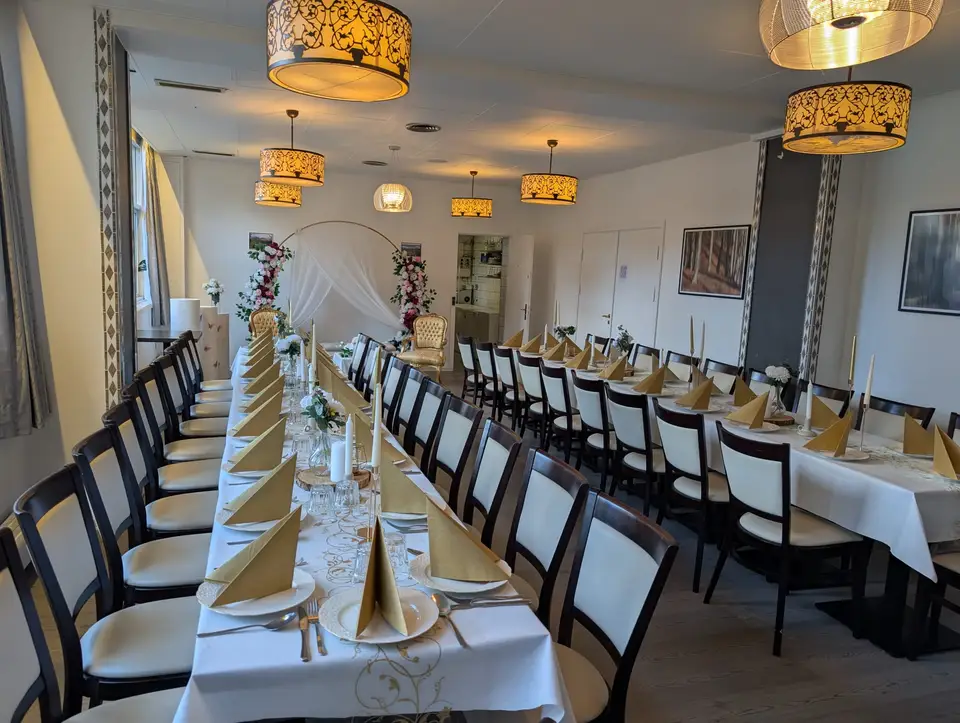
Our hall on Højdevej 59 has patterned pendant lamps down the ceiling that throw a warm yellow light rather than a white one, heavy curtains along the window wall, and dark stone behind the buffet counter. That stone is the useful part: strings of lights, marigold and anything gold read strongly against it, where a pale wall washes them out. The sound system and the projector sit inside the hall fee, so a practised Bhailo song has something to carry it and relatives still in Nepal can be up on the wall.
Timing and food for a Tihar party on Amager
Decide first which of the five days your gathering is really about, because they do not want the same start time. A Laxmi Puja evening begins when it is dark. A Bhai Tika gathering is a daytime affair that can run long into the afternoon. Most families here keep the ritual at home on the true day and hold the party on the nearest Saturday. That is the honest reason to ask early: there is only one hall.
It is one room for 30 to 120 guests, so the puja corner and the dinner tables share a floor and no elder is parked in a side room while their turn goes past.
On the food, three points usually settle it. The kitchen is in this building, so sel roti can go into the oil while your guests are eating and reach them warm rather than an hour old. Achar is best asked for in two bowls, one mild and one not, since most of the heat in this cooking sits beside the plate rather than in the pot. And any menu can be made fully vegetarian, with children aged 5 to 12 at half the menu price. The catering page shows how a menu is put together, and prices and inclusions covers what the hall fee already carries.
Parking on our own ground is free, which is what lets an evening run long without anybody going out to move a car.
Book a visit and stand in the hall before you decide where the lamps go, or call us on +45 21 95 92 92 and tell us which of the five days you are planning around.