
What is Dashain, and how do families keep it in Copenhagen?
10 September 2026 · 5 min
Barley shoots grown in the dark in a bowl of sand, and a fortnight later a smear of red rice pressed onto your forehead by the oldest person in the room. That is Dashain, and for most Nepali families it is the fixed point the rest of the year is measured against.
It is also the festival that is hardest to keep abroad, because it is built around going home. Fifteen days does not survive contact with a Danish autumn, and the relatives who would have filled the house are scattered. What survives is one long day in a room big enough to hold everybody at once.
What Dashain actually is
Dashain is the longest and most important festival in the Nepali year, a Hindu celebration of the goddess Durga and her victory over the demon Mahishasura. Good over evil, and the whole family sitting down together.
It opens with Ghatasthapana. A vessel of water is set up and barley seed is sown in sand in a darkened room, then watered each day, so the shoots come up pale yellow because they have never met daylight. Those shoots are jamara, and they matter later.
The tenth day, Vijaya Dashami, is the day everything else is arranged around. The elders sit down, everyone younger comes to them in turn, and each person receives tika on the forehead, a paste of rice, yoghurt and red vermilion, with a few strands of jamara tucked behind the ear and a blessing spoken out loud. Children are usually given dakshina at the same time, a small gift from the elder's hand. Then you move on to the next elder and the next home, and the days after Dashami go on like that until the full moon closes the festival at Kojagrat Purnima.
Kites, bamboo swings, new clothes and a great deal of cooking sit around all of it. Tihar, the festival of lights, follows a couple of weeks after Dashain ends.
Why the date is never the same twice
Dashain follows the lunar Bikram Sambat calendar, not the one on the wall at work, so it lands on different days every year. It falls in the autumn, and beyond that nobody can tell you the date from memory. The days are settled fairly close to the time, so ask your family or your priest which day is yours before you commit to anything carrying a deposit.
Then there is the Danish half of the problem. The tika day only lands on a Saturday when the calendar happens to be kind, and schools and workplaces here do not move for it. So most families in Copenhagen keep the ritual itself at home in the morning, on the day, and hold the gathering on the nearest Saturday or Sunday.
That puts you on an autumn weekend, in the same weeks Danish families are booking birthdays and companies have started asking about the julefrokost. Ask early rather than late. The hall takes 30 to 120 guests and there is only one of it, so the weekend either side of your tika day is worth holding as soon as the date firms up.
Setting a room up for tika, not for dinner
A Dashain gathering is not a dinner with a ceremony attached to the front of it. The tika is the event and the meal comes after, so the room has to be laid out in that order.
- Two seats for the elders at one end, with clear floor in front of them. This is where every photograph of the day gets taken.
- A small table beside them for the tika plate, the jamara, a mirror and the dakshina.
- The queue sorted by age, oldest to youngest, which people arrange among themselves once the first few have gone up.
- Nothing served until the tika is done. With sixty relatives it takes far longer than anyone plans for, and food already on the tables just goes cold.
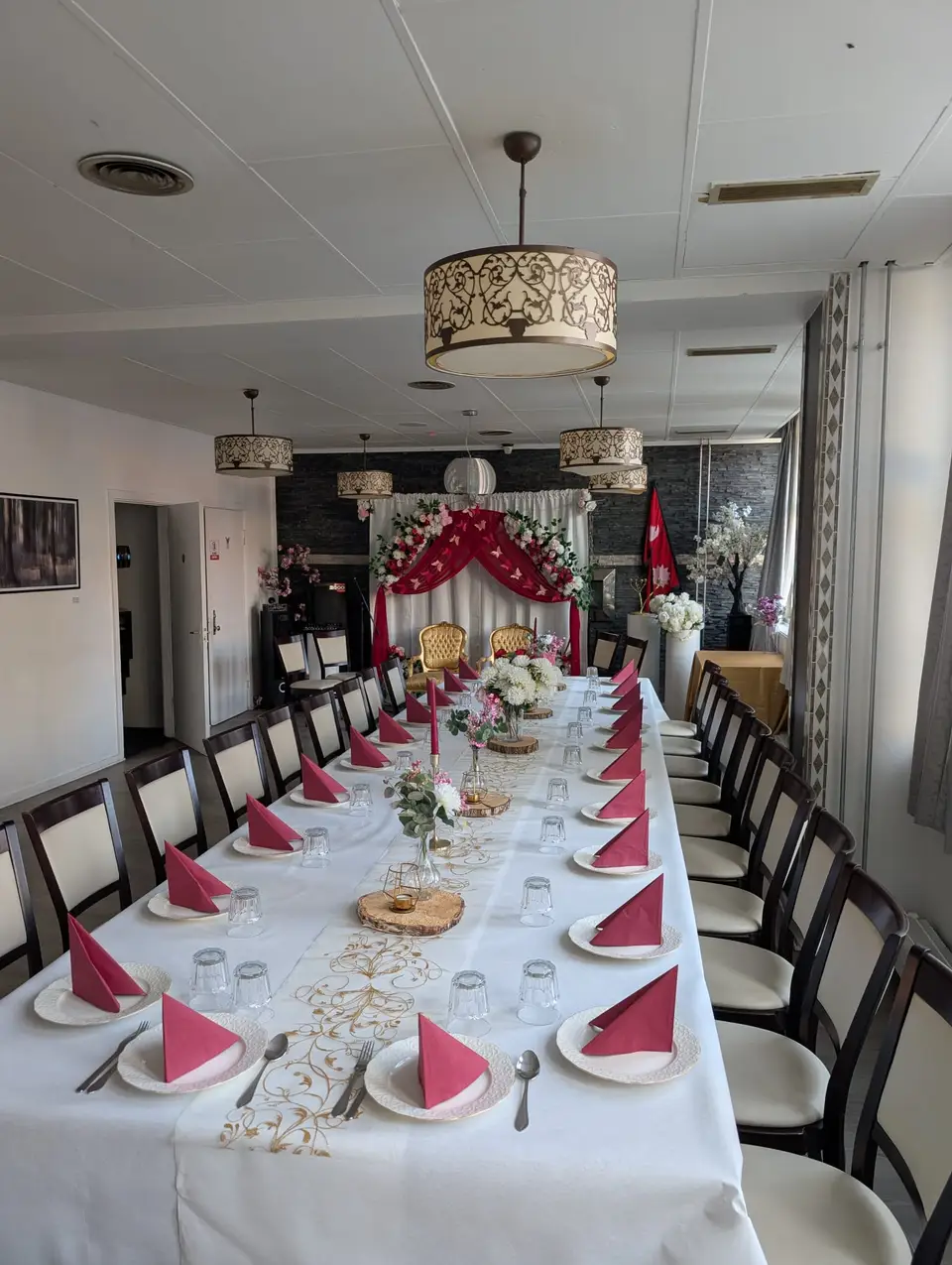
Having one room helps more than it sounds. Our hall is a single space, so the tika corner and the dinner tables share it: the grandparents are not parked away on their own while plates are carried past, and nobody misses their turn because they drifted off down a corridor. The sound system and the projector are inside the hall fee, which is worth knowing if you want pictures of the family still in Nepal up on the wall while the tika runs.
The food, and the one thing worth asking for
Sel roti belongs to this fortnight. It is a ring of sweetened rice batter, soaked, ground and piped by hand into hot oil, made for Dashain and Tihar and eaten warm. Whatever the shape suggests, it is not a doughnut. Because our kitchen is in this building, it can go into the oil while your guests are still eating and reach the table warm, which is most of the point.
Around it goes what a family gathering actually wants. Dal bhat tarkari, the lentils, rice and vegetable curry eaten together off one plate, with refills as the norm. Momo. Sekuwa, marinated meat grilled over charcoal, from the eastern hills. Choila for the Newar side of the family, meat charred over a flame and then dressed sharply with mustard oil and timur. We have written separately about dal bhat and about momo.
The one thing worth asking for is strength. Most of the heat in this cooking lives in the achar at the edge of the plate rather than in the pot, so ask for it in two bowls, one mild and one not. That is what lets a grandmother and a nine year old Danish cousin eat from the same buffet.
Any menu can be made fully vegetarian, which matters if part of the family is keeping a vegetarian fortnight, and the menu price is halved for children aged 5 to 12. What the menus are made of is on the catering page, and what they cost per person is on the price page.
Parking on the site is free, which is the quiet reason a gathering can start at midday and still be going in the evening without anybody having to go out to the car.
Come and stand in the room before you decide where the elders will sit. Book a visit to Højdevej 59 in 2300 København S, or call us on +45 21 95 92 92 and tell us which autumn weekend you are looking at.