
What is the difference between Nepali and Indian food?
17 August 2026 · 5 min
Read a Nepali menu with Danish eyes and a good deal of it looks familiar. Lentils, rice, marinated meat off the grill, a pickle on the side, a dumpling somewhere in the middle. The next thought is a fair one: is this Indian food under a different name?
No, and also not unrelated. Nepal and India share a long border, a pantry and centuries of traffic both ways, so a Nepali menu that looked nothing like an Indian one would be the surprise. The useful answer therefore starts with the overlap.
What the two kitchens genuinely share
Start with the shopping list. Rice, lentils, wheat flour, potatoes, onion, ginger, garlic, green chilli, turmeric, cumin, coriander seed, mustard oil. A cook in Kathmandu and a cook in Delhi reach into much the same cupboard.
The shape of the meal is shared too. Neither kitchen builds dinner around a single centrepiece with side dishes around it. Both put several things on the table at once and let the eater combine them: something wet, something dry, rice or bread underneath, and a sharp thing alongside to cut through the rest.
Dal is dal in both. So is the habit of finishing a pot by pouring hot fat and bloomed spice over it at the last moment. If a dish on our menu reminds you of one you liked at an Indian restaurant, you are not imagining it.
They part company in three specific places, and none of them makes one kitchen better than the other.
The gravy is the clearest difference
The Indian food most Danes know is a North Indian restaurant menu, and its best known dishes are built on richness. Cream, butter, yoghurt or ground nuts give a korma or a butter chicken its body, and a little sugar often rounds it off. That is not a fault. It is the point of those dishes, and done well they are very good.
Nepali cooking generally goes the other way. Savoury dishes are built without cream and without sugar. The body of a sauce comes from onion, tomato, ginger, garlic and the spices themselves, cooked down until they hold together on their own.
The vegetables are chopped rather than pureed, too. A tarkari arrives as pieces you can still identify, cauliflower and potato and beans with their edges intact, instead of a smooth base poured over the top.
Two things follow from that at a party. A plate of this food sits more lightly at ten in the evening than a plate built on cream, which matters when there is dancing afterwards. And a guest who avoids dairy has far more of the table open to them, though that is worth confirming dish by dish, which we do for every booking anyway. Our piece on allergies and special diets covers how that conversation goes.
Timur, jimbu and gundruk
Three ingredients do more than any others to make Nepali food taste like itself.
- Jimbu is a dried Himalayan allium, a relative of the onion and the chive. Dry in the hand it is almost nothing. Bloomed in hot fat for a few seconds it becomes the smell of a whole pot of lentils, and much Nepali dal is finished exactly that way.
- Timur is the Nepali relative of Sichuan pepper. It is citrusy and sharp rather than hot, closer to lime than to chilli. It is the flavour that makes choila recognisable, the Newar dish of meat charred over a flame and then dressed with mustard oil, timur, chilli and plenty of garlic.
- Gundruk is leafy greens fermented until sour. There is a shortcut for Danish readers: think of the sourness of sauerkraut, but with no salt at all, so it lands drier and sharper. The sour note in a Nepali soup comes from fermentation rather than from vinegar or tamarind.
None of the three is a garnish. Take them out and the food loses the thing that identifies it.
Where the heat sits, which is not the same as how hot it is
This one is structural rather than a contest about who is hotter.
In Nepali cooking the chilli generally lives in the achar, the pickle served alongside, instead of being cooked through every pot. The dishes are seasoned the whole way through. The burn is a separate item on the plate.
Around a table of eight that is a pleasant detail. At a buffet for ninety it answers the question every host asks us: what to do when one guest wants it properly hot and another cannot manage any at all. They take from the same trays and set their own level with a spoon. The long version is in our piece on whether Nepali food is spicy.
What all of this changes when you are feeding a hall
Our kitchen, Maiya Nepali Kitchen, is in this building on Højdevej, a corridor away from the hall. The food has nowhere to travel before it is served, and trays get refilled because the cooks can see them going down.
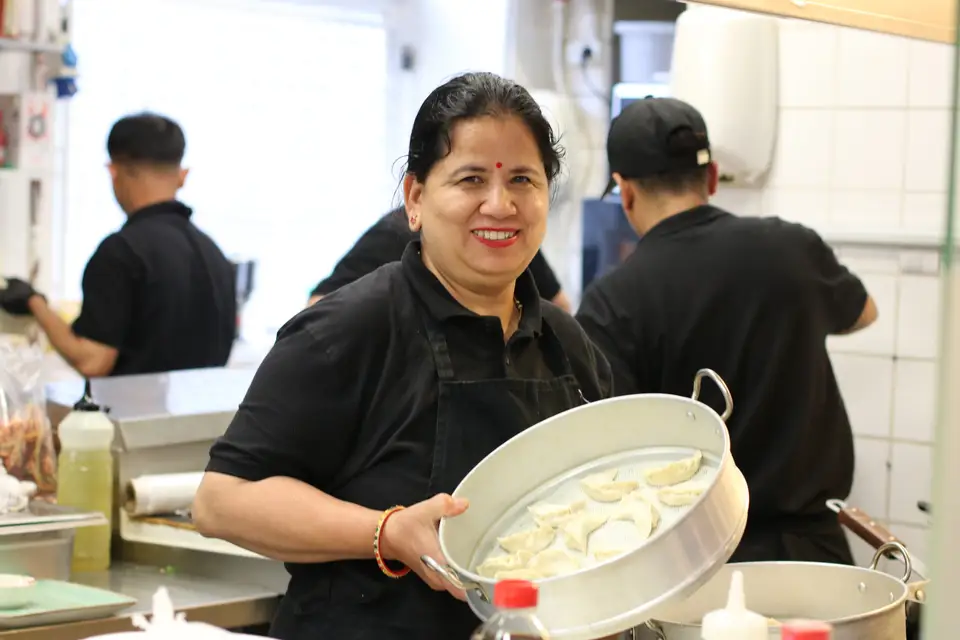
That matters more for this food than for most. Dal bhat tarkari is meant to reach the plate together, lentil soup and rice and vegetable curry at once, with a second helping treated as normal rather than as a favour. Momo are folded by hand in that kitchen and steamed in batches through the evening. Sekuwa comes off charcoal and wants to reach the room while it is still hot, a dish of the Rai and Limbu communities in the eastern hills.
The hall takes 30 to 120 guests, small enough for one kitchen to cook every plate properly and large enough for most family parties. Any menu can be made fully vegetarian, and the vegetarian version is a menu in its own right rather than a subtraction. The prices page and the catering page are both worth reading before you settle anything. Children aged 5 to 12 pay half the menu price.
Nepali food is not hard to find in Copenhagen. What is uncommon is a Nepali kitchen attached to a bookable hall, with the same team cooking the food and carrying it out.
The honest way to settle any of this is to taste it. Book a visit and we will go through a menu with your guest list in front of us, including which dishes to steer your more cautious relatives towards first. Højdevej 59, 2300 København S, and the phone is +45 21 95 92 92.