
What is a Thakali khana set?
3 November 2026 · 5 min
Order a khana set in a Nepali kitchen and nobody asks which curry you want. The rice lands in the middle of the tray, everything else lands around it in its own small steel bowl, and the arrangement is the answer to the question you were about to be asked.
Danish readers usually meet the phrase on a menu, printed near dal bhat, and reasonably assume the two mean the same thing. They very nearly do. What khana set adds is the Thakali way of laying the meal out, and that turns out to matter as much at a table for two as it does in a hall of a hundred people on Højdevej.
What actually lands on the table
Khana means food. The set is exactly what the word promises: a complete meal that arrives at once rather than in courses, assembled on one tray.
In the middle sits bhat, the rice. Around it, in separate bowls:
- Dal, the lentil soup. It comes in its own bowl so you pour it over the rice yourself, a little at a time, instead of finding it already stirred through.
- Tarkari, the vegetable curry, usually built around whatever is good that week.
- A meat dish, or a second vegetable dish doing the same work, for the main interest of the plate.
- Gundruk, leafy greens fermented in their own juices with no salt at all. This is where the sourness on the plate comes from, and it is the flavour most Danish guests cannot place and then go back for.
- Achar, the pickle. This is where the chilli lives.
- Usually a green saag, and something crisp and fried for texture.
The separation is the whole design, not a presentation flourish. Nothing has been combined on your behalf. You take rice, pour a little dal, lift a bit of tarkari across, touch the achar, and build a slightly different mouthful every time. The plate is a set of ingredients for a meal you compose as you go.
Refills are ordinary. More rice and more dal come round as a matter of course rather than as something you pay extra for or feel awkward asking about. We went through that habit properly in what is dal bhat, because Danish guests often read it as generosity when it is simply how the meal works.
Who the Thakali are, and why their plate set the standard
The Thakali are a community from Thak Khola, the valley of the Kali Gandaki in Mustang, in northern Nepal. Their kitchens, the khana ghar, built a reputation on feeding travellers along that route a complete plate with a dependable shape, cooked to a standard, served the same way every time.
That reputation travelled further than the people did. When a Nepali restaurant anywhere in the world writes khana set on a menu, it is borrowing a Thakali format, and saying so is simply accurate. A dish with a named origin is more interesting than one presented as generically Nepali.
How it differs from dal bhat
Dal bhat and khana set describe one meal from two directions. Dal bhat names the components. Khana set names the service: the tray, the bowls, the fact that it comes complete.
The Thakali version also has its own accent. The seasoning leans on timur, the citrusy, sharp Nepali relative of Sichuan pepper, and on jimbu, a dried Himalayan allium that tastes of nothing until it hits hot fat and then flavours an entire pot of dal. Both of them are explained in what are timur and jimbu. The sour register from gundruk is stronger than most people expect. And the cooking avoids cream and sugar in savoury dishes and chops its vegetables rather than pureeing them, so the plate reads as sharper and lighter than the Indian restaurant food many Danish guests are comparing it to in their heads.
On heat: the chilli sits in the achar beside the rice, not stirred through every pot. That is why a khana set suits a table that disagrees about spice: each guest sets their own level with a spoon.
What happens when a hundred people want the same plate
A khana set is portioned for one person. A party in our hall is served from a counter. The translation between the two is the interesting part, and it is mostly about keeping the separation intact.
Every element keeps its own tray, laid out in the order the bowls would have sat in: plates, then rice, then the dal in a pot with a ladle beside it, then tarkari and the meat dish, then gundruk and saag, and the achar last with a card saying what it is. A guest who has never seen a khana set in their life builds a correct one simply by walking the counter from one end to the other. Nobody has to be briefed.
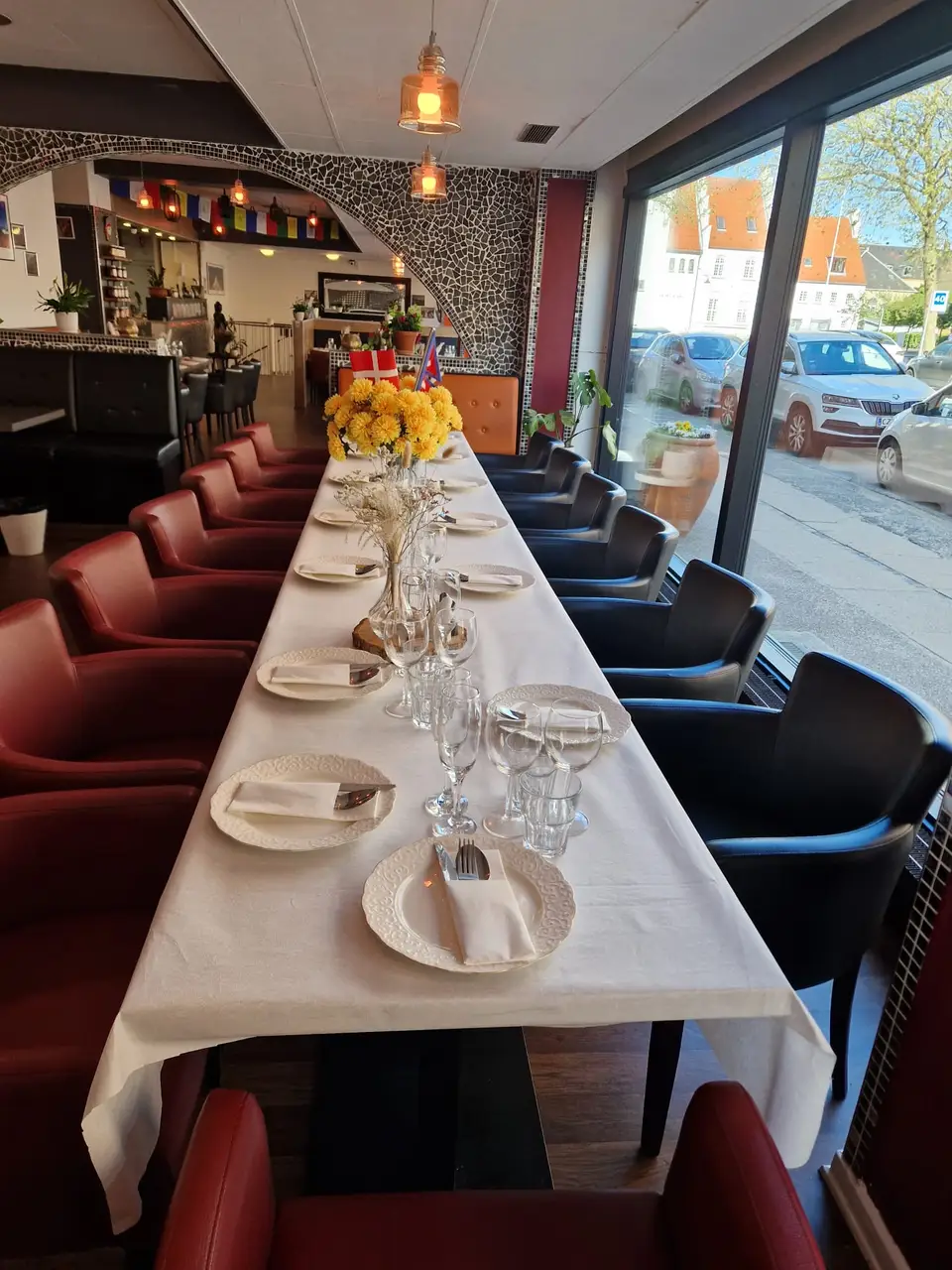
What a hall adds is the kitchen. Maiya Nepali Kitchen works out of the same building at Højdevej 59, a few steps behind the counter, so a tray that empties halfway through the speeches goes back and returns full while people are still eating. The refill habit that defines this meal survives contact with a party of a hundred only because the pots are thirty seconds away. The staff carrying the trays are the people who cooked what is on them, so a guest who stops to ask what gundruk is gets a straight answer rather than a shrug.
Taking the meat off changes nothing structural. The rice, the dal, the tarkari, the greens and the achar were always the body of the plate, which is why a fully vegetarian version of this menu is a complete khana set and not a reduced one. Any of our set menus can be built that way from the start.
Build your own at Højdevej
One hall, 30 to 120 guests, one kitchen behind it, and free parking outside, which on this side of Amager is worth more than it sounds. Before anyone picks a set menu by name, it helps us far more to know who is coming: how many have eaten this food before, how sharp they want the achar, which allergies are in the room.
The catering page sets out what this kitchen cooks, and the prices page shows what sits inside each set menu. Better still, taste it where it will be served: ask for a viewing and bring your questions about the plate.