
Who should be invited to a confirmation?
23 August 2026 · 5 min
A Danish confirmation list has an obvious place to begin, and it is not the address book. It is the photograph from the barnedåb, the one with the faddere standing behind the font. Those people said yes to something fourteen years ago. This is the spring it gets collected.
Work outwards from there and the list almost writes itself. Work inwards from everyone you know, and you spend February arguing about a second cousin. This post is about who belongs on the list. If the names are already settled and you want to know what the total does to the room, how many guests do you invite to a confirmation answers that half.
The circle nobody has to decide about
Grandparents, brothers and sisters, the household itself, and the faddere. These names are not really a decision, and it saves a week to stop treating them as one.
The faddere are the ones most often left out by accident. A christening is fourteen years back. People move to Jutland, friendships loosen, and a godmother who has not been at a family table since the child started school falls off the list. Invite her anyway, and invite her first. Many of these guests stood in a room like ours at the christening itself, and a fadder who hears about the day afterwards hears that the promise stopped counting.
If part of this circle is elderly, pass on the practical detail with the invitation. There is free parking on the site at Højdevej 59, and the nearest bus stop, Sundby Kirkegård on Kastrupvej, is about 181 m from the door, roughly two minutes on foot, on line 8A which runs around the clock. Nobody in the oldest circle should be planning a long walk in good shoes.
Where the family circle stops
The next ring out is aunts, uncles and cousins, and it is the ring that decides your total. Two rules keep it calm.
Invite households, not individuals. A cousin arrives with a partner and two children whether or not you counted them, so count them now.
Then draw the line in the same place on both sides of the family. If every first cousin on the mother's side is invited, every first cousin on the father's side is too. A boundary that holds on one side and bends on the other is the version people remember for years.
Beyond first cousins the honest test is not the family tree but the calendar: do you see these people? A great-aunt who comes to every birthday belongs on the list. A second cousin you last spoke to at a funeral does not, and no one expects otherwise.
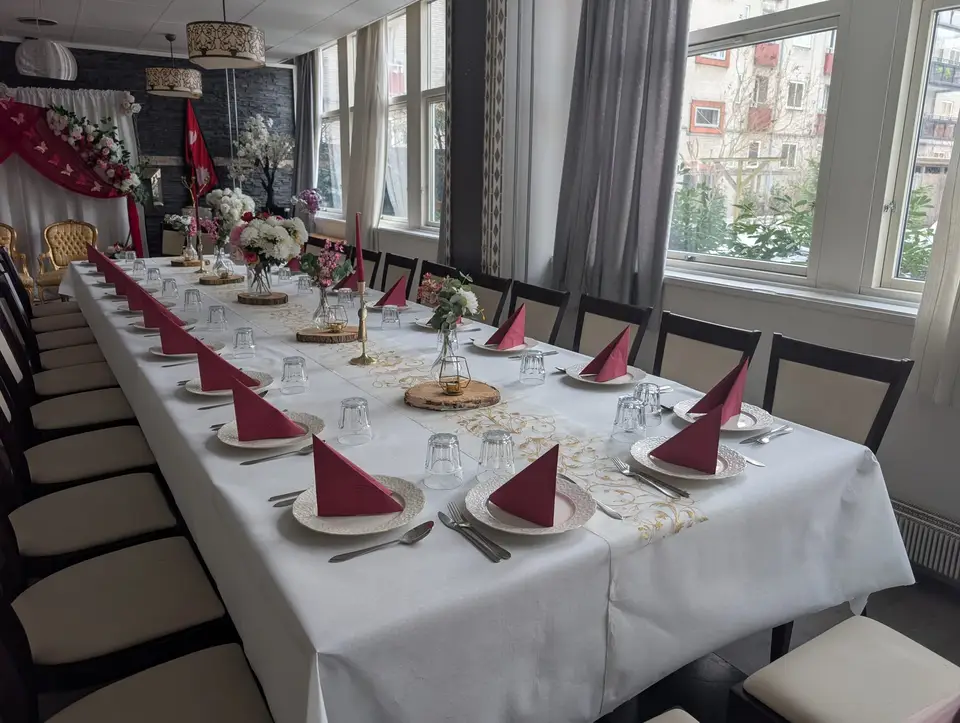
Our hall is one room for 30 to 120 guests. There is no overflow room and no second sitting, so everyone invited is in the same room, hearing the same speeches. That is why the line is best drawn around a whole branch rather than individual names. Our confirmation page shows how an afternoon of that shape is usually laid out.
The confirmand's own guests
Ask the confirmand to write this list before you write yours, because it is the one they will remember. Then settle the class question on purpose: a clear group of close friends, or the whole class. Both work. Inviting most of a class is the option that goes wrong, because a group chat works out the arithmetic by lunchtime.
Friends of a fourteen year old are usually dropped off and collected, so their parents are not invited by default. If a friend's parents are also your friends, they belong in the family circle instead, and should be invited in their own right rather than as an escort.
Younger cousins are the other half of this. They are cheerful, they need a table of their own, and the menu for a child between 5 and 12 is charged at half, which the prices page sets out beside what the hall fee already covers.
When the confirmand's parents are not together
This is the question families most often plan around rather than through, so decide it early and in writing.
If there is to be one party, agree three things before a single invitation goes out: whose name stands at the top of it, who is host on the day, and who speaks and in what order. Almost every awkward moment at a confirmation comes from one of those three being left open.
New partners are invited when they are part of the child's daily life. That is the test worth using, and it is the child's answer, not either parent's.
Seating does the rest of the diplomacy. In one room, two branches of a family are simply two tables, not two ends of the same one. Tell us the shape of the day when you book and we will set the tables and the running order in advance, so that nothing has to be negotiated at the door.
Two smaller parties are also a real answer, and the room takes a shorter list perfectly well.
How to say no, and how to say not this year
Say the size in the invitation itself. A line as plain as "we are holding a small confirmation for the family" does most of the work before anyone has to be turned down.
When you do decline, name the boundary, never the person. "We have kept it to grandparents, faddere and first cousins" can be repeated to anyone. "We did not have room for you" cannot.
Say it early. A hope allowed to run until April costs far more than a no in January. Offer the smaller thing instead: coffee at home the weekend after.
One last piece of arithmetic is worth knowing. The hall fee here has a 30-guest minimum, so a list of 24 is already billed for 30, while the menu and drinks are charged per guest who actually comes. A short list therefore has a few places already paid for. Adding the fadder from Jutland and the neighbour who has known your child since the pram costs a menu, not a room.
Bring the list and stand in the room
Names on paper are abstract. Chairs are not.
Come and see the hall with your list in your hand and we will walk it through table by table before the invitations go out. Ring us on +45 21 95 92 92, send it over to info@maiya.dk, or book a visit at a time that suits you.