
How to budget the food for a party
19 September 2026 · 5 min
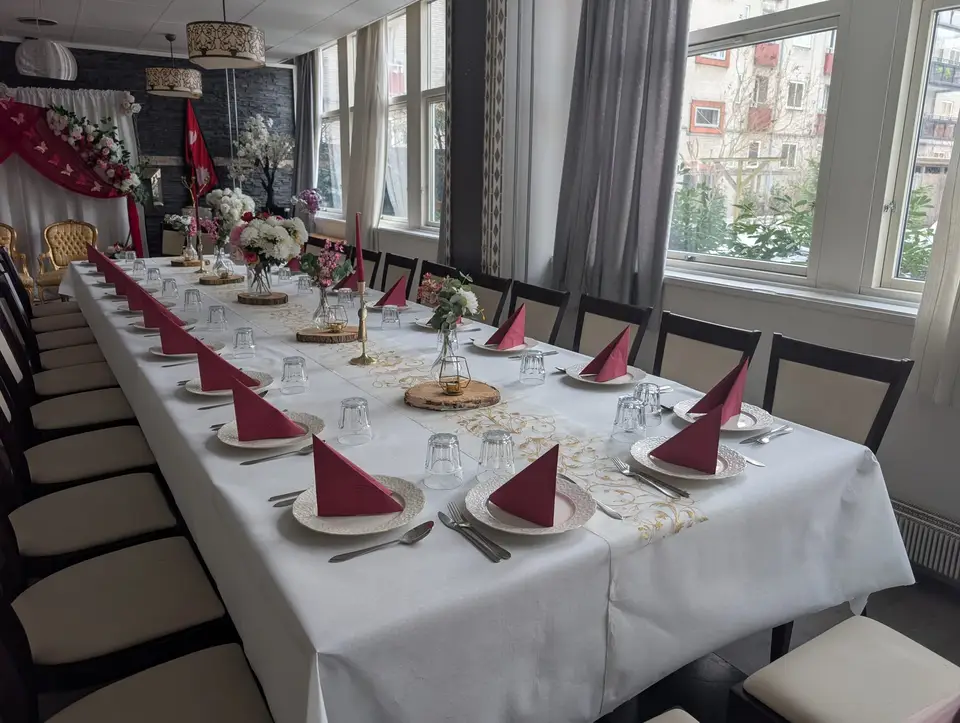
You can write the whole of a party food budget before you know a single price. That sounds backwards, and it is much the faster way round.
The reason is that the prices are the easy part. They sit on a page and take a minute to look up. What takes three weeks is not knowing the shape of the sum, so every new version of the guest list sends you back to ask what it would cost now. Build the arithmetic once, with empty spaces where the figures go, and a guest list you change on Tuesday gives you a new total on Tuesday.
The four lines a food budget actually has
Write these down before anything else, as a formula rather than as an amount.
- The menu, per person, times the number of adults.
- Half the menu price, times the number of children aged 5–12.
- The hall fee, which is also per person, times your guest count, with a floor underneath it.
- Drinks, which is either a figure per guest or a single flat fee, depending on which way you go.
That is the entire structure. Four lines, and three of the four multiply by the number of people in the room, which is why the guest list is the decision that matters most.
Put it in a spreadsheet with the prices as blank cells, fill them from the cost page, and you have a model rather than a quote. Every figure on that page is read from the owner's own system when the page is built, so it never goes quietly stale the way a number copied into a planning document does.
Count your guests in three columns, not one
A single guest number is not enough to price food, because not every guest is a full menu.
Split the list into adults, children aged 5–12, and the youngest ones. The middle column is the one people forget to separate out. Children in that band pay half the menu price, so a christening with fourteen cousins under twelve prices very differently from a company dinner with the same headcount on the door.
Two practical notes on the columns. The band is 5–12 by age on the day, so a child of thirteen sits on the adult line, and the youngest guests are worth asking us about by name rather than assuming. And you do not need a separate line for staff. The hall fee already covers the people serving and the cleaning afterwards, so nobody working your party is a plate you are budgeting for.
The thirty guest floor, which is the one line that is not straight
Three of the four lines rise smoothly with the guest count. The hall fee does not.
There is a booking minimum of thirty. A smaller gathering is no trouble at all and is given exactly the same room, though that part of the bill assumes thirty people whatever the true number turns out to be. Food and drink stay attached to whoever actually arrives.
Draw it on paper and the shape gives itself away. Up to the minimum the hall line is a flat segment, so adding a twenty ninth name does not move it at all. What that name costs you is one plate and one glass. Past the minimum the line starts climbing again, and from there the cost per head settles at roughly the same level all the way up to the room's limit of 120.
The consequence matters most if your list is currently in the twenties. Every name you add on the way up to the minimum is cheaper than the names already written down, because a fixed amount is being shared out between more people. That is the reverse of how a guest list is usually assumed to work.
Drinks, and why one of the options is not per person at all
Drinks sit outside the menu, and there are three shapes to choose between.
An unlimited soft drinks package, priced per guest, behaves exactly like the menu line: it scales with the columns you already counted. Tap water only removes the line. Bringing your own drinks is the interesting one, because it is one fixed amount, set by how large the group is, rather than a charge per bottle or per head. That changes how it sits in the model. Its weight per guest falls as the party grows, and it hands you a shopping list of your own to buy, carry and chill.
There is a fourth case worth knowing about if you were thinking of bringing food as well. A party that books the hall without a menu and brings its own catering can use our plates, glasses and cutlery for a charge per guest, washing up included. That is a line, and it is the one most often left out of a self-catered plan until the week before.
What really moves the total, and what only looks like it does
Once the model runs, you can test decisions instead of arguing about them.
Guest count moves the total more than anything else, because it multiplies three lines at once. The menu tier moves one multiplier: the set menus run Sølv, Guld, Platin and Diamant, and a custom menu is built with you if none of them fits. Our catering page shows how they are put together.
Some things that feel expensive are not separate lines at all. Any of the menus can be made vegetarian right through, which means a vegetarian table is not a second budget running beside the first. It is the same line with the same multiplier. Decoration, the sound system, the projector, staff and cleaning are inside the hall fee rather than five suppliers to find and pay. And because the kitchen is in this building on Højdevej 59, a few steps from the tables, there is no delivery charge and no van, which is a line most catering budgets carry without noticing.
One more never appears in a food budget but lands in your guests' pockets: parking on our own site is free, which in this part of Copenhagen quietly matters to everyone driving in.
Send us your three columns and a date, and we will come back with a real total rather than a range. The prices and inclusions page has every current figure, and you can book a visit to see the room before you commit to a number.