
What time of day should a reception be held?
6 September 2026 · 5 min
A reception is one of the few celebrations that prints two times on the invitation. A birthday party says seven o'clock and leaves the rest to the evening. A reception says two to five, and both numbers are doing work. The first says when the room opens. The second tells everyone, politely and well in advance, that they are free to go.
Choosing those two numbers is most of the planning. The window decides who can realistically come, how long they stay, what the kitchen can send out, and whether the guest of honour spends the afternoon in conversation or standing by the door.
What the end time is actually for
Print only a start time and you have not invited people to a reception. You have invited them to a party with a vague beginning, and they will treat it as one. A few arrive early and stay four hours, most arrive within ten minutes of each other, and nobody knows when it is decent to leave.
The end time is the whole mechanism. It is what lets a colleague read the invitation and think, I can manage an hour of that between the office and the nursery. It is permission, and it is often the reason a guest comes at all.
So print both times, and mean the second one. Three hours is the usual length for a good reason. It is long enough for people to arrive in waves and short enough that nobody has to give up a whole Saturday.
Which three hours to choose
The window is a decision about your guest list rather than about the clock.
- Midday to three. Right when the guests are family, older relatives and small children. People eat properly, the light is at its best for photographs, and everyone is home again in the afternoon.
- Two to five. The classic. It suits a mixed list of family and friends, it collides with neither lunch nor dinner, and guests choose for themselves which end of it to attend.
- Four to seven. The working guest list. Colleagues come straight from the office, nobody spends a holiday on it, and the last hour is usually the liveliest.
A weekday is a serious option for a jubilee or a work anniversary, where four o'clock on a Friday often draws more of the right people than a Saturday would. For a christening or a confirmation the church sets your start time and the reception simply follows the service.
One thing applies to all three windows. In the dark half of the year, a reception that opens at two finishes after sunset. That is no problem when you have planned for it, and an unwelcome surprise if you left the photographs to the last half hour.
How long guests really stay
The useful planning assumption is that a guest arrives inside the first hour and stays for roughly one hour. Some look in for ten minutes on their way somewhere else, some stay to the end, and the middle of that range is what you should order and seat for.
Two things follow, and both of them save worry.
Your room does not need a chair for every name on the invitation list. It needs seats for the number who will be in it at once, a margin on top, and a genuine chair for everyone who cannot stand for an hour. Sixty invitations very rarely mean sixty people in one room at one moment.
And the crowd peaks in the middle. The first half hour is thin, the middle hour is full, the last half hour belongs to a handful of people who know each other well. Put the speech at the start of the middle hour. At the start of the reception, half the guests are still parking.
Food for a crowd that comes and goes
A seated dinner and a reception are different problems. Anything you serve at a reception has to survive being eaten standing up, with a glass already in the other hand, by people who arrive two hours apart.
That means small food, nothing that needs a knife, and nothing that suffers from waiting. It also means the food has to keep arriving instead of appearing once. Our cooks work a few steps from the room they are serving, which is what makes batches practical: a tray when the doors open, another when the room fills, and a last one for the late arrivals who would otherwise find an empty platter. Steamed momo suit this better than almost anything, because one is a mouthful and the next tray is minutes behind.
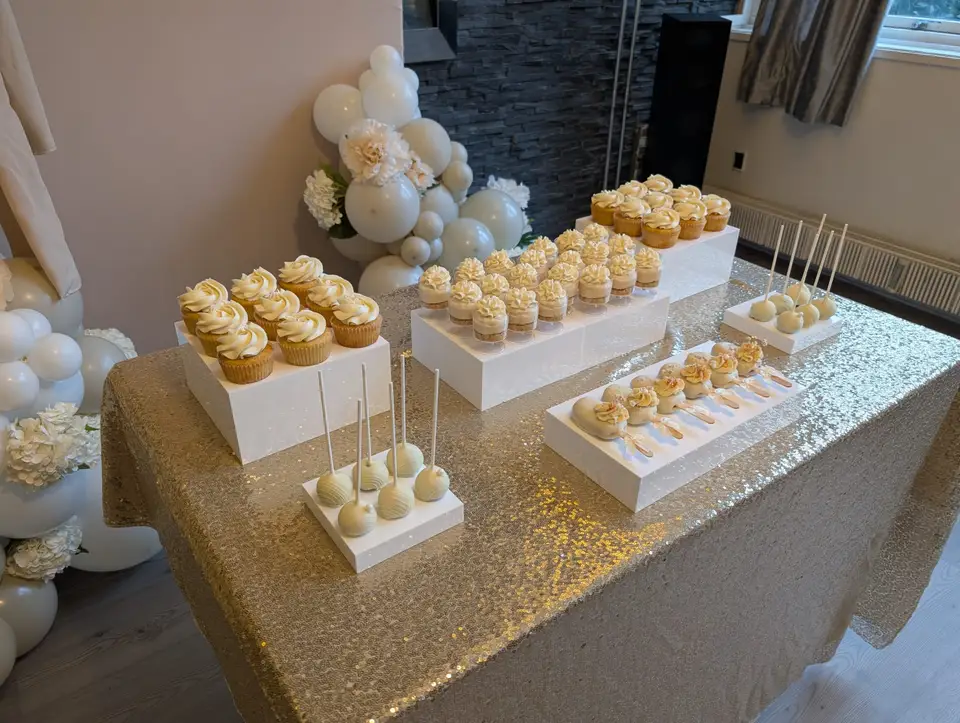
Something sweet is the other half of the spread. A dessert table stands for the whole window, looks after itself and photographs well, and it is the part late guests never miss. Our catering page sets out what an afternoon spread usually looks like.
What one hall on Amager does to the clock
Højdevej 59, in 2300 København S. One room, laid for 30 to 120 guests, with tall windows down one side, so an afternoon reception is lit by daylight for most of its length and asks nothing of a lighting plan.
Free parking on the site counts for more at a reception than at any other kind of party. These are guests dropping in between two other commitments, and a driver who cannot park quickly will not stay for the hour they intended.
One room also makes the hybrid straightforward. The wider circle leaves at five, the tables are laid, and dinner follows for the family in the same space with nobody moved anywhere. Our reception page shows how that afternoon is usually run, and a reception or an evening party is worth reading first if you are still weighing the two formats.
Set the window, then come and stand in it
Choose the three hours from your guest list, print both of them, and tell the venue the number you expect in the busiest hour rather than the number invited.
Then look at the room in that light rather than any other. Ask for a viewing timed to match the reception, or telephone +45 21 95 92 92 and give us the date you have in mind. What the hall fee already covers, and how each menu is costed for every guest, vegetarian versions included, sits on the prices page.