
How much food do you need for 100 guests?
8 September 2026 · 5 min
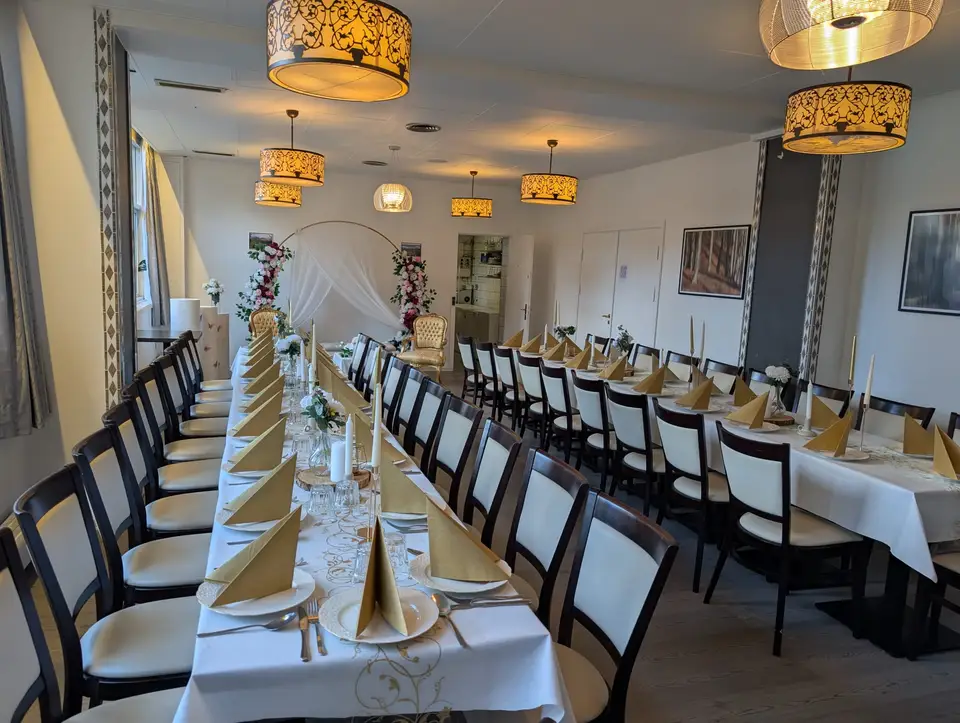
A hundred is the number where a party stops scaling quietly. At forty, a dish that runs low is topped up before anybody notices. At a hundred, every quantity you got roughly right is multiplied by the same margin of error, and the counter is where it shows first.
The useful thing is that the arithmetic is barely about food. It is about who those hundred people are, how many reach the counter in the same minute, and what else has to fit in the room alongside their chairs.
A hundred on the list is not a hundred portions
Split the number before you order anything.
Say the replies come back like this: eighty two adults, eleven children between five and twelve, five under five, and two people working the party. That is your hundred, and it is four different orders wearing one figure.
- The under fives need a chair, or a lap, and very little else. They eat from a parent's plate. Count them as guests, not as portions.
- Children aged five to twelve are the middle case, and the pricing already reflects it. They pay half the menu price here, and a table of eleven children eats appreciably less than a table of eleven adults.
- The people working are the ones families forget every time: the photographer, the musicians, whoever carries the cake in. They eat once the main service is over and the dishes are thinnest, so count them from the start.
- The vegetarian guests are worth counting by name rather than as a number, because a name is checkable and a number drifts. Any menu here can be made fully vegetarian, so this is a line in the order and not a separate arrangement on the side.
Two counts run in parallel, and they are not the same one. The hall fee is per person and rests on a floor of thirty guests. What you eat and drink is billed on the people who walk through the door. The prices page shows how the two fit together, and it reads live from the system the owner keeps current.
What a hundred seated guests do to a room that holds 120
Our hall seats 30 to 120, so a hundred sounds comfortable, and the chairs genuinely are not the problem. The floor is.
Everything else on your list wants floor space too: the counter, the cake table, somewhere for gifts, room to stand and speak, and whatever is left for dancing. At a hundred, that remainder is a decision you make in advance. You cannot lay every table for dinner and then clear a dance floor at ten o'clock without moving a hundred chairs while the room watches.
Table shape does most of the work. Long tables carry more people across the same floor than round tables of eight, and they leave a clean run down the middle for service, which matters far more at a hundred than at fifty. Our post on round tables or long tables weighs the two properly, and how much space you need per guest covers what a chair really occupies once it is pulled back. Our page on a venue for 100 guests shows how the room is usually laid out at this size.
Where the queue stalls at a hundred, and what fixes it
The classic failure is not the order. It is one announcement, one counter, and a hundred people standing up at the same moment. Whoever ends up at the back waits through the entire room, then eats what is left.
Four habits prevent that, and none of them costs anything:
- Release the room in waves, by table, and say out loud which tables are up.
- Let the counter be worked from both ends instead of one.
- Put the drinks and the sweet table somewhere else entirely, so those flows never cross the food queue.
- Site the counter where the queue does not pass behind seated guests.
Ours sits against the dark stone wall on one long side, which keeps the floor clear for the table runs and means nobody eats with a queue at their shoulder.
The refills are what a hundred guests really test. Dishes empty faster than anyone expects at this size, and what goes back out has to be hot. Our kitchen is a few metres away in the same building, so topping up the counter is a short walk rather than a piece of logistics, and the third wave eats what the first wave ate.
Scaling a Nepali menu to a hundred
The instinct is to double every dish. It is the wrong move. At a hundred you want more things on the counter rather than more of each, because one popular dish becomes the bottleneck for the whole room.
Some food scales better than other food, which is worth knowing before you pick a menu. Dal bhat tarkari is built for numbers, because lentil soup, rice and a vegetable curry belong on the plate at once and second helpings are simply what happens. Momo suit a hundred for a different reason: a steamed dumpling is a single mouthful, so a plate empties quickly and is back quickly, and nobody stands looking at a bare dish. Charcoal grilled sekuwa, in the style of the eastern hills, does its best work beside the rice rather than as the thing everyone queues for.
Heat is the other question a hundred guests raise, and it answers itself. It lives in the achar on the side, so every plate is set by the person holding it. Rice with a mild curry covers every child in the room. Our catering page lists what the menus are built from.
Come and count it standing in the room
Send us the date and the hours, the split into adults, children between five and twelve and under fives, whether guests are seated or standing, and the vegetarian names. That is enough to give you a real quantity instead of a guess.
One more thing counts at this size and is rarely planned: a hundred guests arrive in a great many cars. Parking on the site at Højdevej 59 in 2300 København S is free, which is worth more at a hundred than at thirty.
Book a visit and stand where the counter goes before you settle the menu, or ring +45 21 95 92 92 with your date and your headcount.